Wu Zhaozhen, Cui Pengfei, Tao Haitao, Zhang Sujie, Ma Junxun, Liu Zhefeng, Wang Jinliang, Qian Yuanyu, Chen Shixue, Huang Ziwei, Zheng Xuan, Huang Di, Hu Yi
Department of Medical Oncology, Chinese PLA General Hospital, Beijing, China.
Beijing Chest Hospital, Beijing, China.
Clin Med Insights Oncol. 2021 Feb 25;15:1179554921996288. doi: 10.1177/1179554921996288. eCollection 2021.
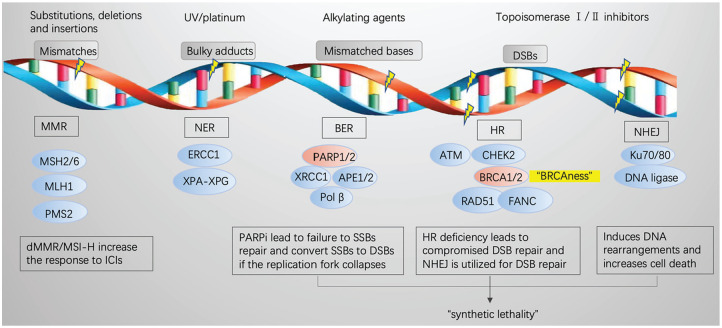
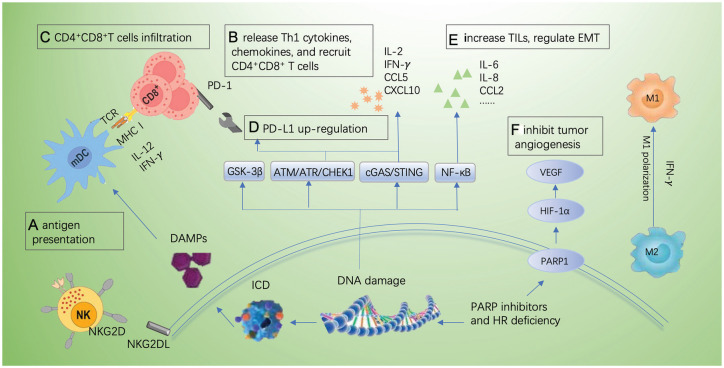
Poly (ADP-ribose) polymerase (PARP) inhibitors have demonstrated great promise for treating cancers with homologous recombination (HR) defects, such as germline BRCA1/2 mutation. Further studies suggest that PARP inhibitors (PARPi) can also exhibit efficacy in HR-competent cancers, by amplifying the DNA damage and inducing immunogenic cell death, and PARPi lead to increasing tumor neoantigen, upregulation of interferons and PD-L1, and modulation of the tumor microenvironment, which may facilitate a more profound antitumor immune response. Immune checkpoint inhibitors (ICIs) targeting PD-1/PD-L1 or CTLA-4 have achieved impressive success in the treatment of different malignancies. However, only a subset of populations derive clinical benefit, and the biomarkers and resistance mechanisms are not fully understood. Therefore, given that PARPi could potentiate the therapeutic effect of ICIs, PARPi combined with ICIs are becoming an alternative for patients who cannot benefit from ICI monotherapy. In this review, we focus on the mechanisms and immune role of PARPi and discuss the rationale and clinical studies of this combined regimen.
聚(ADP - 核糖)聚合酶(PARP)抑制剂已显示出治疗具有同源重组(HR)缺陷的癌症(如种系BRCA1/2突变)的巨大潜力。进一步研究表明,PARP抑制剂(PARPi)在HR功能正常的癌症中也可发挥疗效,通过放大DNA损伤并诱导免疫原性细胞死亡,且PARPi会导致肿瘤新抗原增加、干扰素和PD - L1上调以及肿瘤微环境的调节,这可能促进更有效的抗肿瘤免疫反应。靶向PD - 1/PD - L1或CTLA - 4的免疫检查点抑制剂(ICI)在不同恶性肿瘤的治疗中取得了令人瞩目的成功。然而,只有一部分人群能从临床治疗中获益,且生物标志物和耐药机制尚未完全明确。因此,鉴于PARPi可增强ICI的治疗效果,PARPi与ICI联合正成为无法从ICI单药治疗中获益的患者的一种选择。在本综述中,我们重点关注PARPi的作用机制和免疫作用,并讨论这种联合治疗方案的理论依据和临床研究。