Hartgerink Dianne, Bruynzeel Anna, Eekers Danielle, Swinnen Ans, Hurkmans Coen, Wiggenraad Ruud, Swaak-Kragten Annemarie, Dieleman Edith, van der Toorn Peter-Paul, Oei Bing, van Veelen Lieneke, Verhoeff Joost, Lagerwaard Frank, de Ruysscher Dirk, Lambin Philippe, Zindler Jaap
Department of Radiation Oncology (Maastro), GROW School for Oncology, Maastricht University Medical Centre+, Maastricht, the Netherlands.
Department of Radiation Oncology, Amsterdam University Medical Centers, the Netherlands.
Neurooncol Adv. 2021 Feb 1;3(1):vdab021. doi: 10.1093/noajnl/vdab021. eCollection 2021 Jan-Dec.
The clinical value of whole brain radiotherapy (WBRT) for brain metastases (BM) is a matter of debate due to the significant side effects involved. Stereotactic radiosurgery (SRS) is an attractive alternative treatment option that may avoid these side effects and improve local tumor control. We initiated a randomized trial (NCT02353000) to investigate whether quality of life is better preserved after SRS compared with WBRT in patients with multiple brain metastases.
Patients with 4-10 BM were randomized between the standard arm WBRT (total dose 20 Gy in 5 fractions) or SRS (single fraction or 3 fractions). The primary endpoint was the difference in quality of life (QOL) at 3 months post-treatment.
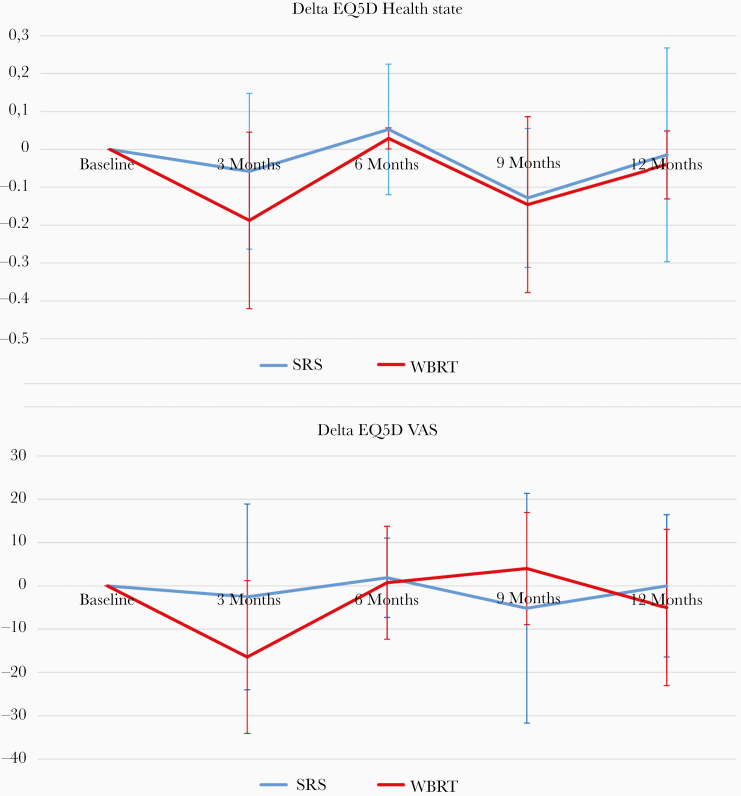
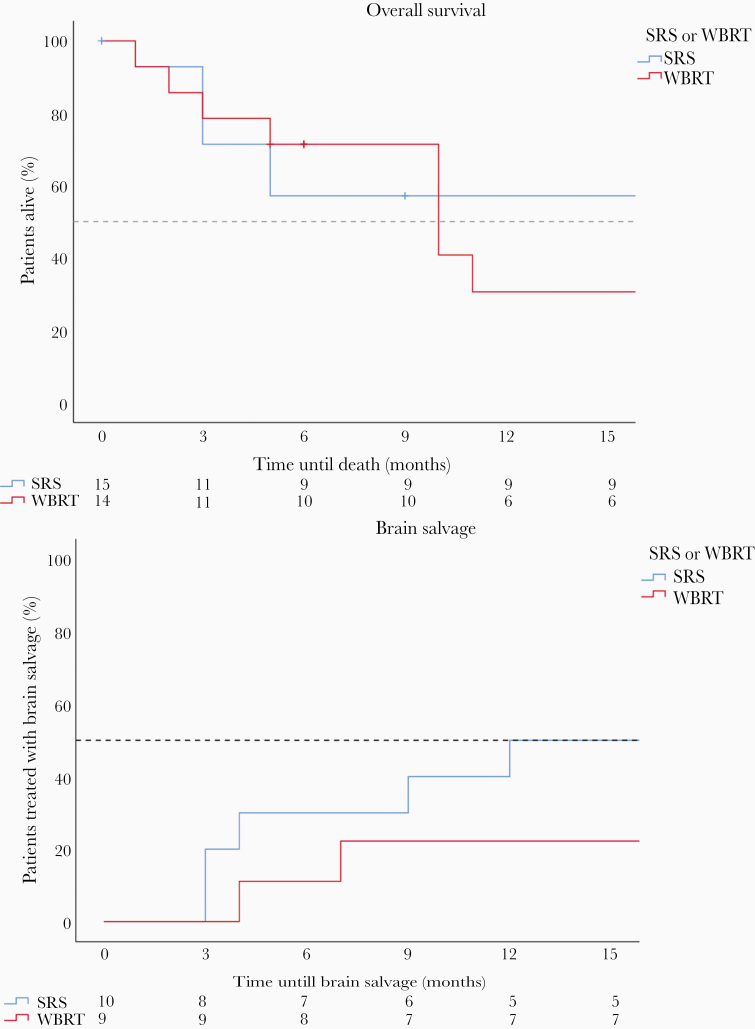
The study was prematurely closed due to poor accrual. A total of 29 patients (13%) were randomized, of which 15 patients have been treated with SRS and 14 patients with WBRT. The median number of lesions were 6 (range: 4-9) and the median total treatment volume was 13.0 cc (range: 1.8-25.9 cc). QOL at 3 months decreased in the SRS group by 0.1 (SD = 0.2), compared to 0.2 (SD = 0.2) in the WBRT group ( = .23). The actuarial 1-year survival rates were 57% (SRS) and 31% (WBRT) ( = .52). The actuarial 1-year brain salvage-free survival rates were 50% (SRS) and 78% (WBRT) ( = .22).
In patients with 4-10 BM, SRS alone resulted in 1-year survival for 57% of patients while maintaining quality of life. Due to the premature closure of the trial, no statistically significant differences could be determined.
由于全脑放疗(WBRT)存在显著副作用,其对脑转移瘤(BM)的临床价值存在争议。立体定向放射外科(SRS)是一种有吸引力的替代治疗选择,可能避免这些副作用并改善局部肿瘤控制。我们开展了一项随机试验(NCT02353000),以研究在多发脑转移瘤患者中,与WBRT相比,SRS后生活质量是否能得到更好的保留。
4至10个脑转移瘤的患者被随机分为标准组WBRT(总剂量20 Gy,分5次)或SRS(单次分割或3次分割)。主要终点是治疗后3个月时生活质量(QOL)的差异。
由于入组不佳,该研究提前结束。共有29例患者(13%)被随机分组,其中15例接受SRS治疗,14例接受WBRT治疗。病变的中位数为6个(范围:4 - 9个),总治疗体积的中位数为13.0 cc(范围:1.8 - 25.9 cc)。SRS组3个月时QOL下降0.1(标准差 = 0.2),而WBRT组为0.2(标准差 = 0.2)(P = 0.23)。1年精算生存率分别为57%(SRS)和31%(WBRT)(P = 0.52)。1年无脑部挽救精算生存率分别为50%(SRS)和78%(WBRT)(P = 0.22)。
在有4至10个脑转移瘤的患者中,单独使用SRS可使57%的患者存活1年,同时维持生活质量。由于试验提前结束,无法确定统计学上的显著差异。