Department of Epidemiology, Johns Hopkins Bloomberg School of Public Health, Baltimore, Maryland.
Cochlear Center for Hearing and Public Health, Johns Hopkins Bloomberg School of Public Health, Baltimore, Maryland.
JAMA Netw Open. 2021 Mar 1;4(3):e211558. doi: 10.1001/jamanetworkopen.2021.1558.
Impairments in vision or hearing are common and have been independently linked to higher risk of dementia in older adults. There is a limited understanding of the prevalence of concurrent functional vision and hearing impairment (dual sensory impairment) and its contribution to dementia risk.
To examine the age-specific prevalence of functional dual sensory impairment among older adults, and to investigate the cross-sectional and 7-year longitudinal associations between functional dual sensory impairment and dementia.
DESIGN, SETTING, AND PARTICIPANTS: This cohort study of 7562 older adults used data from the US National Health and Aging Trends Study (NHATS), a nationally representative cohort study of community-dwelling, Medicare beneficiaries aged 65 years and older in the US. Participants in the study with complete data on hearing, vision, and dementia were included in analysis. Data were collected between 2011 and 2018, and between March 2018 and May 2020.
Self-reported functional sensory impairments (ie, no sensory impairment, functional vision impairment only, functional hearing impairment only, and functional dual sensory impairment).
Age-specific prevalence of functional sensory impairments was calculated. Generalized linear regression with a complementary log-log link and a discrete time proportional hazards model with a complementary log-log link were used to assess the cross-sectional and 7-year longitudinal hazard of dementia.
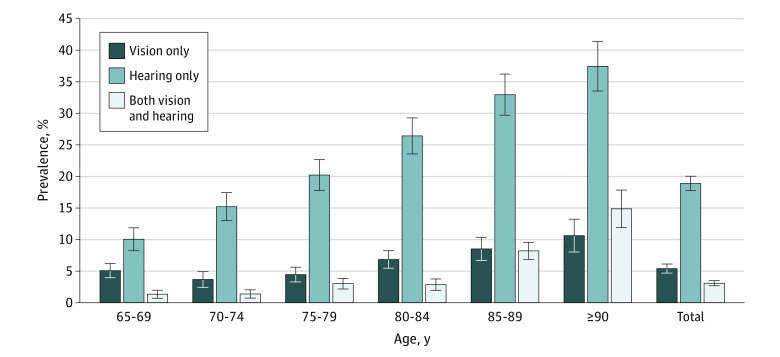
Of 7562 participants, 3073 (40.7%) were ages 80 years or older and 4411 (58.3%) were women. Overall, 5.4% (95% CI, 4.7%-6.1%) of participants reported functional vision impairment only, 18.9% (95% CI, 18.9%-17.8%) reported functional hearing impairment only, and 3.1% (95% CI, 2.7%-3.5%) reported functional dual sensory impairment (prevalence estimates are weighted). Participants reporting sensory impairments were older (no impairment: age ≥90 years, 2.12% [95% CI, 1.79%-2.46%] vs functional dual sensory impairment: age ≥90 years, 20.06% [95% CI, 16.02%-24.10%]), had lower education (no impairment: <high school, 19.05% [95% CI, 17.27%-20.83%] vs functional dual sensory impairment: <high school, 46.15% [95% CI, 38.38%-53.92%]), and greater disease burden (eg, heart disease: no impairment, 15.30% [95% CI, 14.04%-16.55%] vs functional dual sensory impairment, 25.49% [95% CI, 19.96%-31.02%]). Compared with no impairment, functional vision impairment (adjusted hazard ratio [aHR], 1.89; 95% CI, 1.57-2.28), functional hearing impairment (aHR, 1.14; 95% CI, 1.00-1.31), and functional dual sensory impairment (aHR, 2.00; 95% CI, 1.57-2.53) were associated with a higher cross-sectional hazard of dementia. Over 7 years, functional vision impairment (aHR, 1.40; 95% CI, 1.12-1.74), functional hearing impairment (aHR, 1.09; 95% CI, 0.95-1.24), and functional dual sensory impairment (aHR, 1.50; 95% CI, 1.12-2.02) were associated with a higher hazard of incident dementia compared with no impairment.
In this cohort study of US Medicare beneficiaries, dual sensory impairment was prevalent in older adults and associated with increased risk of dementia. These findings suggest that sensory rehabilitative interventions for multiple impairments may be an additional resource in efforts to reduce dementia risk.
视力或听力障碍在老年人中很常见,并且已被独立证明与痴呆风险增加有关。对于同时存在的功能性视力和听力障碍(双重感觉障碍)的流行程度及其对痴呆风险的贡献,人们的了解有限。
检查老年人中功能性双重感觉障碍的特定年龄流行率,并研究功能性双重感觉障碍与痴呆之间的横断面和 7 年纵向关联。
设计、地点和参与者:这项针对美国国家健康老龄化趋势研究(NHATS)的 7562 名老年人的队列研究是一项全国代表性的社区居住的医疗保险受益人的队列研究,参与者年龄在 65 岁及以上。研究中包括听力、视力和痴呆症完整数据的参与者。数据收集于 2011 年至 2018 年以及 2018 年 3 月至 2020 年 5 月。
自我报告的功能性感觉障碍(即无感觉障碍、仅功能性视力障碍、仅功能性听力障碍和功能性双重感觉障碍)。
计算功能性感觉障碍的特定年龄流行率。使用互补对数-对数链接的广义线性回归和互补对数-对数链接的离散时间比例危害模型来评估痴呆的横断面和 7 年纵向危险。
在 7562 名参与者中,3073 名(40.7%)年龄在 80 岁或以上,4411 名(58.3%)为女性。总体而言,5.4%(95%CI,4.7%-6.1%)的参与者报告仅存在功能性视力障碍,18.9%(95%CI,18.9%-17.8%)报告仅存在功能性听力障碍,3.1%(95%CI,2.7%-3.5%)报告存在功能性双重感觉障碍(患病率估计值为加权值)。报告感觉障碍的参与者年龄更大(无障碍:年龄≥90 岁,2.12%[95%CI,1.79%-2.46%]与功能性双重感觉障碍:年龄≥90 岁,20.06%[95%CI,16.02%-24.10%]),受教育程度较低(无障碍:未完成高中学业,19.05%[95%CI,17.27%-20.83%]与功能性双重感觉障碍:未完成高中学业,46.15%[95%CI,38.38%-53.92%]),疾病负担更大(例如,心脏病:无障碍,15.30%[95%CI,14.04%-16.55%]与功能性双重感觉障碍,25.49%[95%CI,19.96%-31.02%])。与无障碍相比,功能性视力障碍(调整后的危险比[aHR],1.89;95%CI,1.57-2.28)、功能性听力障碍(aHR,1.14;95%CI,1.00-1.31)和功能性双重感觉障碍(aHR,2.00;95%CI,1.57-2.53)与痴呆的横断面危险更高相关。在 7 年期间,功能性视力障碍(aHR,1.40;95%CI,1.12-1.74)、功能性听力障碍(aHR,1.09;95%CI,0.95-1.24)和功能性双重感觉障碍(aHR,1.50;95%CI,1.12-2.02)与无障碍相比,发生痴呆的风险更高。
在这项针对美国医疗保险受益人的队列研究中,双重感觉障碍在老年人中很普遍,并且与痴呆风险增加相关。这些发现表明,针对多种障碍的感官康复干预措施可能是降低痴呆风险的额外资源。