Luzi Livio, Carruba Michele, Crialesi Roberta, Da Empoli Stefano, Dagani Regina, Lovati Elisabetta, Nicolucci Antonio, Berra Cesare C, Cipponeri Elisa, Vaccaro Ketty, Lenzi Andrea
Department of Biomedical Sciences for Health, University of Milan, Milan, Italy.
Department of Endocrinology, Nutrition and Metabolic Diseases, IRCCS Multimedica, Via Milanese 300, 20099, Sesto San Giovanni, Milan, Italy.
Acta Diabetol. 2021 Jul;58(7):919-927. doi: 10.1007/s00592-021-01700-2. Epub 2021 Mar 19.
Since 2010, more than half of World population lives in Urban Environments. Urban Diabetes has arisen as a novel nosological entity in Medicine. Urbanization leads to the accrual of a number of factors increasing the vulnerability to diabetes mellitus and related diseases. Herein we report clinical-epidemiological data of the Milano Metropolitan Area in the contest of the Cities Changing Diabetes Program. Since the epidemiological picture was taken in January 2020, on the edge of COVID-19 outbreak in the Milano Metropolitan Area, a perspective addressing potential interactions between diabetes and obesity prevalence and COVID-19 outbreak, morbidity and mortality will be presented. To counteract lock-down isolation and, in general, social distancing a pilot study was conducted to assess the feasibility and efficacy of tele-monitoring via Flash Glucose control in a cohort of diabetic patients in ASST North Milano.
Data presented derive from 1. ISTAT (National Institute of Statistics of Italy), 2. Milano ATS web site (Health Agency of Metropolitan Milano Area), which entails five ASST (Health Agencies in the Territories). A pilot study was conducted in 65 screened diabetic patients (only 40 were enrolled in the study of those 36 were affected by type 2 diabetes and 4 were affected by type 1 diabetes) of ASST North Milano utilizing Flash Glucose Monitoring for 3 months (mean age 65 years, HbA1c 7,9%. Patients were subdivided in 3 groups using glycemic Variability Coefficient (VC): a. High risk, VC > 36, n. 8 patients; Intermediate risk 20 < VC < 36, n. 26 patients; Low risk VC < 20, n. 4 patients. The control group was constituted by 26 diabetic patients non utilizing Flash Glucose monitoring.
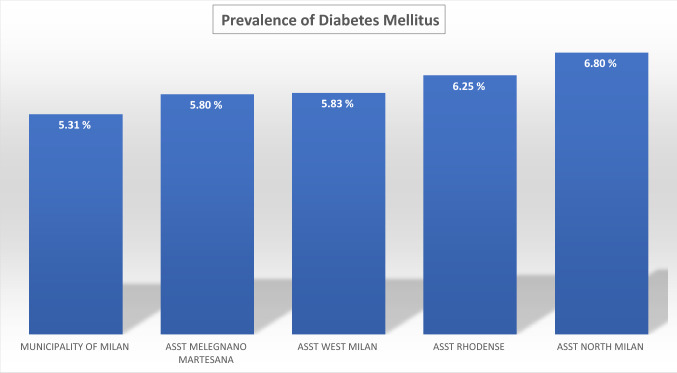
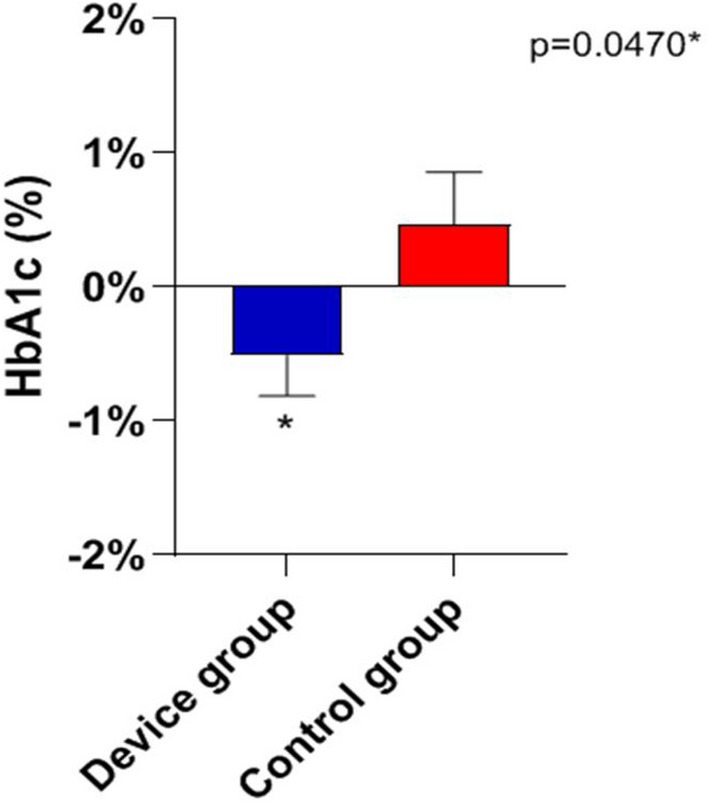
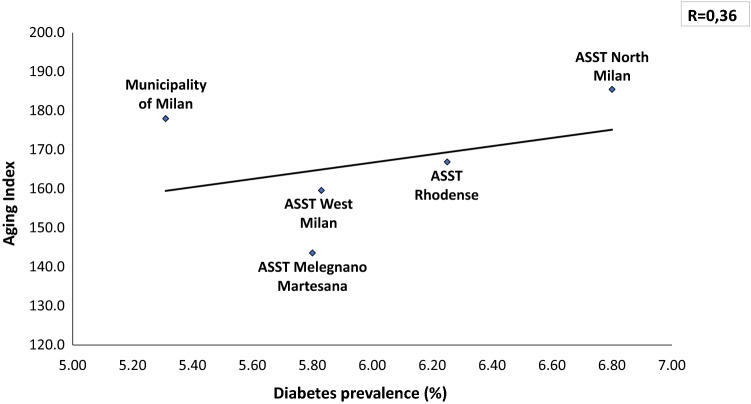
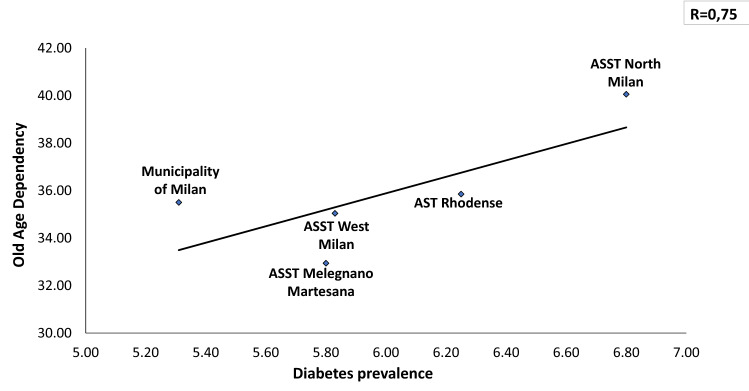
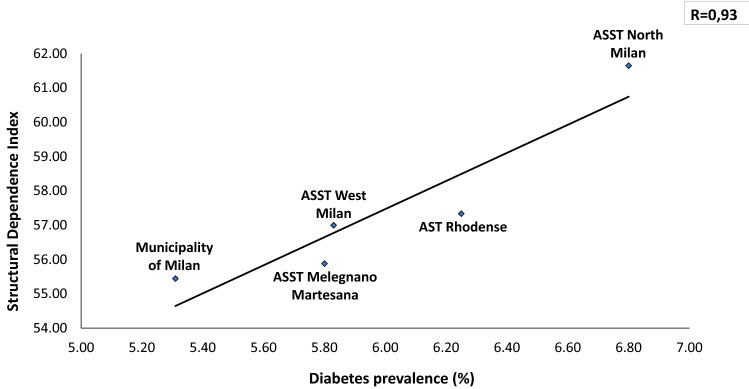
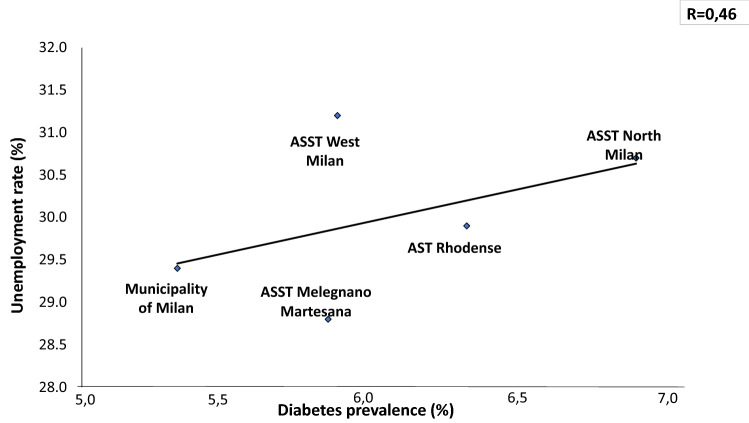
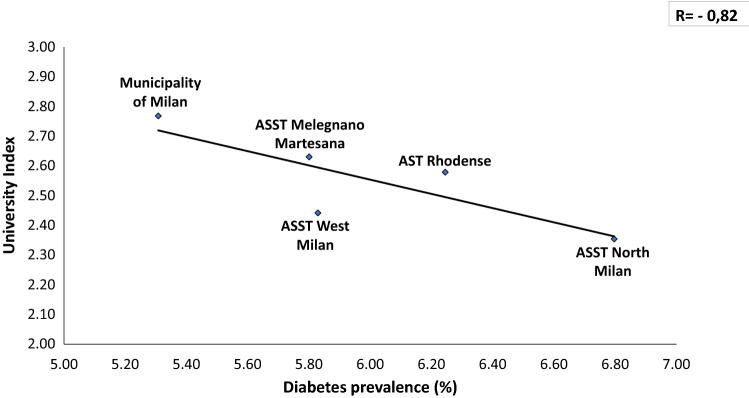
In a total population of 3.227.264 (23% is over 65 y) there is an overall prevalence of 5.65% with a significant difference between Downtown ASST (5.31%) and peripheral ASST (ASST North Milano, 6.8%). Obesity and overweight account for a prevalence of 7.8% and 27.7%, respectively, in Milano Metropolitan Area. We found a linear relationship (R = 0.36) between prevalence of diabetes and aging index. Similarly, correlations between diabetes prevalence and both older people depending index and structural dependence index (R = 0.75 and R = 0.93, respectively), were found. A positive correlation (R = 0.46) with percent of unoccupied people and diabetes prevalence was also found. A reverse relationship between diabetes prevalence and University level instruction rate was finally identified (R = - 0.82). Our preliminary study demonstrated a reduction of Glycated Hemoglobin (p = 0.047) at 3 months follow-up during the lock-down period, indicating Flash Glucose Monitoring and remote control as a potential methodology for diabetes management during COVID-19 lock-down.
The increase in diabetes and obesity prevalence in Milano Metropolitan Area, which took place over 30 years, is related to several environmental factors. We hypothesize that some of those factors may have also determined the high incidence and virulence of COVID-19 in the Milano area. Health Agencies of Milano Metropolitan Area are presently taking care of diabetic patients facing the new challenge of maintaining sustainable diabetes care costs in light of an increase in urban population and of the new life-style. The COVID-19 pandemic will modify the management of diabetic and obese patients permanently, via the implementation of approaches that entail telemedicine technology. The pilot study conducted during the lock-down period indicates an improvement of glucose control utilizing a remote glucose control system in the Milano Metropolitan Area, suggesting a wider utilization of similar methodologies during the present "second wave" lock-down.
自2010年以来,全球一半以上的人口居住在城市环境中。城市糖尿病已成为医学领域一种新的疾病实体。城市化导致多种因素积累,增加了患糖尿病及相关疾病的易感性。在此,我们报告在“城市改变糖尿病”项目背景下米兰大都市区的临床流行病学数据。由于该流行病学情况是在2020年1月采集的,正值米兰大都市区新冠疫情爆发前夕,本文将呈现关于糖尿病和肥胖患病率与新冠疫情爆发、发病率和死亡率之间潜在相互作用的观点。为应对封锁隔离以及总体上的社交距离措施,在米兰北部ASST的一组糖尿病患者中进行了一项试点研究,以评估通过动态血糖监测进行远程监测的可行性和有效性。
所呈现的数据来源于:1. 意大利国家统计局(ISTAT);2. 米兰地区卫生局网站(米兰大都市区卫生局),该网站涵盖五个地方卫生局(ASST,地区卫生机构)。在米兰北部ASST对65名经筛查的糖尿病患者进行了一项试点研究(仅40名患者纳入研究,其中36名患有2型糖尿病,4名患有1型糖尿病),使用动态血糖监测3个月(平均年龄65岁,糖化血红蛋白7.9%)。根据血糖变异系数(VC)将患者分为3组:a. 高风险组,VC>36,8名患者;中风险组,20<VC<36,26名患者;低风险组,VC<20,4名患者。对照组由26名未使用动态血糖监测的糖尿病患者组成。
在总人口3227264人中(23%年龄超过65岁),总体患病率为5.65%,市中心ASST(5.31%)与周边ASST(米兰北部ASST,6.8%)之间存在显著差异。米兰大都市区肥胖和超重的患病率分别为7.8%和27.7%。我们发现糖尿病患病率与老龄化指数之间存在线性关系(R = 0.36)。同样,发现糖尿病患病率与老年人依赖指数和结构依赖指数之间存在相关性(分别为R = 0.75和R = 0.93)。还发现糖尿病患病率与未就业人口百分比呈正相关(R = 0.46)。最终确定糖尿病患病率与大学学历教育率呈负相关(R = -0.82)。我们的初步研究表明,在封锁期间随访3个月时糖化血红蛋白有所降低(p = 0.047),这表明动态血糖监测和远程控制是新冠疫情封锁期间糖尿病管理的一种潜在方法。
米兰大都市区30多年来糖尿病和肥胖患病率的上升与多种环境因素有关。我们假设其中一些因素可能也导致了米兰地区新冠疫情的高发病率和高致病性。米兰大都市区的卫生机构目前正在照顾糖尿病患者,鉴于城市人口增加和新的生活方式,面临着维持可持续糖尿病护理成本的新挑战。新冠疫情将通过实施涉及远程医疗技术的方法,永久性地改变糖尿病和肥胖患者的管理方式。在封锁期间进行的试点研究表明,米兰大都市区使用远程血糖控制系统可改善血糖控制,这表明在当前的“第二波”封锁期间应更广泛地使用类似方法。