LSC, Academy of Mathematics and Systems Science, Chinese Academy of Sciences, Beijing, China.
Biometric Research Program, Division of Cancer Treatment and Diagnostics, National Cancer Institute, National Institutes of Health, Bethesda, MD, 20892, USA.
BMC Med Res Methodol. 2021 Mar 19;21(1):55. doi: 10.1186/s12874-021-01239-4.
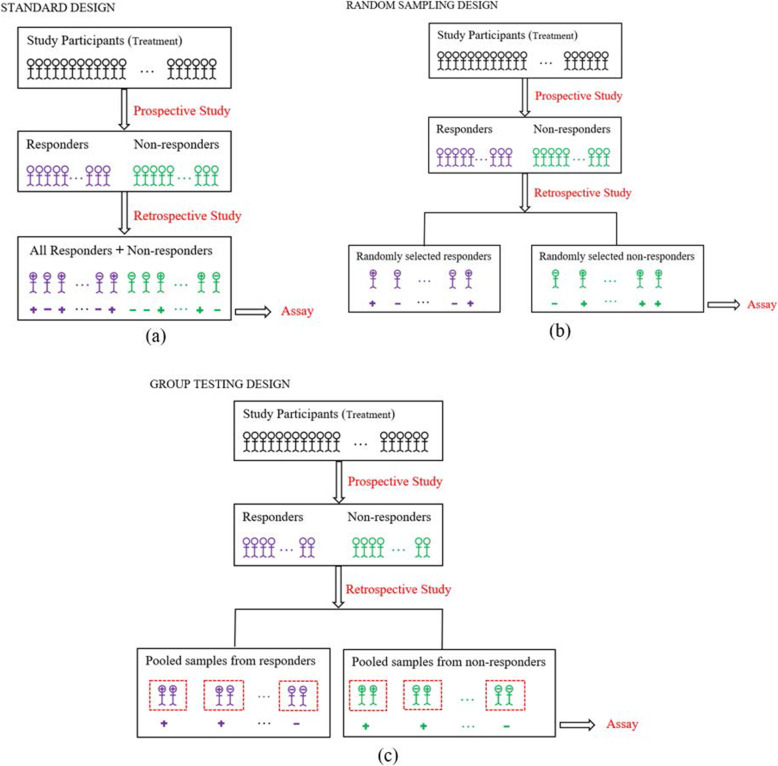
Cancer treatment is increasingly dependent on biomarkers for prognostication and treatment selection. Potential biomarkers are frequently evaluated in prospective-retrospective studies in which biomarkers are measured retrospectively on archived specimens after completion of prospective clinical trials. In light of the high costs of some assays, random sampling designs have been proposed that measure biomarkers for a random sub-sample of subjects selected on the basis of observed outcome and possibly other variables. Compared with a standard design that measures biomarkers on all subjects, a random sampling design can be cost-efficient in the sense of reducing the cost of the study substantially while achieving a reasonable level of precision.
For a biomarker that indicates the presence of some molecular alteration (e.g., mutation in a gene), we explore the use of a group testing strategy, which involves physically pooling specimens across subjects and assaying pooled samples for the presence of the molecular alteration of interest, for further improvement in cost-efficiency beyond random sampling. We propose simple and general approaches to estimating the prognostic and predictive values of biomarkers with group testing, and conduct simulation studies to validate the proposed estimation procedures and to assess the cost-efficiency of the group testing design in comparison to the standard and random sampling designs.
Simulation results show that the proposed estimation procedures perform well in realistic settings and that a group testing design can have considerably higher cost-efficiency than a random sampling design.
Group testing can be used to improve the cost-efficiency of biomarker studies.
癌症治疗越来越依赖于生物标志物来进行预后和治疗选择。潜在的生物标志物经常在前瞻性回顾性研究中进行评估,其中生物标志物在完成前瞻性临床试验后,对存档标本进行回顾性测量。鉴于一些检测的高成本,已经提出了随机抽样设计,该设计测量基于观察到的结果和其他可能变量选择的随机亚组受试者的生物标志物。与测量所有受试者生物标志物的标准设计相比,随机抽样设计可以通过显著降低研究成本而实现合理的精度水平,从而在成本效益方面具有优势。
对于指示某种分子改变(例如基因中的突变)存在的生物标志物,我们探索了使用群体检测策略的方法,该策略涉及跨受试者物理地汇集标本,并对汇集的样本进行感兴趣的分子改变的检测,从而进一步提高成本效益,超出随机抽样的范围。我们提出了使用群体检测来估计生物标志物的预后和预测值的简单而通用的方法,并进行了模拟研究,以验证所提出的估计程序,并评估群体检测设计相对于标准和随机抽样设计的成本效益。
模拟结果表明,所提出的估计程序在实际环境中表现良好,并且群体检测设计的成本效益可以大大高于随机抽样设计。
群体检测可用于提高生物标志物研究的成本效益。