• 文献检索
  • 文档翻译
  • 深度研究
  • 学术资讯
  • Suppr Zotero 插件Zotero 插件
  • 邀请有礼
  • 套餐&价格
  • 历史记录
应用&插件
Suppr Zotero 插件Zotero 插件浏览器插件Mac 客户端Windows 客户端微信小程序
定价
高级版会员购买积分包购买API积分包
服务
文献检索文档翻译深度研究API 文档MCP 服务
关于我们
关于 Suppr公司介绍联系我们用户协议隐私条款
关注我们

Suppr 超能文献

核心技术专利:CN118964589B侵权必究
粤ICP备2023148730 号-1Suppr @ 2026

文献检索

告别复杂PubMed语法,用中文像聊天一样搜索,搜遍4000万医学文献。AI智能推荐,让科研检索更轻松。

立即免费搜索

文件翻译

保留排版,准确专业,支持PDF/Word/PPT等文件格式,支持 12+语言互译。

免费翻译文档

深度研究

AI帮你快速写综述,25分钟生成高质量综述,智能提取关键信息,辅助科研写作。

立即免费体验

一项关于以色列对 COVID-19 疫苗的态度在民族、性别和教育方面差异的研究——对疫苗实施政策的影响。

A study of ethnic, gender and educational differences in attitudes toward COVID-19 vaccines in Israel - implications for vaccination implementation policies.

机构信息

School of Public Health, University of Haifa, Abba Khoushy 199, 3498838, Haifa, Israel.

Statistics Consulting Unit, University of Haifa, Haifa, Israel.

出版信息

Isr J Health Policy Res. 2021 Mar 19;10(1):26. doi: 10.1186/s13584-021-00458-w.

DOI:10.1186/s13584-021-00458-w
PMID:33741063
原文链接:https://pmc.ncbi.nlm.nih.gov/articles/PMC7977502/
Abstract

BACKGROUND

Vaccines for COVID-19 are currently available for the public in Israel. The compliance with vaccination has differed between sectors in Israel and the uptake has been substantially lower in the Arab compared with the Jewish population.

AIM

To assess ethnic and socio-demographic factors in Israel associated with attitudes towards COVID-19 vaccines prior to their introduction.

METHODS

A national cross-sectional survey was carried out In Israel during October 2020 using an internet panel of around 100,000 people, supplemented by snowball sampling. A sample of 957 adults aged 30 and over were recruited of whom 606 were Jews (49% males) and 351 were Arabs (38% males).

RESULTS

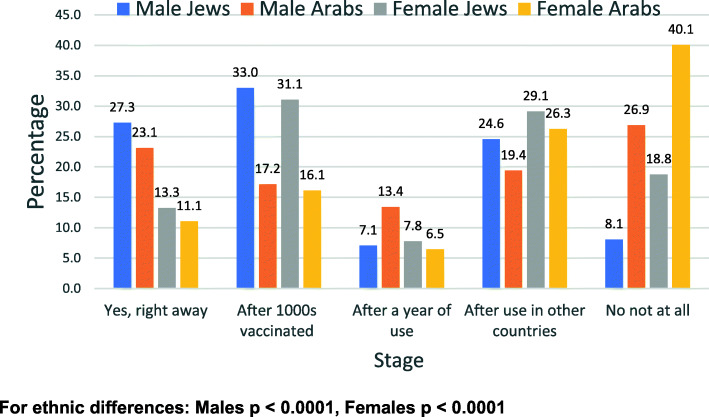
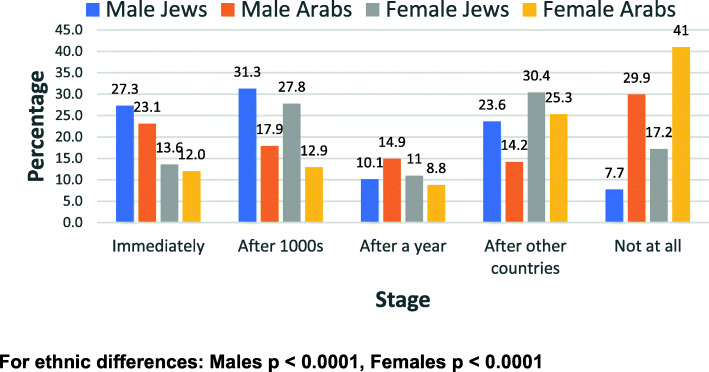
The sample of Arabs was younger than for the Jewish respondents. Among the men, 27.3% of the Jewish and 23.1% of the Arab respondents wanted to be vaccinated immediately, compared with only 13.6% of Jewish women and 12.0% of Arab women. An affirmative answer to the question as to whether they would refuse the vaccine at any stage was given by 7.7% of Jewish men and 29.9% of Arab men, and 17.2% of Jewish women and 41.0% of Arab women. Higher education was associated with less vaccine hesitancy. In multiple logistic regression analysis, the ethnic and gender differences persisted after controlling for age and education. Other factors associated with vaccine hesitancy were the belief that the government restrictions were too lenient and the frequency of socializing prior to the pandemic.

CONCLUSIONS

The study revealed a relatively high percentage reported would be reluctant to get vaccinated, prior to the introduction of the vaccine. This was more marked so for Arabs then Jews, and more so for women within the ethnic groups. While this was not a true random sample, the findings are consistent with the large ethnic differences in compliance with the vaccine, currently encountered and reinforce the policy implications for developing effective communication to increase vaccine adherence. Government policies directed at controlling the pandemic should include sector-specific information campaigns, which are tailored to ensure community engagement, using targeted messages to the suspected vaccine hesitant groups. Government ministries, health service providers and local authorities should join hands with civil society organizations to promote vaccine promotion campaigns.

摘要

背景

目前,COVID-19 疫苗已在以色列向公众提供。以色列各部门对疫苗的接种情况不同,阿拉伯人口的接种率明显低于犹太人口。

目的

评估以色列在推出 COVID-19 疫苗之前与人们对疫苗的态度相关的种族和社会人口学因素。

方法

2020 年 10 月,在以色列使用大约 10 万人的互联网小组进行了一项全国性横断面调查,同时还进行了雪球抽样。招募了 957 名年龄在 30 岁及以上的成年人,其中 606 名是犹太人(男性占 49%),351 名是阿拉伯人(男性占 38%)。

结果

阿拉伯人的样本比犹太人的样本年轻。在男性中,27.3%的犹太人和 23.1%的阿拉伯受访者表示希望立即接种疫苗,而只有 13.6%的犹太女性和 12.0%的阿拉伯女性希望立即接种疫苗。有 7.7%的犹太男性和 29.9%的阿拉伯男性以及 17.2%的犹太女性和 41.0%的阿拉伯女性表示,他们在任何阶段都可能拒绝接种疫苗。受教育程度越高,对疫苗的犹豫程度越低。在多因素逻辑回归分析中,在控制年龄和教育程度后,种族和性别差异仍然存在。与疫苗犹豫相关的其他因素包括政府限制过于宽松以及大流行前社交的频率。

结论

研究表明,在推出疫苗之前,报告表示不愿意接种疫苗的人相对较多。在阿拉伯人当中,这种情况比犹太人更为明显,在各个群体中的女性中更为明显。虽然这不是一个真正的随机样本,但这些发现与目前疫苗接种率方面存在的巨大种族差异一致,并加强了制定有效沟通策略以提高疫苗接种率的政策意义。政府控制大流行的政策应包括针对特定部门的信息宣传活动,这些活动应根据社区参与情况进行调整,向疑似疫苗犹豫群体发送有针对性的信息。政府部门、卫生服务提供者和地方当局应与民间社会组织携手合作,共同推动疫苗推广活动。
https://cdn.ncbi.nlm.nih.gov/pmc/blobs/91f2/7980642/39702ff00865/13584_2021_458_Fig5_HTML.jpg
https://cdn.ncbi.nlm.nih.gov/pmc/blobs/91f2/7980642/7896147561f9/13584_2021_458_Fig1_HTML.jpg
https://cdn.ncbi.nlm.nih.gov/pmc/blobs/91f2/7980642/ec6f67204f23/13584_2021_458_Fig2_HTML.jpg
https://cdn.ncbi.nlm.nih.gov/pmc/blobs/91f2/7980642/162168865ee7/13584_2021_458_Fig3_HTML.jpg
https://cdn.ncbi.nlm.nih.gov/pmc/blobs/91f2/7980642/c8a5956e3a62/13584_2021_458_Fig4_HTML.jpg
https://cdn.ncbi.nlm.nih.gov/pmc/blobs/91f2/7980642/39702ff00865/13584_2021_458_Fig5_HTML.jpg
https://cdn.ncbi.nlm.nih.gov/pmc/blobs/91f2/7980642/7896147561f9/13584_2021_458_Fig1_HTML.jpg
https://cdn.ncbi.nlm.nih.gov/pmc/blobs/91f2/7980642/ec6f67204f23/13584_2021_458_Fig2_HTML.jpg
https://cdn.ncbi.nlm.nih.gov/pmc/blobs/91f2/7980642/162168865ee7/13584_2021_458_Fig3_HTML.jpg
https://cdn.ncbi.nlm.nih.gov/pmc/blobs/91f2/7980642/c8a5956e3a62/13584_2021_458_Fig4_HTML.jpg
https://cdn.ncbi.nlm.nih.gov/pmc/blobs/91f2/7980642/39702ff00865/13584_2021_458_Fig5_HTML.jpg

相似文献

1
A study of ethnic, gender and educational differences in attitudes toward COVID-19 vaccines in Israel - implications for vaccination implementation policies.一项关于以色列对 COVID-19 疫苗的态度在民族、性别和教育方面差异的研究——对疫苗实施政策的影响。
Isr J Health Policy Res. 2021 Mar 19;10(1):26. doi: 10.1186/s13584-021-00458-w.
2
Factors associated with seasonal influenza and HPV vaccination uptake among different ethnic groups in Arab and Jewish society in Israel.以色列阿拉伯和犹太社会不同族群中与季节性流感和 HPV 疫苗接种率相关的因素。
Int J Equity Health. 2021 Sep 7;20(1):201. doi: 10.1186/s12939-021-01523-1.
3
A high rate of COVID-19 vaccine hesitancy in a large-scale survey on Arabs.在一项针对阿拉伯人的大规模调查中,对 COVID-19 疫苗的犹豫率很高。
Elife. 2021 May 27;10:e68038. doi: 10.7554/eLife.68038.
4
Changes in long-term employment and income following COVID-19 (SARS-CoV-2) infection among Jewish and Arab populations in Israel.以色列犹太人和阿拉伯人群感染新冠病毒(SARS-CoV-2)后长期就业和收入的变化。
BMC Public Health. 2025 Mar 31;25(1):1205. doi: 10.1186/s12889-025-22426-8.
5
Patient demands for ethnic-based separation in public hospitals in Israel: patients' and practitioners' perspectives.以色列公立医院中患者基于种族进行隔离的需求:患者与从业者的观点
Isr J Health Policy Res. 2018 Nov 15;7(1):44. doi: 10.1186/s13584-018-0237-9.
6
Disordered eating among Arab and Jewish youth in Israel: the role of eating dinner with the family.以色列阿拉伯和犹太青年的饮食失调:与家人共进晚餐的作用。
Isr J Health Policy Res. 2020 Jun 10;9(1):27. doi: 10.1186/s13584-020-00388-z.
7
Cross-cultural ageism: ageism and attitudes toward aging among Jews and Arabs in Israel.跨文化年龄歧视:以色列的犹太人和阿拉伯人之间的年龄歧视和对老龄化的态度。
Int Psychogeriatr. 2013 Jan;25(1):6-15. doi: 10.1017/S1041610212001548. Epub 2012 Sep 13.
8
Changes in Quality of Life Following SARS-CoV-2 Infection Among Jewish and Arab Populations in Israel: A Cross-Sectional Study.SARS-CoV-2 感染对以色列犹太人群和阿拉伯人群生活质量的影响:一项横断面研究。
Int J Public Health. 2023 Jun 12;68:1605970. doi: 10.3389/ijph.2023.1605970. eCollection 2023.
9
Developing and validating a culturally tailored questionnaire to assess COVID-19 vaccine hesitancy in Israel's ultraorthodox Jewish population.开发并验证一份针对文化定制的问卷,以评估以色列极端正统犹太人群体中对新冠疫苗的犹豫态度。
Hum Vaccin Immunother. 2024 Dec 31;20(1):2429233. doi: 10.1080/21645515.2024.2429233. Epub 2024 Dec 5.
10
Different Reasons for Not Completing Routine Vaccinations Among Jewish and Arab Children in Israel.以色列犹太儿童和阿拉伯儿童常规疫苗接种未完成的不同原因。
J Racial Ethn Health Disparities. 2020 Apr;7(2):298-304. doi: 10.1007/s40615-019-00658-w. Epub 2019 Nov 12.

引用本文的文献

1
Determining population-specific risk factors for COVID-19 susceptibility and severity to inform future individual-level integrated risk scoring.确定特定人群中新冠病毒易感性和严重程度的风险因素,为未来的个体层面综合风险评分提供依据。
BMC Infect Dis. 2025 Aug 4;25(1):977. doi: 10.1186/s12879-025-11357-9.
2
Sex differences in acute respiratory tract infections-multi-year analysis based on data from a large tertiary care medical center in Israel.急性呼吸道感染中的性别差异——基于以色列一家大型三级医疗中心数据的多年分析
Front Public Health. 2025 Mar 25;13:1502036. doi: 10.3389/fpubh.2025.1502036. eCollection 2025.
3
Developing and validating a culturally tailored questionnaire to assess COVID-19 vaccine hesitancy in Israel's ultraorthodox Jewish population.

本文引用的文献

1
Dealing with vaccine hesitancy in Africa: the prospective COVID-19 vaccine context.应对非洲的疫苗犹豫:预期的 COVID-19 疫苗背景。
Pan Afr Med J. 2021 Jan 5;38:3. doi: 10.11604/pamj.2021.38.3.27401. eCollection 2021.
2
Susceptibility to misinformation about COVID-19 around the world.世界各地对新冠疫情错误信息的易感性。
R Soc Open Sci. 2020 Oct 14;7(10):201199. doi: 10.1098/rsos.201199. eCollection 2020 Oct.
3
Factors Associated With US Adults' Likelihood of Accepting COVID-19 Vaccination.与美国成年人接受 COVID-19 疫苗意愿相关的因素。
开发并验证一份针对文化定制的问卷,以评估以色列极端正统犹太人群体中对新冠疫苗的犹豫态度。
Hum Vaccin Immunother. 2024 Dec 31;20(1):2429233. doi: 10.1080/21645515.2024.2429233. Epub 2024 Dec 5.
4
Understanding Vaccine Hesitancy: A Comparison of Sociodemographic and Socioeconomic Predictors with Health Literacy Dimensions.理解疫苗犹豫:社会人口统计学和社会经济预测因素与健康素养维度的比较
Vaccines (Basel). 2024 Oct 4;12(10):1141. doi: 10.3390/vaccines12101141.
5
Gendered (SDG5) and other perspectives on COVID-19 vaccination status: a focus on South Africa's Limpopo province.关于新冠疫苗接种状况的性别视角(可持续发展目标5)及其他观点:以南非林波波省为重点
Front Glob Womens Health. 2024 Jul 30;5:1420967. doi: 10.3389/fgwh.2024.1420967. eCollection 2024.
6
Pandemic fatigue, behavioral intention and predictors of COVID-19 vaccination among individuals living with HIV in Bench Sheko Zone, in Southern Ethiopia, application of TBP: a facility based cross sectional study.在埃塞俄比亚南部 Bench Sheko 地区,针对艾滋病毒感染者的大流行疲劳、行为意向和 COVID-19 疫苗接种预测因素:基于设施的横断面研究,应用 TBP。
Front Public Health. 2024 Feb 27;12:1305777. doi: 10.3389/fpubh.2024.1305777. eCollection 2024.
7
Willingness to Embrace COVID-19 Vaccination Amongst Residents in a Low-Income Nation: Insights From a Cross-Sectional Study on a Limited Cohort.低收入国家居民对新冠疫苗接种的接受意愿:来自一项有限队列横断面研究的见解
Inquiry. 2024 Jan-Dec;61:469580241237697. doi: 10.1177/00469580241237697.
8
Health literacy and COVID-19 vaccine acceptance worldwide: A systematic review.全球健康素养与新冠疫苗接种接受度:一项系统评价。
SAGE Open Med. 2023 Oct 9;11:20503121231197869. doi: 10.1177/20503121231197869. eCollection 2023.
9
COVID-19 Vaccination Actual Uptake and Potential Inequalities Due to Socio-Demographic Characteristics: A Population-Based Study in the Umbria Region, Italy.新冠病毒疫苗接种的实际接种率及因社会人口特征导致的潜在不平等:意大利翁布里亚地区的一项基于人群的研究
Vaccines (Basel). 2023 Aug 9;11(8):1351. doi: 10.3390/vaccines11081351.
10
Credibility of vaccine-related content on Twitter during COVID-19 pandemic.新冠疫情期间推特上疫苗相关内容的可信度
PLOS Glob Public Health. 2023 Jul 19;3(7):e0001385. doi: 10.1371/journal.pgph.0001385. eCollection 2023.
JAMA Netw Open. 2020 Oct 1;3(10):e2025594. doi: 10.1001/jamanetworkopen.2020.25594.
4
The French public's attitudes to a future COVID-19 vaccine: The politicization of a public health issue.法国公众对未来 COVID-19 疫苗的态度:公共卫生问题的政治化。
Soc Sci Med. 2020 Nov;265:113414. doi: 10.1016/j.socscimed.2020.113414. Epub 2020 Oct 6.
5
What led to the Nigerian boycott of the polio vaccination campaign?是什么导致尼日利亚抵制小儿麻痹症疫苗接种运动?
PLoS Med. 2007 Mar;4(3):e73. doi: 10.1371/journal.pmed.0040073.