Institute of Ophthalmology, University College London, London, London, UK.
Moorfields Eye Hospital NHS Foundation Trust, London, London, UK.
Br J Ophthalmol. 2022 Mar;106(3):297-304. doi: 10.1136/bjophthalmol-2020-318452. Epub 2021 Mar 19.
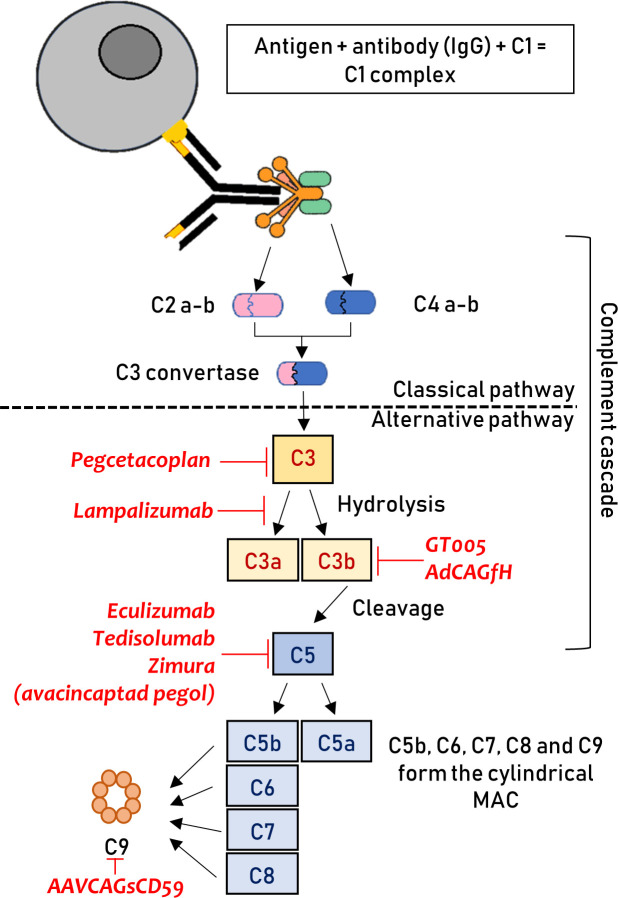
Age-related macular degeneration (AMD) is the leading cause of irreversible blindness in the developed world. The identification of the central role of vascular endothelial growth factor (VEGF) in the pathogenesis of neovascular AMD and the introduction of anti-VEGF agents as gold-standard treatment, have drastically changed its prognosis-something yet to be seen in dry AMD. Several therapeutic avenues with a wide variability of targets are currently being investigated in dry AMD. The approaches being investigated to reduce the rate of disease progression include, (1) drugs with antioxidative properties, (2) inhibitors of the complement cascade, (3) neuroprotective agents, (4) visual cycle inhibitors, (5) gene therapy and (6) cell-based therapies. A number of early phase clinical trials have provided promising results, with many more ongoing and anticipated in the near future. In this review, we aim to provide an update of the interventional trials to date and future prospects for the treatment of dry AMD.
年龄相关性黄斑变性(AMD)是发达国家导致不可逆性失明的主要原因。血管内皮生长因子(VEGF)在新生血管性 AMD 发病机制中的核心作用的确定,以及抗 VEGF 药物作为金标准治疗方法的引入,极大地改变了其预后——而干性 AMD 尚未出现这种情况。目前正在干性 AMD 中研究多种具有广泛靶目标的治疗途径。正在研究的旨在降低疾病进展速度的方法包括:(1)具有抗氧化特性的药物;(2)补体级联抑制剂;(3)神经保护剂;(4)视觉循环抑制剂;(5)基因治疗;和(6)基于细胞的疗法。许多早期临床试验已经取得了有希望的结果,未来还会有更多的临床试验正在进行或即将进行。在这篇综述中,我们旨在提供迄今为止干预性试验的最新信息,并对干性 AMD 的治疗的未来前景进行展望。