From the Division of Clinical Geriatrics (H.X., S.G.-P., M.E.), Division of Neurogeriatrics (L.J., A.W.), Department of Neurobiology, Care Sciences and Society, and Department of Medical Epidemiology and Biostatistics (H.X.), Karolinska Institutet; Department of Internal Medicine (S.G.-P.), Neurology Section, Södersjukhuset, Stockholm, Sweden; H. Lundbeck A/S (L.J.), Copenhagen, Denmark; Department of Community Medicine and Rehabilitation (P.N.), Geriatric Medicine, Umeå University; and Theme Aging (S.G.-P., M.A.), Karolinska University Hospital, Stockholm, Sweden.
Neurology. 2021 Apr 27;96(17):e2220-e2230. doi: 10.1212/WNL.0000000000011832. Epub 2021 Mar 19.
To investigate whether cholinesterase inhibitors (ChEIs) are associated with slower cognitive decline in Alzheimer dementia and decreased risk of severe dementia or death.
Patients with Alzheimer dementia from the Swedish Dementia Registry starting on ChEIs within 3 months of the dementia diagnosis were included and compared to nontreated patients with Alzheimer dementia. In a propensity score-matched cohort, the association between ChEI use and cognitive trajectories assessed by Mini-Mental State Examination (MMSE) scores was examined with a mixed model, and severe dementia (MMSE score <10) or death as an outcome was assessed with Cox proportional hazards models.
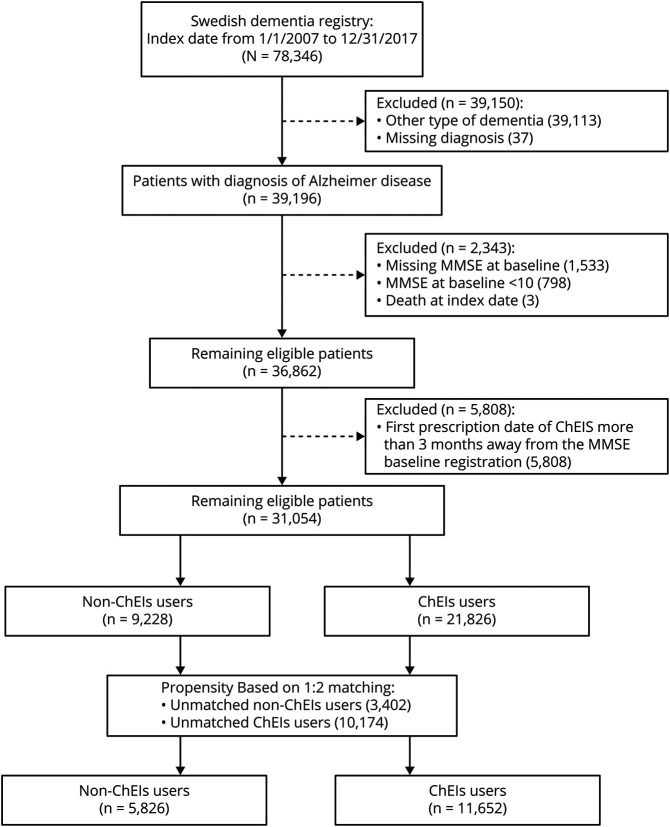
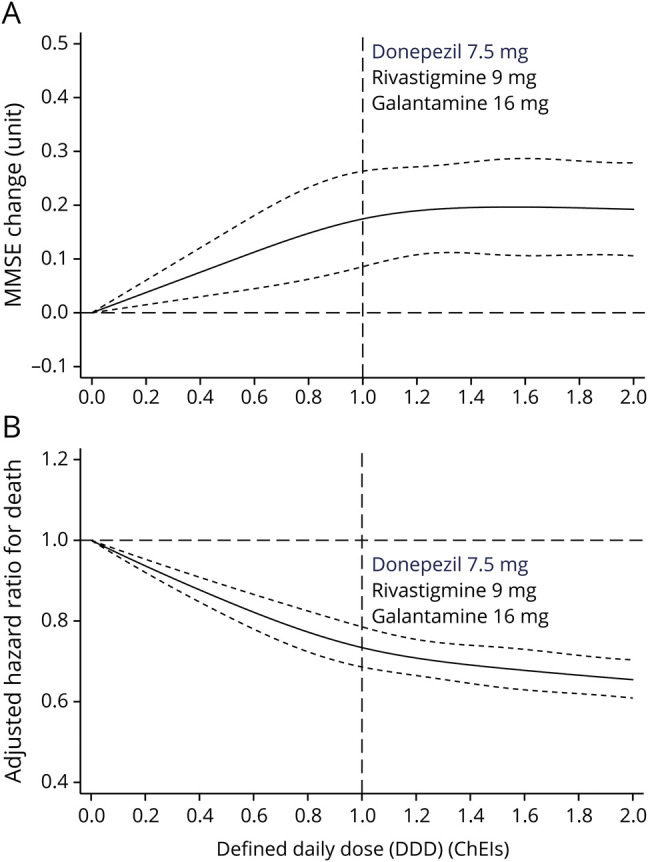
The matched cohort included 11,652 ChEI users and 5,826 nonusers. During an average of 5 years of follow-up, 255 cases developed severe dementia, and 6,055 (35%) died. ChEI use was associated with higher MMSE score at each visit (0.13 MMSE points per year; 95% confidence interval [CI] 0.06-0.20). ChEI users had a 27% lower risk of death (0.73, 95% CI 0.69-0.77) compared with nonusers. Galantamine was associated with lower risk of death (0.71, 95% CI 0.65-0.76) and lower risk of severe dementia (0.69, 95% CI 0.47-1.00) and had the strongest effect on cognitive decline of all the ChEIs (0.18 MMSE points per year, 95% CI 0.07-0.28).
ChEIs are associated with cognitive benefits that are modest but persist over time and with reduced mortality risk, which could be explained partly by their cognitive effects. Galantamine was the only ChEI demonstrating a significant reduction in the risk of developing severe dementia.
This study provides Class III evidence that for patients with Alzheimer dementia ChEIs decrease long-term cognitive decline and risk of death and that galantamine decreases the risk of severe dementia.
探讨胆碱酯酶抑制剂(ChEIs)是否与阿尔茨海默病患者认知能力下降速度减缓以及严重痴呆或死亡风险降低相关。
纳入瑞典痴呆登记处中在痴呆诊断后 3 个月内开始使用 ChEIs 的阿尔茨海默病患者,并与未接受治疗的阿尔茨海默病患者进行比较。在倾向评分匹配队列中,采用混合模型评估使用 ChEI 与使用简易精神状态检查(MMSE)评分评估的认知轨迹之间的关联,采用 Cox 比例风险模型评估严重痴呆(MMSE 评分<10)或死亡作为结局。
匹配队列纳入了 11652 例 ChEI 使用者和 5826 例未使用者。在平均 5 年的随访期间,255 例患者发展为严重痴呆,6055 例(35%)死亡。与未使用者相比,ChEI 使用者在每次就诊时 MMSE 评分均更高(每年增加 0.13 分;95%置信区间 [CI] 0.06-0.20)。与未使用者相比,ChEI 使用者的死亡风险降低了 27%(0.73,95% CI 0.69-0.77)。加兰他敏与死亡风险降低(0.71,95% CI 0.65-0.76)和严重痴呆风险降低(0.69,95% CI 0.47-1.00)相关,并且对所有 ChEIs 中认知下降的影响最强(每年增加 0.18 分,95% CI 0.07-0.28)。
ChEIs 与认知获益相关,这些获益虽然程度较轻,但可随时间持续存在,并降低死亡风险,其部分原因可能是认知效应。加兰他敏是唯一一种可显著降低严重痴呆风险的 ChEI。
本研究提供 III 级证据表明,对于阿尔茨海默病患者,ChEIs 可减缓长期认知能力下降和死亡风险,并且加兰他敏可降低严重痴呆风险。