University of Zurich (UZH), Department of Molecular Mechanisms of Disease (DMMD), Zurich, Switzerland.
University of Zurich and University Hospital Zurich (USZ), Department of Pathology and Molecular Pathology, Zürich, Switzerland.
Mod Pathol. 2021 Aug;34(8):1468-1477. doi: 10.1038/s41379-021-00788-9. Epub 2021 Mar 19.
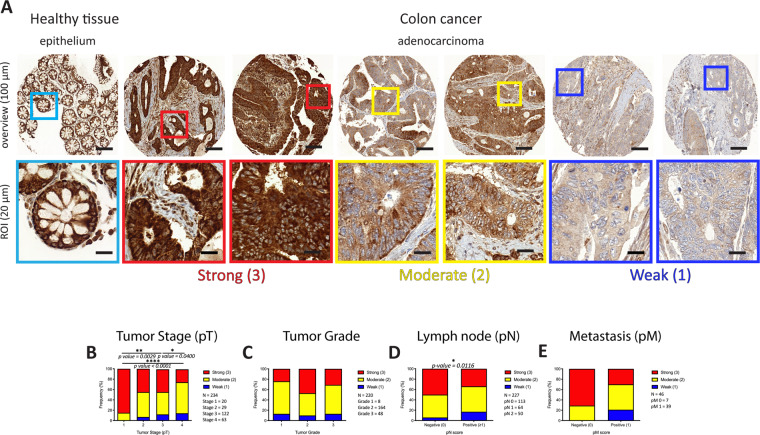
ADP-ribosylation (ADPR) is a posttranslational modification whose importance in oncology keeps increasing due to frequent use of PARP inhibitors (PARPi) to treat different tumor types. Due to the lack of suitable tools to analyze cellular ADPR levels, ADPR's significance for cancer progression and patient outcome is unclear. In this study, we assessed ADPR levels by immunohistochemistry using a newly developed anti-ADP-ribose (ADPr) antibody, which is able to detect both mono- and poly-ADPR. Tissue microarrays containing brain (n = 103), breast (n = 1108), colon (n = 236), lung (n = 138), ovarian (n = 142), and prostate (n = 328) cancers were used to correlate ADPR staining intensities to clinico-pathological data, including patient overall survival (OS), tumor grade, tumor stage (pT), lymph node status (pN), and the presence of distant metastasis (pM). While nuclear ADPR was detected only in a minority of the samples, cytoplasmic ADPR (cyADPR) staining was observed in most tumor types. Strong cyADPR intensities were significantly associated with better overall survival in invasive ductal breast cancer (p < 0.0001), invasive lobular breast cancer (p < 0.005), and high grade serous ovarian cancer patients (p < 0.01). Furthermore, stronger cytoplasmic ADPR levels significantly correlated with early tumor stage in colorectal and in invasive ductal breast adenocarcinoma (p < 0.0001 and p < 0.01, respectively) and with the absence of regional lymph node metastasis in colorectal adenocarcinoma (p < 0.05). No correlation to cyADPR was found for prostate and lung cancer or brain tumors. In conclusion, our new anti-ADP-ribose antibody revealed heterogeneous ADPR staining patterns with predominant cytoplasmic ADPR staining in most tumor types. Different cyADPR staining patterns could help to better understand variable response rates to PARP inhibitors in the future.
ADP-核糖基化(ADPR)是一种翻译后修饰,由于频繁使用 PARP 抑制剂(PARPi)来治疗不同类型的肿瘤,其在肿瘤学中的重要性不断增加。由于缺乏合适的工具来分析细胞内 ADPR 水平,ADPR 对癌症进展和患者预后的意义尚不清楚。在这项研究中,我们使用一种新开发的抗 ADP-核糖(ADPr)抗体通过免疫组织化学评估 ADPR 水平,该抗体能够检测单聚和多聚 ADPR。使用包含脑(n=103)、乳腺(n=1108)、结肠(n=236)、肺(n=138)、卵巢(n=142)和前列腺(n=328)癌的组织微阵列将 ADPR 染色强度与临床病理数据相关联,包括患者总生存(OS)、肿瘤分级、肿瘤分期(pT)、淋巴结状态(pN)和远处转移(pM)的存在。虽然核 ADPR 仅在少数样本中检测到,但细胞质 ADPR(cyADPR)染色在大多数肿瘤类型中均可见。强 cyADPR 强度与浸润性导管乳腺癌(p<0.0001)、浸润性小叶乳腺癌(p<0.005)和高级别浆液性卵巢癌患者的总生存时间显著相关(p<0.01)。此外,更强的细胞质 ADPR 水平与结直肠和浸润性导管乳腺癌腺癌的早期肿瘤分期显著相关(p<0.0001 和 p<0.01),与结直肠腺癌无区域性淋巴结转移显著相关(p<0.05)。在前列腺癌、肺癌或脑肿瘤中未发现与 cyADPR 相关。总之,我们的新型抗 ADP-核糖抗体揭示了具有主要细胞质 ADPR 染色的异质性 ADPR 染色模式,在大多数肿瘤类型中均可见。不同的 cyADPR 染色模式有助于更好地理解未来对 PARP 抑制剂的可变反应率。