Sir William Dunn School of Pathology, University of Oxford, Oxford, United Kingdom.
Max Planck Institute for Biology of Ageing, Cologne, Germany.
Elife. 2018 Feb 26;7:e34334. doi: 10.7554/eLife.34334.
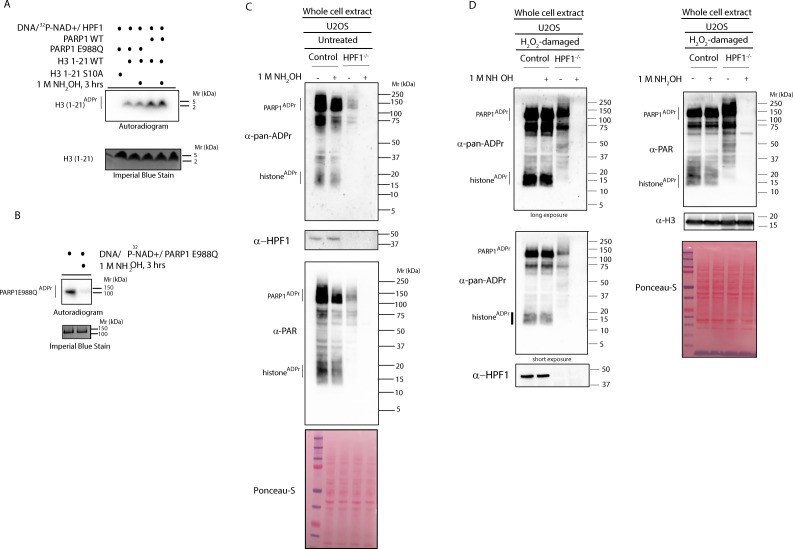
Poly(ADP-ribose) polymerases (PARPs) are a family of enzymes that synthesise ADP-ribosylation (ADPr), a reversible modification of proteins that regulates many different cellular processes. Several mammalian PARPs are known to regulate the DNA damage response, but it is not clear which amino acids in proteins are the primary ADPr targets. Previously, we reported that ARH3 reverses the newly discovered type of ADPr (ADPr on serine residues; Ser-ADPr) and developed tools to analyse this modification (Fontana et al., 2017). Here, we show that Ser-ADPr represents the major fraction of ADPr synthesised after DNA damage in mammalian cells and that globally Ser-ADPr is dependent on HPF1, PARP1 and ARH3. In the absence of HPF1, glutamate/aspartate becomes the main target residues for ADPr. Furthermore, we describe a method for site-specific validation of serine ADP-ribosylated substrates in cells. Our study establishes serine as the primary form of ADPr in DNA damage signalling.
多聚(ADP-核糖)聚合酶(PARPs)是一类能够合成 ADP-核糖基化(ADPr)的酶,ADPr 是一种可逆的蛋白质修饰,能够调节多种不同的细胞过程。目前已知几种哺乳动物 PARPs 能够调节 DNA 损伤反应,但尚不清楚蛋白质中的哪些氨基酸是 ADPr 的主要靶标。先前,我们报道了 ARH3 能够逆转新发现的 ADPr 类型(丝氨酸残基上的 ADPr;Ser-ADPr),并开发了分析这种修饰的工具(Fontana 等人,2017 年)。在这里,我们表明 Ser-ADPr 代表哺乳动物细胞中 DNA 损伤后合成的 ADPr 的主要部分,并且 Ser-ADPr 全局依赖于 HPF1、PARP1 和 ARH3。在没有 HPF1 的情况下,谷氨酸/天冬氨酸成为 ADPr 的主要靶标残基。此外,我们描述了一种在细胞中对丝氨酸 ADP-核糖基化底物进行特异性验证的方法。我们的研究确立了丝氨酸是 DNA 损伤信号中 ADPr 的主要形式。