Department of Clinical Genetics, Maastricht University Medical Center+ (MUMC+), Maastricht, The Netherlands.
Research School for Developmental Biology (GROW), Maastricht University, Maastricht, The Netherlands.
Genet Med. 2021 Jun;23(6):1125-1136. doi: 10.1038/s41436-021-01116-x. Epub 2021 Mar 19.
Consanguineous couples are at increased risk of being heterozygous for the same autosomal recessive (AR) disorder(s), with a 25% risk of affected offspring as a consequence. Until recently, comprehensive preconception carrier testing (PCT) for AR disorders was unavailable in routine diagnostics. Here we developed and implemented such a test in routine clinical care.
We performed exome sequencing (ES) for 100 consanguineous couples. For each couple, rare variants that could give rise to biallelic variants in offspring were selected. These variants were subsequently filtered against a gene panel consisting of ~2,000 genes associated with known AR disorders (OMIM-based). Remaining variants were classified according to American College of Medical Genetics and Genomics/Association for Molecular Pathology (ACMG/AMP) guidelines, after which only likely pathogenic and pathogenic (class IV/V) variants, present in both partners, were reported.
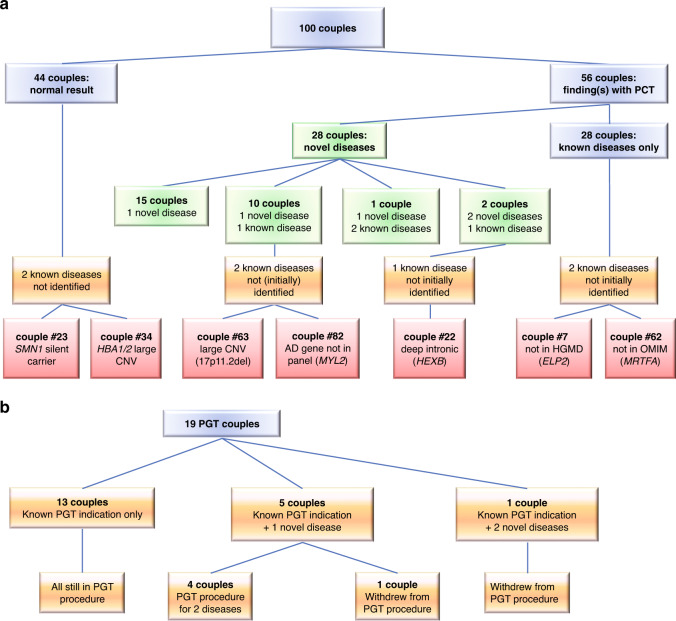
In 28 of 100 tested consanguineous couples (28%), likely pathogenic and pathogenic variants not previously known in the couple or their family were reported conferring 25% risk of affected offspring.
ES-based PCT provides a powerful diagnostic tool to identify AR disease carrier status in consanguineous couples. Outcomes provided significant reproductive choices for a higher proportion of these couples than previous tests.
血缘亲属的夫妇有更高的风险成为同一常染色体隐性(AR)疾病的杂合子携带者,其结果是 25%的后代可能受到影响。直到最近,常规诊断中还无法进行全面的 AR 疾病携带者检测(PCT)。在这里,我们在常规临床护理中开发并实施了这样的检测。
我们对 100 对血缘亲属夫妇进行了外显子组测序(ES)。对于每对夫妇,选择可能导致后代出现双等位基因突变的罕见变异。这些变体随后根据包含约 2000 个与已知 AR 疾病相关的基因的基因面板进行过滤(基于 OMIM)。根据美国医学遗传学与基因组学学院/分子病理学协会(ACMG/AMP)指南对剩余的变体进行分类,之后仅报告在双方都存在的可能致病性和致病性(IV/V 类)变体。
在 100 对接受测试的血缘亲属夫妇中,有 28 对(28%)报告了以前在夫妇或其家族中未知的可能致病性和致病性变体,这使 25%的后代有患病风险。
基于 ES 的 PCT 为识别血缘亲属夫妇中的 AR 疾病携带者状态提供了一种强大的诊断工具。与之前的测试相比,这种检测结果为这些夫妇中的更大比例提供了重要的生殖选择。