Caruso Damiano, Rosati Elisa, Panvini Nicola, Rengo Marco, Bellini Davide, Moltoni Giulia, Bracci Benedetta, Lucertini Elena, Zerunian Marta, Polici Michela, De Santis Domenico, Iannicelli Elsa, Anibaldi Paolo, Carbone Iacopo, Laghi Andrea
Radiology Unit, Department of Surgical and Medical Sciences and Translational Medicine, Sapienza University of Rome - Sant'Andrea University Hospital, Via di Grottarossa, 1035-1039, 00189, Rome, Italy.
Diagnostic Imaging Unit, Department of Medico-Surgical Sciences and Biotechnologies, ICOT Hospital, "Sapienza" University of Rome, Via Franco Faggiana, 1668, 04100, Latina, Italy.
Insights Imaging. 2021 Mar 20;12(1):40. doi: 10.1186/s13244-021-00980-0.
Patient body size represents the main determinant of parenchymal enhancement and by adjusting the contrast media (CM) dose to patient weight may be a more appropriate approach to avoid a patient over dosage of CM. To compare the performance of fixed-dose and lean body weight (LBW)-adapted contrast media dosing protocols, in terms of image quality and parenchymal enhancement.
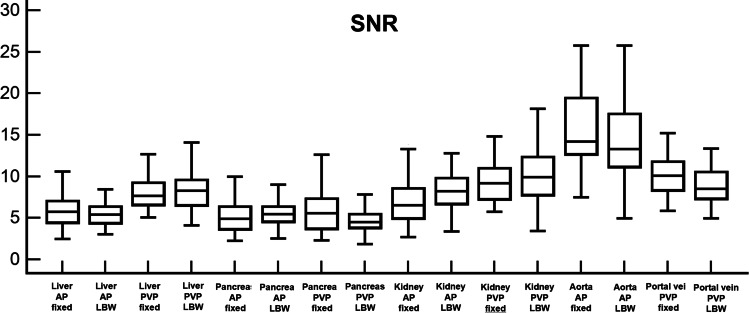
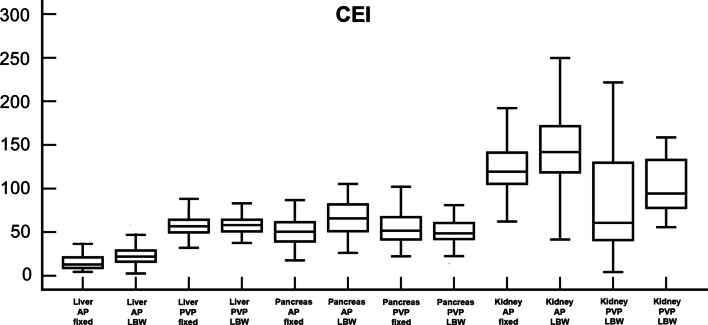
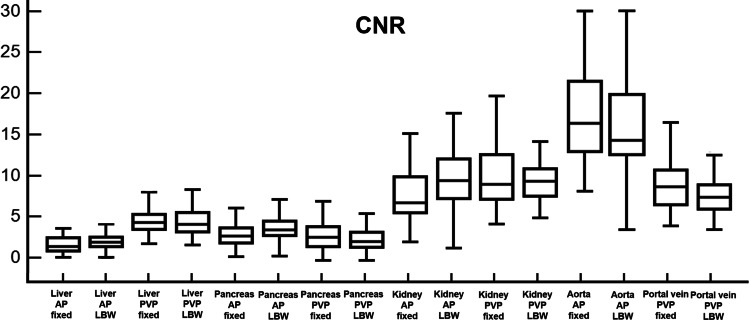
One-hundred cancer patients undergoing multiphasic abdominal CT were prospectively enrolled in this multicentric study and randomly divided in two groups: patients in fixed-dose group (n = 50) received 120 mL of CM while in LBW group (n = 50) the amount of CM was computed according to the patient's LBW. LBW protocol group received a significantly lower amount of CM (103.47 ± 17.65 mL vs. 120.00 ± 0.00 mL, p < 0.001). Arterial kidney signal-to-noise ratio (SNR) and contrast-to-noise ratio (CNR) and pancreatic CNR were significantly higher in LBW group (all p ≤ 0.004). LBW group provided significantly higher arterial liver, kidney, and pancreatic contrast enhancement index (CEI) and portal venous phase kidney CEI (all p ≤ 0.002). Significantly lower portal vein SNR and CNR were observed in LBW-Group (all p ≤ 0.020).
LBW-adapted CM administration for abdominal CT reduces the volume of injected CM and improves both image quality and parenchymal enhancement.
患者体型是实质强化的主要决定因素,根据患者体重调整造影剂(CM)剂量可能是避免患者造影剂过量的更合适方法。比较固定剂量和基于瘦体重(LBW)调整的造影剂给药方案在图像质量和实质强化方面的表现。
100例接受多期腹部CT检查的癌症患者前瞻性纳入本多中心研究,并随机分为两组:固定剂量组(n = 50)患者接受120 mL造影剂,而LBW组(n = 50)造影剂用量根据患者的LBW计算。LBW方案组接受的造影剂剂量显著更低(103.47±17.65 mL对120.00±0.00 mL,p < 0.001)。LBW组的肾动脉信噪比(SNR)、对比噪声比(CNR)和胰腺CNR显著更高(所有p≤0.004)。LBW组的肝动脉、肾和胰腺对比增强指数(CEI)以及门静脉期肾CEI显著更高(所有p≤0.002)。在LBW组观察到门静脉SNR和CNR显著更低(所有p≤0.020)。
腹部CT采用基于LBW调整的CM给药可减少造影剂注射量,并改善图像质量和实质强化。