Monticone Marco, Portoghese Igor, Cazzaniga Daniele, Liquori Valentina, Marongiu Giuseppe, Capone Antonio, Campagna Marcello, Zatti Giovanni
Department Medical Sciences and Public Health, University of Cagliari, Cittadella Universitaria, Strada Statale, 554 - Monserrato, Cagliari, Italy.
Neurorehabilitation Unit, Department Neuroscience and Rehabilitation, G. Brotzu Hospital, Cagliari, Italy.
BMC Musculoskelet Disord. 2021 Mar 20;22(1):293. doi: 10.1186/s12891-021-04140-9.
General physiotherapy is a common means of rehabilitation after surgery for proximal humeral fracture (PHF). Better-targeted exercises seem worthy of investigation and the aim of this study was to assess the efficacy of a rehabilitation program including task-oriented exercises in improving disability, pain, and quality of life in patients after a PHF.
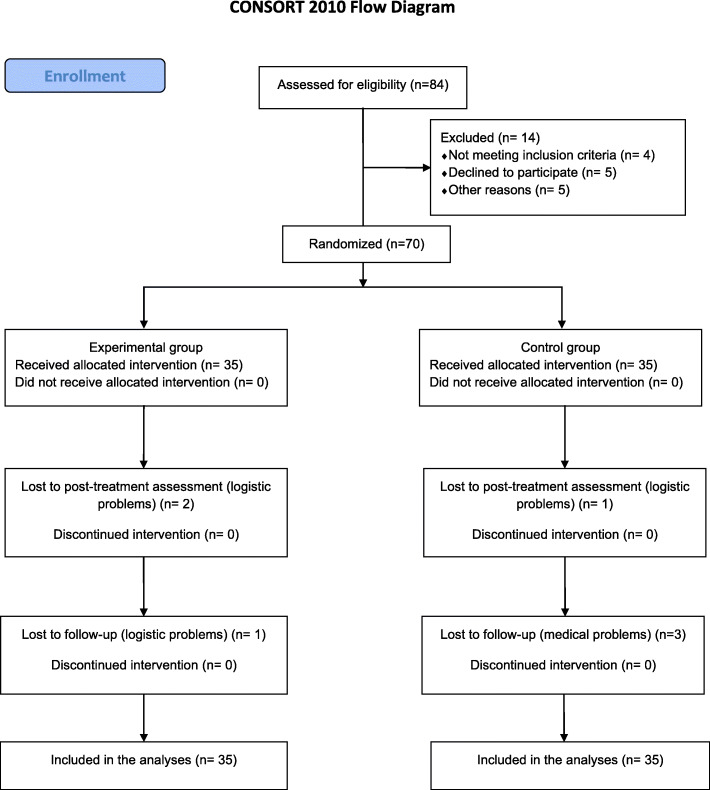
By means of a randomized controlled trial with one-year follow-up, 70 working patients (mean age of 49 ± 11 years; 41 females), who were selected for open reduction and internal fixation with plates caused by PHF, were randomized to be included in an experimental (n = 35) or control group (n = 35). There was a permuted-block randomization plan, and a list of program codes was previously created; subsequently, an automatic assignment system was used to conceal the allocation. The first group underwent a supervised rehabilitation program of task-oriented exercises based on patients' specific job activities, and occupational therapy. The second group underwent general physiotherapy, including supervised mobility, strengthening and stretching exercises. Both groups individually followed programs of 60-min session three times per week for 12 weeks in the outpatient setting. The Disability Arm Shoulder Hand questionnaire (DASH; scores range from 0 to 100; primary outcome), a Pain intensity Numerical Rating Scale (scores range 0 to 10; secondary outcomes), and the Short-Form Health Survey (scores range from 0 to 100; secondary outcomes) assessed the interventions. Participants were evaluated before surgery, before and after rehabilitation (primary endpoint), and at the one-year follow-up (secondary endpoint). A linear mixed model analysis for repeated measures was carried out for each outcome measure (p < 0.05).
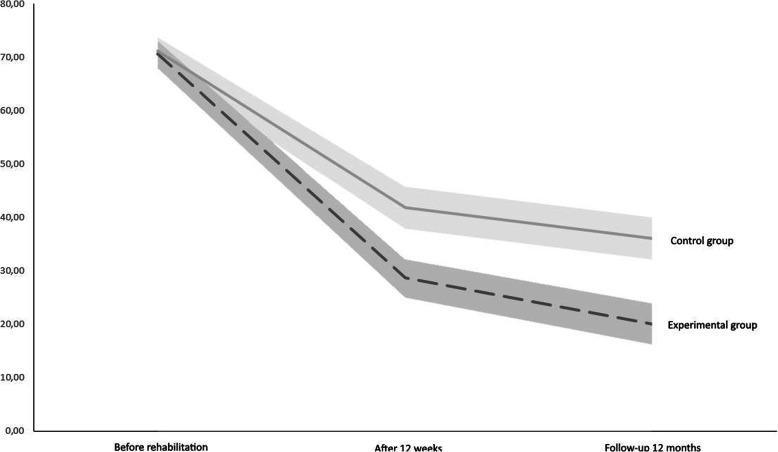
Time, group and time by group showed significant effects for all outcome measures in favour of the experimental group. The DASH and the DASH work achieved clinically important between-group differences of 16.0 points (95% confidence interval [C.I.] 7.3 to 24.7) and 19.7 (95% C.I. 9.0 to 30.5) at follow-up, respectively. The NRS achieved a between-group difference of 2.9 (95% C.I. 1.0 to 3.9) at follow-up. As for SF-36, there were between-group differences ranging from 17.9 to 37.0 at follow-up.
A rehabilitation program based on task-oriented exercises was useful in improving disability, pain, and quality of life in working patients after PHFs. Improvements lasted for at least 12 months.
On 16/12/2019, the trial was retrospectively registered in the ISRCTN registry with the ID number 17996552 .
一般物理治疗是肱骨近端骨折(PHF)手术后常见的康复手段。针对性更强的锻炼似乎值得研究,本研究旨在评估一项包含任务导向性锻炼的康复计划对改善PHF患者的残疾状况、疼痛及生活质量的效果。
通过一项为期一年随访的随机对照试验,选取70例因PHF接受切开复位钢板内固定术的在职患者(平均年龄49±11岁;41例女性),随机分为试验组(n = 35)和对照组(n = 35)。采用了分组随机化计划,预先创建了程序代码列表;随后,使用自动分配系统对分配情况进行隐匿。第一组接受基于患者特定工作活动的任务导向性锻炼及职业治疗的监督康复计划。第二组接受一般物理治疗,包括监督下的活动度、强化和伸展锻炼。两组均在门诊环境中,每周进行3次每次60分钟的训练,共12周。采用上肢、肩部和手部功能障碍问卷(DASH;评分范围0至100;主要结局)、疼痛强度数字评定量表(评分范围0至10;次要结局)及简短健康调查问卷(评分范围0至100;次要结局)对干预措施进行评估。在手术前、康复前后(主要终点)及一年随访时(次要终点)对参与者进行评估。对每个结局指标进行重复测量的线性混合模型分析(p < 0.05)。
时间、组间及时间与组间的交互作用对所有结局指标均有显著影响,支持试验组。随访时,DASH及DASH工作维度在组间达到了具有临床意义的差异,分别为16.0分(95%置信区间[C.I.] 7.3至24.7)和19.7分(95% C.I. 9.0至30.5)。数字评定量表在随访时组间差异为2.9(95% C.I. 1.0至3.9)。至于简短健康调查问卷,随访时组间差异在17.9至37.0之间。
基于任务导向性锻炼的康复计划对改善PHF后在职患者的残疾状况、疼痛及生活质量有效。改善效果至少持续12个月。
2019年12月16日,该试验在国际标准随机对照试验编号注册库中进行了回顾性注册,编号为17996552。