Jiangsu Provincial Key Lab of Solid Organic Waste Utilization, Jiangsu Collaborative Innovation Center of Solid Organic Wastes, Educational Ministry Engineering Center of Resource-saving fertilizers, Nanjing Agricultural University, Nanjing, 210095, PR China.
The Key Laboratory of Plant Immunity, Nanjing Agricultural University, Nanjing, 210095, PR China.
Microbiome. 2021 Mar 20;9(1):64. doi: 10.1186/s40168-021-01025-w.
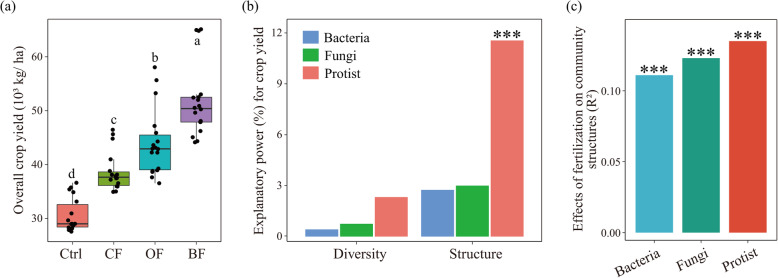
Microbiomes play vital roles in plant health and performance, and the development of plant beneficial microbiomes can be steered by organic fertilizer inputs. Especially well-studied are fertilizer-induced changes on bacteria and fungi and how changes in these groups alter plant performance. However, impacts on protist communities, including their trophic interactions within the microbiome and consequences on plant performance remain largely unknown. Here, we tracked the entire microbiome, including bacteria, fungi, and protists, over six growing seasons of cucumber under different fertilization regimes (conventional, organic, and Trichoderma bio-organic fertilization) and linked microbial data to plant yield to identify plant growth-promoting microbes.
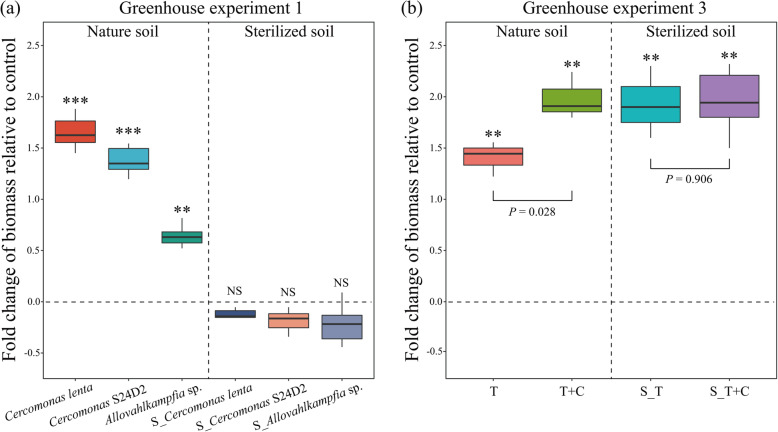
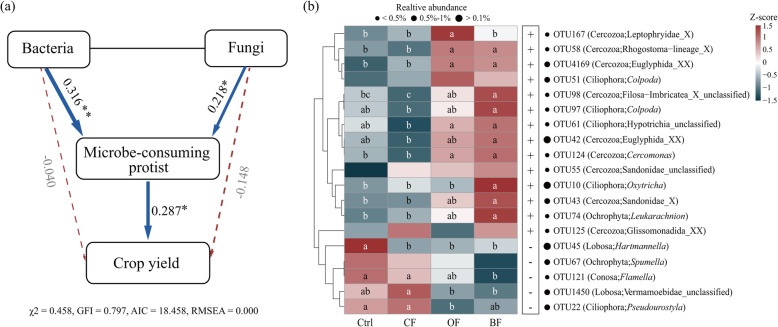
Yields were higher in the (bio-)organic fertilization treatments. Soil abiotic conditions were altered by the fertilization regime, with the prominent effects coming from the (bio-)organic fertilization treatments. Those treatments also led to the pronounced shifts in protistan communities, especially microbivorous cercozoan protists. We found positive correlations of these protists with plant yield and the density of potentially plant-beneficial microorganisms. We further explored the mechanistic ramifications of these relationships via greenhouse experiments, showing that cercozoan protists can positively impact plant growth, potentially via interactions with plant-beneficial microorganisms including Trichoderma, the biological agent delivered by the bio-fertilizer.
We show that protists may play central roles in stimulating plant performance through microbiome interactions. Future agricultural practices might aim to specifically enhance plant beneficial protists or apply those protists as novel, sustainable biofertilizers. Video abstract.
微生物组在植物健康和性能中发挥着至关重要的作用,而有益微生物组的开发可以通过有机肥料的投入来引导。特别是,研究了肥料对细菌和真菌的诱导变化,以及这些群体的变化如何改变植物的性能。然而,原生动物群落的影响,包括它们在微生物组中的营养相互作用以及对植物性能的后果,在很大程度上仍然未知。在这里,我们在黄瓜的六个生长季节中跟踪了整个微生物组,包括细菌、真菌和原生动物,在不同的施肥制度(常规、有机和木霉生物有机施肥)下,并将微生物数据与植物产量联系起来,以确定促进植物生长的微生物。
(生物)有机施肥处理的产量更高。施肥制度改变了土壤的非生物条件,(生物)有机施肥处理的影响最为显著。这些处理还导致原生动物群落的明显变化,特别是食菌的原生动物。我们发现这些原生动物与植物产量和潜在有益微生物的密度呈正相关。我们通过温室实验进一步探讨了这些关系的机制后果,表明原生动物可以通过与包括木霉在内的有益微生物的相互作用,对植物生长产生积极影响,而木霉是生物肥料中提供的生物制剂。
我们表明,原生动物可能通过微生物组相互作用在刺激植物性能方面发挥核心作用。未来的农业实践可能旨在专门增强植物有益的原生动物,或应用这些原生动物作为新的、可持续的生物肥料。视频摘要。