Marzuillo Pierluigi, Pezzella Vincenza, Guarino Stefano, Di Sessa Anna, Baldascino Maria, Polito Cesare, Miraglia Del Giudice Emanuele, Nunziata Felice
Department of Woman, Child and of General and Specialized Surgery, Università della Campania "Luigi Vanvitelli", Via Luigi De Crecchio 2, 80138, Napoli, Italy.
Department of Pediatrics, AORN Sant'Anna e San Sebastiano, Via Ferdinando Palasciano, 81100, Caserta, Italy.
Pediatr Nephrol. 2021 Sep;36(9):2883-2890. doi: 10.1007/s00467-021-05022-x. Epub 2021 Mar 20.
Acute kidney injury (AKI) enhances the risk of later chronic kidney disease. Significant prevalence of AKI is reported in adults with community acquired pneumonia (CAP). We investigated prevalence of and prognostic factors for AKI in children hospitalized for CAP.
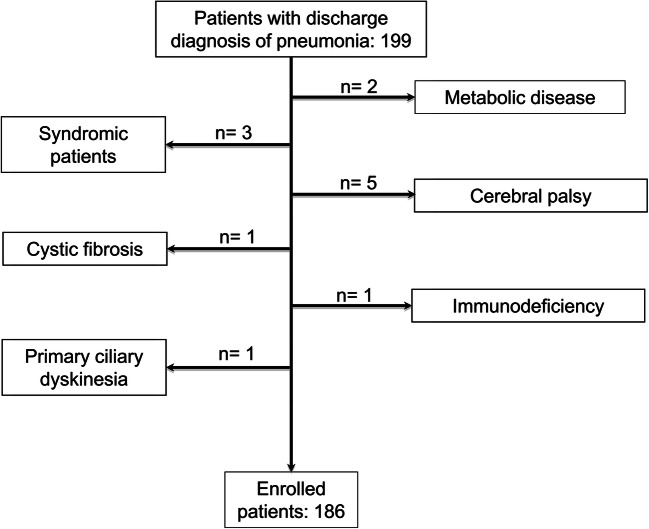
We retrospectively collected clinical and biochemical data of 186 children (48.4% male; mean age 2.6±2.4 years) hospitalized for X-ray-confirmed CAP. AKI was defined according to Kidney Disease/Improving Global Outcomes creatinine criteria. We considered as basal serum creatinine the value estimated with Hoste (age) equation assuming basal eGFR were median age-based eGFR normative values for children ≤ 2 years of age and eGFR= 120 mL/min/1.73m for children > 2 years. Univariate and multivariate logistic regression models were used to explore associations with AKI.
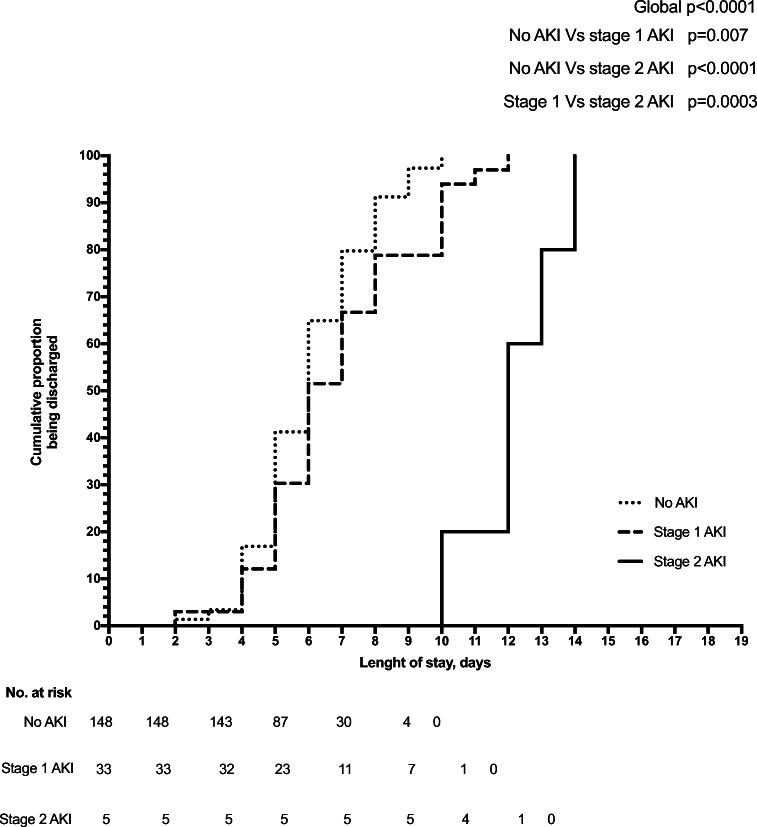
AKI was found in 38/186 (20.4%) patients. No patient required hemodialysis nor reached AKI stage 3, 5 (2.7%) reached AKI stage 2, and 33 (17.7%) AKI stage 1. Mean length of stay was 6.0±1.7, 6.9±2.3, and 12.2±1.5 days, for patients without AKI, stage 1 AKI, and stage 2 AKI (p < 0.001), respectively. Duration of symptoms before hospitalization (OR 1.2; 95%CI 1.09-1.43; p = 0.001), severe pneumonia (OR 11.9; 95%CI 4.3-33.3; p < 0.001), and serum C-reactive protein levels (OR 1.1; 95%CI 1.04-1.23; p = 0.004) were independent AKI predictors.
About 1/5 of children hospitalized for CAP present a generally mild AKI with a longer stay for those with more severe AKI. Attention should be paid to kidney health of children with CAP especially in presence of higher duration of symptoms before hospitalization, severe pneumonia and higher serum CRP levels.
急性肾损伤(AKI)会增加日后患慢性肾脏病的风险。据报道,社区获得性肺炎(CAP)成人患者中AKI的患病率较高。我们调查了因CAP住院的儿童中AKI的患病率及其预后因素。
我们回顾性收集了186例因X线确诊为CAP而住院的儿童(男性占48.4%;平均年龄2.6±2.4岁)的临床和生化数据。AKI根据肾脏病改善全球预后组织(Kidney Disease/Improving Global Outcomes)的肌酐标准进行定义。我们将根据霍斯特(Hoste)年龄方程估算的值视为基础血清肌酐,假设基础估算肾小球滤过率(eGFR)为≤2岁儿童基于年龄中位数的eGFR正常值,>2岁儿童的eGFR = 120 mL/min/1.73m²。采用单因素和多因素逻辑回归模型探讨与AKI的关联。
186例患者中有38例(20.4%)发生AKI。无患者需要血液透析,也无患者达到AKI 3期,5例(2.7%)达到AKI 2期,33例(17.7%)为AKI 1期。无AKI、AKI 1期和AKI 2期患者的平均住院时间分别为6.0±1.7天、6.9±2.3天和12.2±1.5天(p<0.001)。住院前症状持续时间(比值比[OR]1.2;95%置信区间[CI]1.09 - 1.43;p = 0.001)、重症肺炎(OR 11.9;95%CI 4.3 - 33.3;p<0.001)和血清C反应蛋白水平(OR 1.1;95%CI 1.04 - 1.23;p = 0.004)是AKI的独立预测因素。
因CAP住院的儿童中约五分之一存在一般为轻度的AKI,AKI较严重的患儿住院时间更长。应关注CAP患儿的肾脏健康,尤其是住院前症状持续时间较长、患有重症肺炎和血清C反应蛋白水平较高的患儿。