Reynolds Hanna, Steinfort Sarah, Tillyard Jane, Ellis Sarah, Hayes Alan, Hanson Erik D, Wijeratne Tissa, Skinner Elizabeth H
Department of Physiotherapy, Western Health, 176 Furlong Rd, St Albans, 3021, Australia.
Australian Institute of Musculoskeletal Science, Melbourne, Victoria, Australia.
BMC Neurol. 2021 Mar 22;21(1):132. doi: 10.1186/s12883-021-02052-8.
Stroke is a leading cause of disability worldwide and the cardiovascular fitness levels of stroke survivors are diminished to an extent that impairs functioning and activities of daily living performance. While cardiovascular training seems an empirically appropriate intervention, the optimal dosage and intensity of cardiovascular training in stroke survivors remains unclear. The aim was to determine the safety and feasibility of moderate-intensity cardiovascular training following stroke, including measurement of adherence to training.
A pilot, prospective, patient- and assessor-blinded randomised controlled trial conducted in a tertiary, metropolitan hospital-based community rehabilitation centre. Eligibility criteria included ambulant (> 100 m), 6 weeks-12 months post stroke. Moderate-intensity fitness training or control (low-intensity) exercise was offered biweekly for 12 weeks. Outcome measures included adverse events, peak oxygen uptake (VO), functional exercise capacity (6-Minute Walk Test, 10-m Walk Test) and health-related quality of life (Short Form-36) and mood (Patient Health Questionnaire, PHQ9).
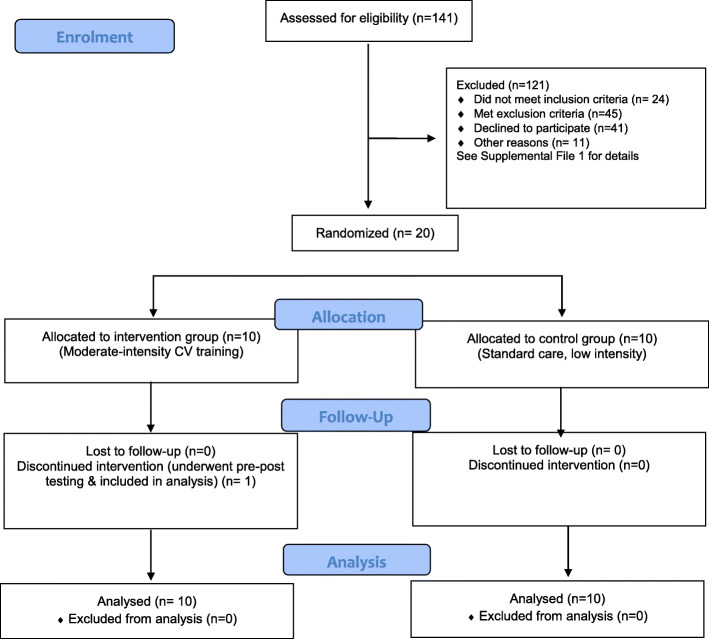
Feasibility: Seventy-one (50%) of 141 screened participants were eligible (29% did not agree to participate). Twenty participants (10 intervention, 10 control) were recruited. The median (%; IQR) supervised sessions was 19.5 (81%; 12, 20); and 20 (83%; 19, 22) in the intervention and control groups, respectively. Progression of duration and intensity was limited; mean of 10 sessions to achieve target duration (30 min). There were no adverse events. Baseline peak oxygen uptake (VO) levels were low (15.94 ml/kg/min). Significant improvements in VO peak in both groups were observed (p < 0.05). Although there were no significant between-group differences, this feasibility trial was not powered to detect change.
Moderate-intensity fitness training was safe but achievement of target duration and intensity was challenging for stroke survivors. A definitive adequately-powered randomised trial is required. Alternative fitness training protocols may need to be explored.
The trial protocol was prospectively registered on the Australian New Zealand Clinical Trials Registry ( ACTRN 12613000822785 ) on 25/07/2013.
中风是全球致残的主要原因,中风幸存者的心血管健康水平下降到了损害其功能和日常生活活动能力的程度。虽然心血管训练似乎是一种经验上合适的干预措施,但中风幸存者心血管训练的最佳剂量和强度仍不明确。目的是确定中风后进行中等强度心血管训练的安全性和可行性,包括对训练依从性的测量。
在一家大都市三级医院的社区康复中心进行了一项前瞻性、患者和评估者双盲的随机对照试验。纳入标准包括中风后6周 - 12个月、能够行走(>100米)。每两周提供一次中等强度健身训练或对照(低强度)运动,为期12周。结果指标包括不良事件、峰值摄氧量(VO)、功能运动能力(6分钟步行试验、10米步行试验)、健康相关生活质量(简短健康调查问卷-36)和情绪(患者健康问卷,PHQ9)。
可行性:141名筛查参与者中有71名(50%)符合条件(29%不同意参与)。招募了20名参与者(10名干预组,10名对照组)。干预组和对照组的监督课程中位数(%;四分位间距)分别为19.5(81%;12, 20)和20(83%;19, 22)。持续时间和强度的进展有限;平均需要10次课程才能达到目标持续时间(30分钟)。没有不良事件。基线峰值摄氧量(VO)水平较低(15.94毫升/千克/分钟)。两组的VO峰值均有显著改善(p < 0.05)。虽然两组之间没有显著差异,但该可行性试验没有足够的效力来检测变化。
中等强度健身训练是安全的,但中风幸存者要达到目标持续时间和强度具有挑战性。需要进行一项有足够效力的确定性随机试验。可能需要探索替代的健身训练方案。
该试验方案于2013年7月25日在澳大利亚新西兰临床试验注册中心(ACTRN 12613000822785)进行了前瞻性注册。