Haines Terry P, Bowles Kelly-Ann, Mitchell Deb, O'Brien Lisa, Markham Donna, Plumb Samantha, May Kerry, Philip Kathleen, Haas Romi, Sarkies Mitchell N, Ghaly Marcelle, Shackell Melina, Chiu Timothy, McPhail Steven, McDermott Fiona, Skinner Elizabeth H
Department of Physiotherapy, Monash University, Frankston, Victoria, Australia.
Allied Health Research Unit, Monash Health, Cheltenham, Victoria, Australia.
PLoS Med. 2017 Oct 31;14(10):e1002412. doi: 10.1371/journal.pmed.1002412. eCollection 2017 Oct.
Disinvestment (removal, reduction, or reallocation) of routinely provided health services can be difficult when there is little published evidence examining whether the services are effective or not. Evidence is required to understand if removing these services produces outcomes that are inferior to keeping such services in place. However, organisational imperatives, such as budget cuts, may force healthcare providers to disinvest from these services before the required evidence becomes available. There are presently no experimental studies examining the effectiveness of allied health services (e.g., physical therapy, occupational therapy, and social work) provided on weekends across acute medical and surgical hospital wards, despite these services being routinely provided internationally. The aim of this study was to understand the impact of removing weekend allied health services from acute medical and surgical wards using a disinvestment-specific non-inferiority research design.
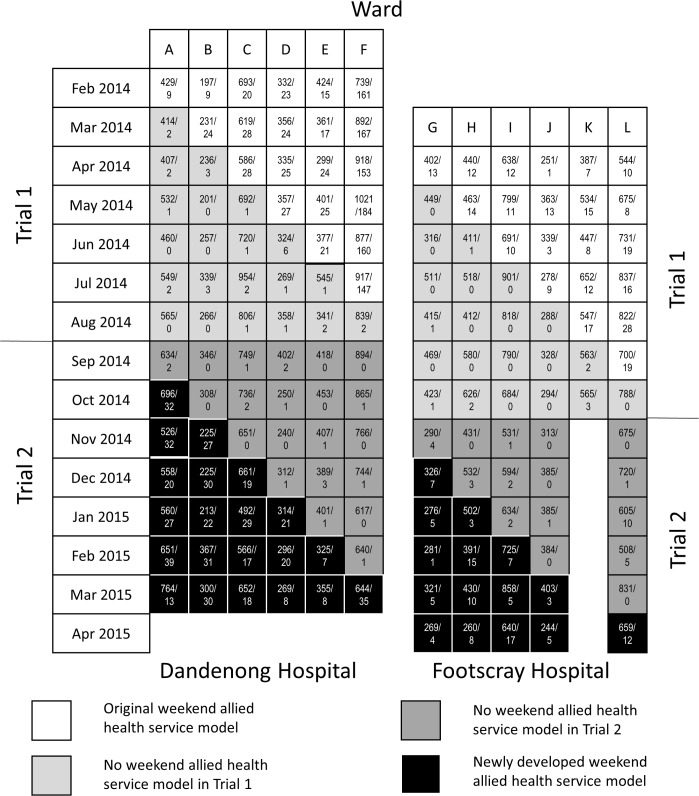
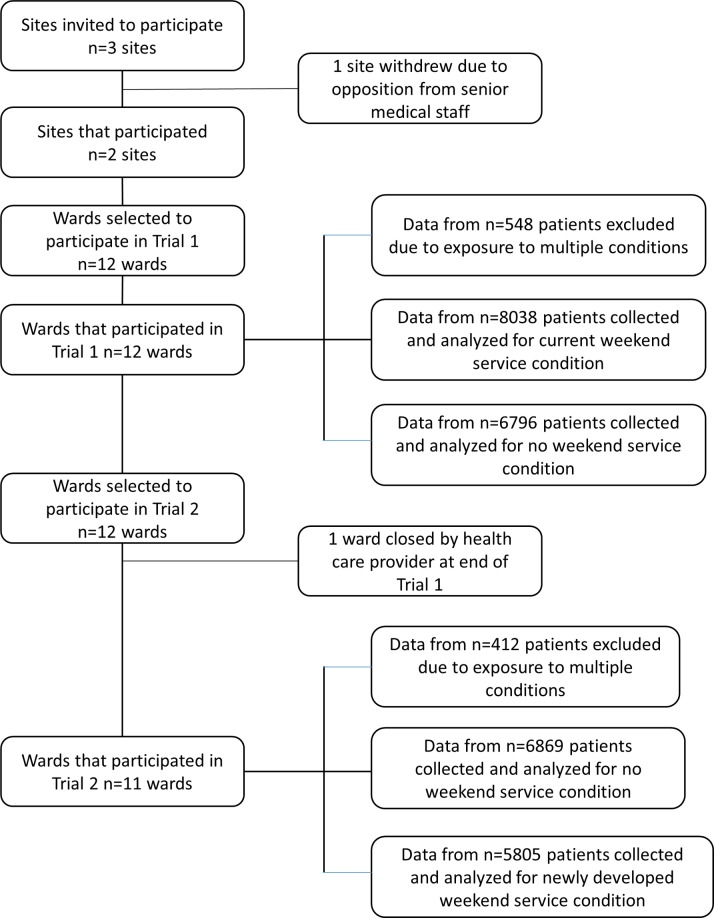
We conducted 2 stepped-wedge cluster randomised controlled trials between 1 February 2014 and 30 April 2015 among patients on 12 acute medical or surgical hospital wards spread across 2 hospitals. The hospitals involved were 2 metropolitan teaching hospitals in Melbourne, Australia. Data from n = 14,834 patients were collected for inclusion in Trial 1, and n = 12,674 in Trial 2. Trial 1 was a disinvestment-specific non-inferiority stepped-wedge trial where the 'current' weekend allied health service was incrementally removed from participating wards each calendar month, in a random order, while Trial 2 used a conventional non-inferiority stepped-wedge design, where a 'newly developed' service was incrementally reinstated on the same wards as in Trial 1. Primary outcome measures were patient length of stay (proportion staying longer than expected and mean length of stay), the proportion of patients experiencing any adverse event, and the proportion with an unplanned readmission within 28 days of discharge. The 'no weekend allied health service' condition was considered to be not inferior if the 95% CIs of the differences between this condition and the condition with weekend allied health service delivery were below a 2% increase in the proportion of patients who stayed in hospital longer than expected, a 2% increase in the proportion who had an unplanned readmission within 28 days, a 2% increase in the proportion who had any adverse event, and a 1-day increase in the mean length of stay. The current weekend allied health service included physical therapy, occupational therapy, speech therapy, dietetics, social work, and allied health assistant services in line with usual care at the participating sites. The newly developed weekend allied health service allowed managers at each site to reprioritise tasks being performed and the balance of hours provided by each professional group and on which days they were provided. Analyses conducted on an intention-to-treat basis demonstrated that there was no estimated effect size difference between groups in the proportion of patients staying longer than expected (weekend versus no weekend; estimated effect size difference [95% CI], p-value) in Trial 1 (0.40 versus 0.38; estimated effect size difference 0.01 [-0.01 to 0.04], p = 0.31, CI was both above and below non-inferiority margin), but the proportion staying longer than expected was greater with the newly developed service compared to its no weekend service control condition (0.39 versus 0.40; estimated effect size difference 0.02 [0.01 to 0.04], p = 0.04, CI was completely below non-inferiority margin) in Trial 2. Trial 1 and 2 findings were discordant for the mean length of stay outcome (Trial 1: 5.5 versus 6.3 days; estimated effect size difference 1.3 days [0.9 to 1.8], p < 0.001, CI was both above and below non-inferiority margin; Trial 2: 5.9 versus 5.0 days; estimated effect size difference -1.6 days [-2.0 to -1.1], p < 0.001, CI was completely below non-inferiority margin). There was no difference between conditions for the proportion who had an unplanned readmission within 28 days in either trial (Trial 1: 0.01 [-0.01 to 0.03], p = 0.18, CI was both above and below non-inferiority margin; Trial 2: -0.01 [-0.02 to 0.01], p = 0.62, CI completely below non-inferiority margin). There was no difference between conditions in the proportion of patients who experienced any adverse event in Trial 1 (0.01 [-0.01 to 0.03], p = 0.33, CI was both above and below non-inferiority margin), but a lower proportion of patients had an adverse event in Trial 2 when exposed to the no weekend allied health condition (-0.03 [-0.05 to -0.004], p = 0.02, CI completely below non-inferiority margin). Limitations of this research were that 1 of the trial wards was closed by the healthcare provider after Trial 1 and could not be included in Trial 2, and that both withdrawing the current weekend allied health service model and installing a new one may have led to an accommodation period for staff to adapt to the new service settings. Stepped-wedge trials are potentially susceptible to bias from naturally occurring change over time at the service level; however, this was adjusted for in our analyses.
In Trial 1, criteria to say that the no weekend allied health condition was non-inferior to current weekend allied health condition were not met, while neither the no weekend nor current weekend allied health condition demonstrated superiority. In Trial 2, the no weekend allied health condition was non-inferior to the newly developed weekend allied health condition across all primary outcomes, and superior for the outcomes proportion of patients staying longer than expected, proportion experiencing any adverse event, and mean length of stay.
Australian New Zealand Clinical Trials Registry ACTRN12613001231730 and ACTRN12613001361796.
当几乎没有公开证据来检验常规提供的医疗服务是否有效时,撤资(取消、减少或重新分配)这些服务可能会很困难。需要证据来了解取消这些服务所产生的结果是否比保留这些服务更差。然而,诸如预算削减等组织需求可能会迫使医疗服务提供者在获得所需证据之前就对这些服务进行撤资。目前尚无实验研究来检验在急性内科和外科医院病房周末提供的联合健康服务(如物理治疗、职业治疗和社会工作)的有效性,尽管这些服务在国际上是常规提供的。本研究的目的是采用特定于撤资的非劣效性研究设计,了解从急性内科和外科病房取消周末联合健康服务的影响。
2014年2月1日至2015年4月30日期间,我们在分布于两家医院的12个急性内科或外科医院病房的患者中进行了2项阶梯楔形整群随机对照试验。所涉及的医院是澳大利亚墨尔本的两家大都市教学医院。收集了来自14834名患者的数据纳入试验1,12674名患者的数据纳入试验2。试验1是一项特定于撤资的非劣效性阶梯楔形试验,其中“当前”的周末联合健康服务在每个日历月以随机顺序从参与的病房中逐步取消,而试验2采用传统的非劣效性阶梯楔形设计,其中“新开发”的服务在与试验1相同的病房中逐步恢复。主要结局指标包括患者住院时间(住院时间超过预期的比例和平均住院时间)、发生任何不良事件的患者比例以及出院后28天内非计划再入院的比例。如果该情况与提供周末联合健康服务的情况之间差异的95%置信区间低于住院时间超过预期的患者比例增加2%、28天内非计划再入院的患者比例增加2%、发生任何不良事件的患者比例增加2%以及平均住院时间增加1天,则“无周末联合健康服务”情况被认为是不劣的。当前的周末联合健康服务包括物理治疗、职业治疗、言语治疗、饮食学、社会工作以及符合参与地点常规护理的联合健康助理服务。新开发的周末联合健康服务允许每个地点的管理人员重新确定正在执行的任务的优先级,以及每个专业组提供的小时数平衡以及提供这些服务的日期。基于意向性分析表明,在试验1中,住院时间超过预期的患者比例在两组之间没有估计的效应大小差异(周末与无周末;估计效应大小差异[95%置信区间],p值)(0.40对0.38;估计效应大小差异0.01[-0.01至0.04],p = 0.31,置信区间在非劣效性边界之上和之下),但与无周末服务对照情况相比,新开发的服务住院时间超过预期的比例更高(0.39对0.40;估计效应大小差异0.02[0.01至0.04],p = 0.04,置信区间完全低于非劣效性边界)在试验2中。试验1和2关于平均住院时间结局的结果不一致(试验1:5.5天对6.3天;估计效应大小差异1.3天[0.9至1.8],p < 0.001,置信区间在非劣效性边界之上和之下;试验2:5.9天对5.0天;估计效应大小差异 -1.6天[-2.0至 -1.1],p < 0.001,置信区间完全低于非劣效性边界)。在任何一项试验中,28天内非计划再入院的患者比例在不同情况之间没有差异(试验1:0.01[-0.01至0.03],p = 0.18,置信区间在非劣效性边界之上和之下;试验2: -0.01[-0.02至0.01],p = 0.62,置信区间完全低于非劣效性边界)。试验1中发生任何不良事件的患者比例在不同情况之间没有差异(0.01[-0.01至0.03],p = 0.33,置信区间在非劣效性边界之上和之下),但在试验2中,当处于无周末联合健康服务情况时,发生不良事件的患者比例较低(-0.03[-0.05至 -0.004],p = 0.02,置信区间完全低于非劣效性边界)。本研究的局限性在于,试验1之后,其中一个试验病房被医疗服务提供者关闭,无法纳入试验2,并且取消当前的周末联合健康服务模式和安装新的模式都可能导致工作人员有一个适应新服务环境的适应期。阶梯楔形试验可能容易受到服务水平上随时间自然发生变化的偏差影响;然而,我们在分析中对此进行了调整。
在试验1中,无周末联合健康服务情况不劣于当前周末联合健康服务情况的标准未得到满足,而无周末和当前周末联合健康服务情况均未显示出优越性。在试验2中所有主要结局方面,无周末联合健康服务情况不劣于新开发的周末联合健康服务情况,并且在住院时间超过预期的患者比例、发生任何不良事件的患者比例和平均住院时间结局方面更优。
澳大利亚新西兰临床试验注册中心ACTRN12613001231730和ACTRN12613001361796。