Liu Wenya, Feng Hai, Zheng Shuilin, Xu Shuaishuai, Massey Isaac Yaw, Zhang Chengcheng, Wang Xiaoyan, Yang Fei
Hunan Provincial Key Laboratory of Clinical Epidemiology, Xiangya School of Public Health, Central South University, Changsha, China.
Department of Gastroenterology, Third Xiangya Hospital, Central South University, Changsha, China.
Front Physiol. 2021 Mar 4;12:574913. doi: 10.3389/fphys.2021.574913. eCollection 2021.
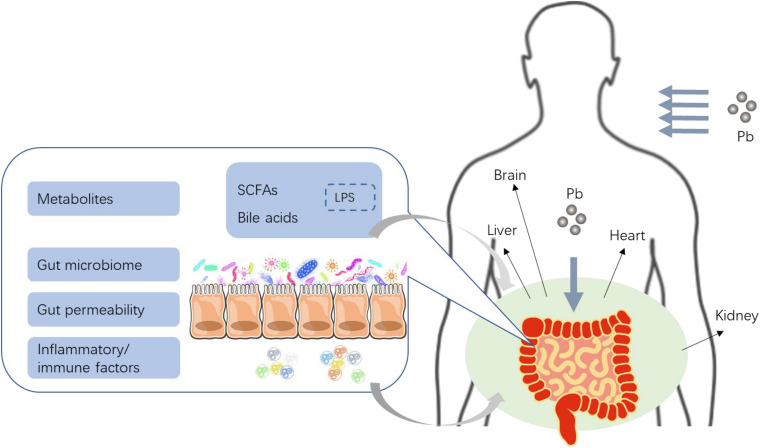
Lead (Pb) is a toxic heavy metal, having profound threats to the global population. Multiple organs such as kidney, and liver, as well as nervous, hematologic, and reproductive systems, are commonly considered the targets of Pb toxicity. Increasing researches reported that the effects of Pb on gastrointestinal tracts are equally intensive, especially on intestinal microbiota. This review summarized Pb toxicity on gut physiology and microbiota in different animal models and in humans, of which the alterations may further have effects on other organs in host. To be more specific, Pb can impair gut barrier and increase gut permeability, which make inflammatory cytokines, immunologic factors, as well as microbial metabolites such as bile acids (BA) and short-chain fatty acids (SCFAs) enter the enterohepatic circulation easily, and finally induce multiple systematic lesion. In addition, we emphasized that probiotic treatment may be one of the feasible and effective strategies for preventing Pb toxicity.
铅(Pb)是一种有毒重金属,对全球人口构成严重威胁。肾脏、肝脏等多个器官以及神经、血液和生殖系统通常被认为是铅毒性的靶器官。越来越多的研究报告称,铅对胃肠道的影响同样强烈,尤其是对肠道微生物群。本综述总结了铅在不同动物模型和人类中对肠道生理和微生物群的毒性,其中这些改变可能会进一步影响宿主的其他器官。更具体地说,铅会损害肠道屏障并增加肠道通透性,这使得炎性细胞因子、免疫因子以及胆汁酸(BA)和短链脂肪酸(SCFAs)等微生物代谢产物容易进入肠肝循环,最终引发多系统病变。此外,我们强调益生菌治疗可能是预防铅毒性的可行且有效策略之一。