Reale Marcella, Costantini Erica, Greig Nigel H
Department of Medical, Oral and Biotechnological Sciences, University "G. d'Annunzio" Chieti-Pescara, Chieti, Italy.
Drug Design and Development Section, Translational Gerontology Branch, Intramural Research Program, National Institute on Aging, National Institutes of Health, Baltimore, MD, United States.
Front Psychiatry. 2021 Mar 5;12:536257. doi: 10.3389/fpsyt.2021.536257. eCollection 2021.
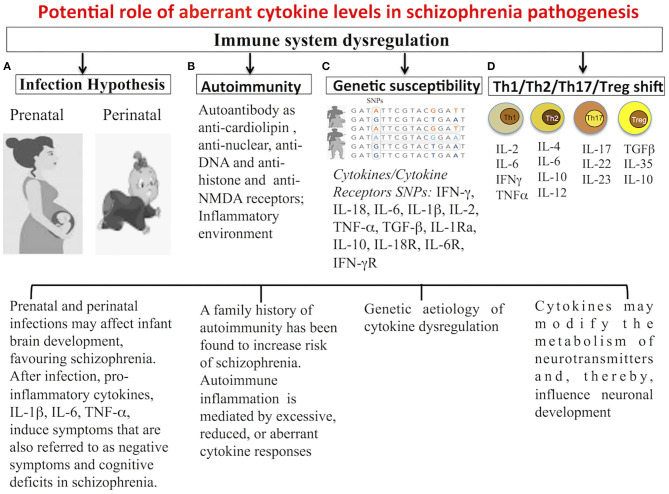
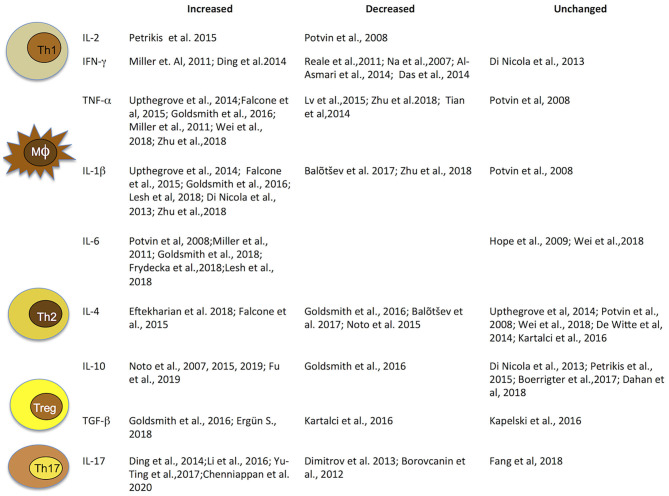
Cytokines are one of the most important components of the immune system. They orchestrate the brain's response to infectious and other exogenous insults and are crucial mediators of the cross-talk between the nervous and immune systems. Epidemiological studies have demonstrated that severe infections and autoimmune disorders, in addition to genetic predisposition, are risk factors for schizophrenia. Furthermore, maternal infection during pregnancy appears to increase the risk of schizophrenia, and proinflammatory cytokines may be negatively involved in the neurodevelopmental process. A cytokine imbalance has been described in the blood and cerebrospinal fluid of schizophrenia patients, particularly in the T helper type 1 [Th1] and type 2 [Th2] cytokines, albeit the results of such studies appear to be contradictory. Chronic stress, likewise, appears to contribute to a lasting proinflammatory state and likely also promotes the disorder. The aim of this mini-review is to investigate the roles of different cytokines in the pathophysiology of schizophrenia and define how cytokines may represent key molecular targets to regulate for the prevention and treatment of schizophrenia. How current antipsychotic drugs impact cytokine networks is also evaluated. In this context, we propose to change the focus of schizophrenia from a traditionally defined brain disorder, to one that is substantially impacted by the periphery and immune system.
细胞因子是免疫系统最重要的组成部分之一。它们协调大脑对感染及其他外源性损伤的反应,是神经和免疫系统之间相互作用的关键介质。流行病学研究表明,除了遗传易感性外,严重感染和自身免疫性疾病也是精神分裂症的危险因素。此外,孕期母亲感染似乎会增加精神分裂症的风险,促炎细胞因子可能对神经发育过程产生负面影响。精神分裂症患者的血液和脑脊液中存在细胞因子失衡,特别是在1型辅助性T细胞(Th1)和2型辅助性T细胞(Th2)细胞因子方面,尽管此类研究结果似乎相互矛盾。同样,慢性应激似乎会导致持久的促炎状态,也可能促进该疾病的发展。本综述的目的是研究不同细胞因子在精神分裂症病理生理学中的作用,并确定细胞因子如何成为预防和治疗精神分裂症的关键分子调控靶点。同时还评估了当前抗精神病药物如何影响细胞因子网络。在此背景下,我们建议将精神分裂症的关注点从传统定义的脑部疾病,转变为一种受到外周和免疫系统显著影响的疾病。