Wang I-Lin, Chen Yi-Ming, Zhang Ke-Ke, Li Yu-Ge, Su Yu, Wu Chou, Ho Chun-Sheng
College of Physical Education, Hubei Normal University, Huangshi 435002, China.
Graduate Institute, Jilin Sport University, Changchun, 130022 Jilin, China.
Appl Bionics Biomech. 2021 Mar 3;2021:5551199. doi: 10.1155/2021/5551199. eCollection 2021.
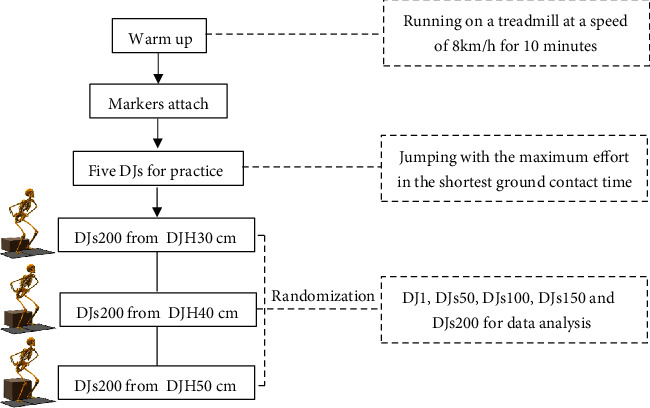
Drop jump (DJ) is often used as a plyometric exercise to improve jumping performance. Training from improper drop heights and for improper durations lead to unfavorable biomechanical changes in the lower extremities when landing, which result in reduced training effects and even lower extremity injuries. . To study the effects of repeated DJ training at drop heights of 30 cm, 40 cm, and 50 cm (drop jump height (DJH) 30, DJH40, and DJH50) on lower extremity kinematics and kinetics. The 1st, 50th, 100th, 150th, and 200th DJs (DJ1, DJs50, DJs100, DJs150, and DJs200) were recorded by using a BTS motion capture system and force platform. The MATLAB software was used to compare the kinematic and stiffness data of DJ1, DJs50, DJs100, DJs150, and DJs200 with one-way ANOVA repeated measure. If there were significant differences, the LSD method was used for post hoc comparisons. . Twenty healthy male Division III athlete volunteers were selected as subjects, and 200 drop jumps (DJs200) were performed from DJH30, DJH40, and DJH50. . The jumping height (JH), contact time (CT), and GRF increased with drop height, and the stiffness of the legs and ankle at DJH30 was higher than that at DJH40 and DJH50 ( < 0.05). . Within DJs200, training at DJH50 yield the high impact easily leads to lower extremity injury; training at DJH30 can increase the stiffnesses of the legs and ankle joints, thus effectively utilizing the SSC benefits to store and release elastic energy, reducing the risk of lower extremity musculoskeletal injury. Therefore, coaches can choose different drop heights and training quantities for each person to better prevent lower extremity injury.
跳深(DJ)常被用作一种增强式训练来提高跳跃能力。从不当的跳下高度和进行不当的训练时长会导致着陆时下肢出现不利的生物力学变化,进而导致训练效果降低甚至下肢受伤。为研究在30厘米、40厘米和50厘米跳下高度(跳深高度(DJH)30、DJH40和DJH50)进行重复跳深训练对下肢运动学和动力学的影响。使用BTS运动捕捉系统和测力平台记录第1次、第50次、第100次、第150次和第200次跳深(DJ1、DJs50、DJs100、DJs150和DJs200)。使用MATLAB软件通过单向方差分析重复测量来比较DJ1、DJs50、DJs100、DJs150和DJs200的运动学和刚度数据。若存在显著差异,则使用最小显著差法进行事后比较。选取20名健康的男子三级运动员志愿者作为受试者,从DJH30、DJH40和DJH50进行200次跳深(DJs200)。跳跃高度(JH)、接触时间(CT)和地面反作用力(GRF)随跳下高度增加,且DJH30时腿部和脚踝的刚度高于DJH40和DJH50时(<0.05)。在DJs200内,DJH50的训练容易产生高冲击力,易导致下肢受伤;DJH30的训练可增加腿部和踝关节的刚度,从而有效利用肌肉收缩-放松周期的益处来储存和释放弹性能量,降低下肢肌肉骨骼受伤风险。因此,教练可为每个人选择不同的跳下高度和训练量,以更好地预防下肢受伤。