Osmanovic Alma, Ranxha Gresa, Kumpe Mareike, Wurster Claudia D, Stolte Benjamin, Cordts Isabell, Günther René, Freigang Maren, Müschen Lars H, Binz Camilla, Hermann Andreas, Deschauer Marcus, Lingor Paul, Ludolph Albert C, Hagenacker Tim, Schreiber-Katz Olivia, Petri Susanne
Department of Neurology, Hannover Medical School, Carl-Neuberg-Strasse 1, Hannover 30625, Germany.
Department of Neurology, Hannover Medical School, Hannover, Germany.
Ther Adv Neurol Disord. 2021 Mar 5;14:1756286421998902. doi: 10.1177/1756286421998902. eCollection 2021.
Nusinersen was the first approved disease-modifying therapy for all 5q-spinal muscular atrophy (SMA) patients regardless of age or disease severity. Its efficacy in adults has recently been demonstrated in a large cohort by motor outcome measures, which were only partially suitable to detect changes in very mildly or severely affected patients. Patient-reported outcome measures (PROs) have been suggested as a valuable addition. Here, we aimed to assess treatment satisfaction and investigate whether it may be a useful PRO to monitor SMA patients.
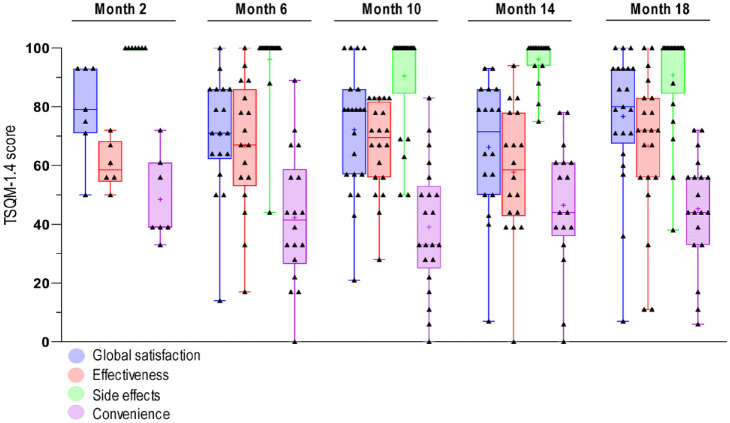
We enrolled 91 mainly adult 5q-SMA patients treated with nusinersen in a national, multicenter, cross-sectional observational study. 21 patients underwent longitudinal follow up. Patients' satisfaction with treatment in four dimensions (global, effectiveness, convenience, side effects) was assessed by the Treatment Satisfaction Questionnaire for Medication German version 1.4 (TSQM-1.4) and related to clinical parameters, motor scores, and treatment duration.
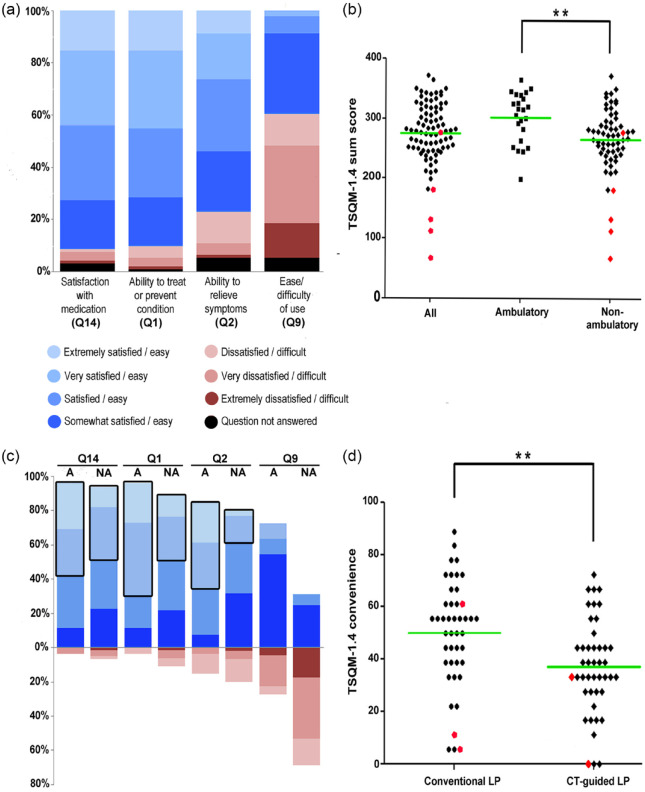
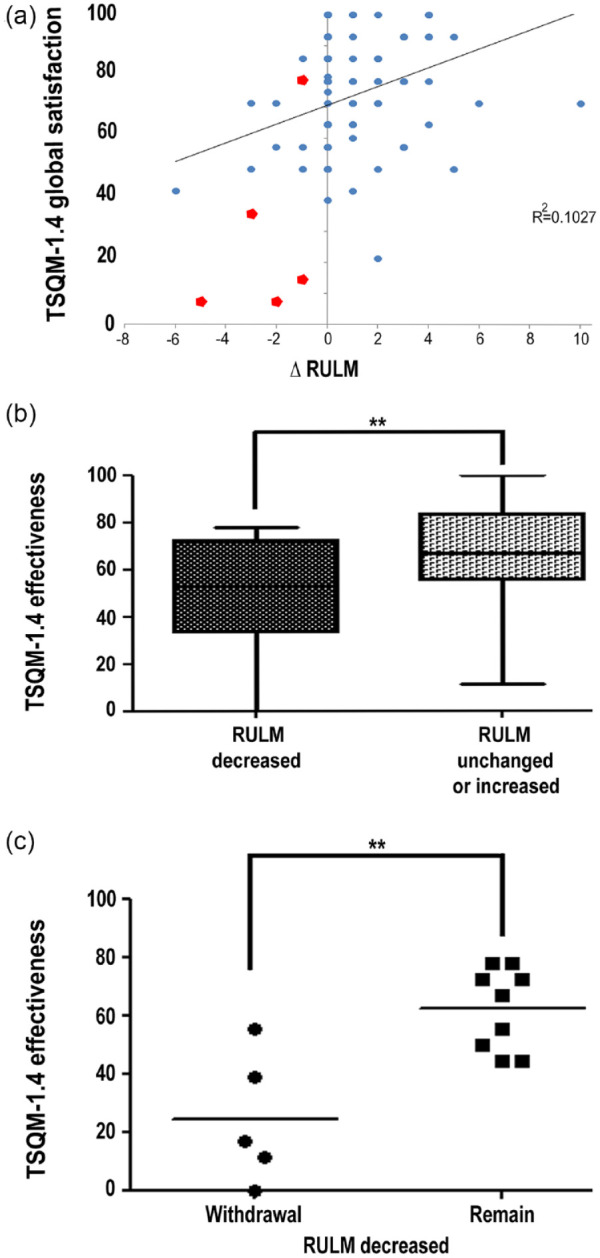
More than 90% of SMA patients were consistently satisfied over a median treatment duration of 10 months. Highest mean scores were observed in the dimensions 'side effects,' 'global satisfaction,' and 'effectiveness' (93.5 ± 14.8 73.1 ± 21.0 and 64.8 ± 20.6, respectively). Patients' satisfaction with the convenience of treatment was considerably lower (43.6 ± 20.2). Interestingly, satisfaction with the effectiveness was higher in ambulatory ( = 0.014) compared with non-ambulatory patients and directly correlated to motor outcome measures. Five non-ambulatory patients withdrew from therapy. All of them presented with a deterioration of motor outcome measures and reported dissatisfaction with treatment effectiveness and convenience.
Most patients were satisfied with nusinersen treatment effectiveness. Less severely affected patients indicated higher satisfaction. The TSQM-1.4 helped to identify therapy non-responders, who mainly addressed dissatisfaction with effectiveness and convenience. We suggest introducing the TSQM-1.4 as an additional PRO in SMA into clinical practice.
对于所有5q型脊髓性肌萎缩症(SMA)患者,无论其年龄或疾病严重程度如何,诺西那生钠是首个获批的疾病修饰疗法。最近在一个大型队列中通过运动结局指标证实了其在成人患者中的疗效,不过这些指标仅部分适用于检测极轻度或重度受累患者的变化。有人建议增加患者报告结局指标(PRO)。在此,我们旨在评估治疗满意度,并调查其是否可能是监测SMA患者的有用PRO。
我们在一项全国性、多中心、横断面观察性研究中纳入了91例主要为成人的接受诺西那生钠治疗的5q-SMA患者。21例患者接受了纵向随访。通过药物治疗满意度问卷德文版1.4(TSQM-1.4)评估患者在四个维度(总体、有效性、便利性、副作用)上对治疗的满意度,并将其与临床参数、运动评分和治疗持续时间相关联。
在中位治疗持续时间10个月内,超过90%的SMA患者持续感到满意。在“副作用”“总体满意度”和“有效性”维度上观察到的平均得分最高(分别为93.5±14.8、73.1±21.0和64.8±20.6)。患者对治疗便利性的满意度相当低(43.6±20.2)。有趣的是,与非行走患者相比,行走患者对有效性的满意度更高(=0.014),且与运动结局指标直接相关。5例非行走患者退出治疗。他们均出现运动结局指标恶化,并报告对治疗有效性和便利性不满意。
大多数患者对诺西那生钠治疗的有效性感到满意。受累程度较轻的患者满意度更高。TSQM-1.4有助于识别治疗无反应者,他们主要表达了对有效性和便利性的不满。我们建议将TSQM-1.4作为SMA的一项额外PRO引入临床实践。