Jiang Huigang, Xiao Li, Jin Kunlin, Shao Bei
Department of Neurology, Yiwu City Center Hospital, Wenzhou Medical University, Yiwu, Zhejiang 322000, P.R. China.
Department of Neurology, Shaoyang City Center Hospital, Shaoyang, Hunan 422000, P.R. China.
Exp Ther Med. 2021 May;21(5):433. doi: 10.3892/etm.2021.9850. Epub 2021 Feb 26.
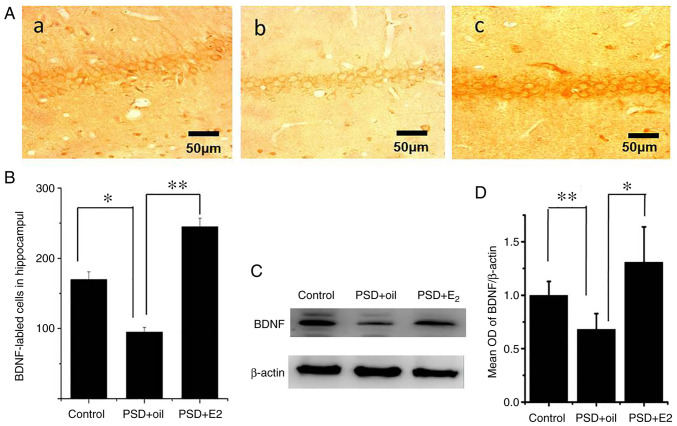
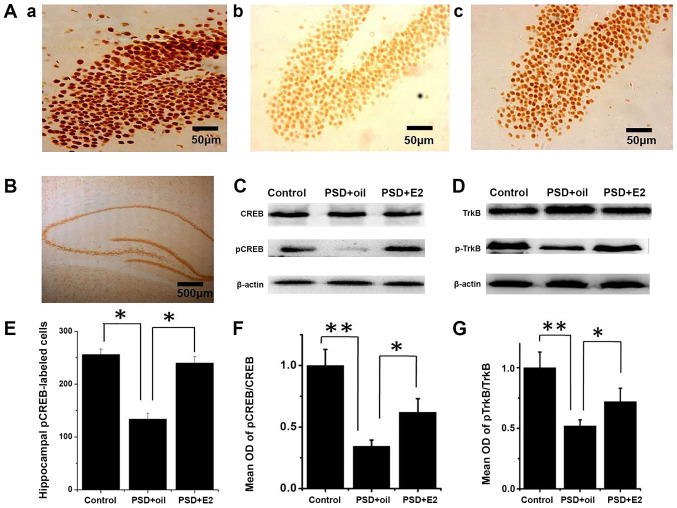
A previous study demonstrated that 17β-estradiol (E2), which is an antidepressant, can ameliorate post-stroke depression (PSD); however, the underlying mechanisms governing this remain largely unknown. Therefore, the present study developed a PSD model in rats, which was induced by left middle cerebral artery occlusion followed by exposure to chronic mild stress for 2 weeks. The results revealed that the activity of the cAMP response element-binding protein (CREB), a cellular transcription factor, and the associated brain-derived neurotrophic factor (BDNF)/tyrosine kinase B (TrkB) signaling were all attenuated in the hippocampus in PSD rats. The depression-like behaviors were significantly improved after treatment with E2, along with increased CREB and the BDNF/TrkB signaling activity. These results provide novel insight into the molecular basis of PSD, and suggest the potential involvement of CREB/BDNF/TrkB signaling in E2-mediated improvement of PSD in rats.
先前的一项研究表明,作为一种抗抑郁药的17β-雌二醇(E2)可改善中风后抑郁症(PSD);然而,其潜在机制在很大程度上仍不清楚。因此,本研究建立了大鼠PSD模型,该模型通过左侧大脑中动脉闭塞并随后暴露于慢性轻度应激2周诱导而成。结果显示,细胞转录因子环磷酸腺苷反应元件结合蛋白(CREB)的活性以及相关的脑源性神经营养因子(BDNF)/酪氨酸激酶B(TrkB)信号通路在PSD大鼠的海马体中均减弱。用E2治疗后,抑郁样行为得到显著改善,同时CREB以及BDNF/TrkB信号通路活性增加。这些结果为PSD的分子基础提供了新的见解,并表明CREB/BDNF/TrkB信号通路可能参与E2介导的大鼠PSD改善过程。