Shah Imran Ullah, Sameen Aysha, Manzoor Muhammad Faisal, Ahmed Zahoor, Gao Jian, Farooq Umar, Siddiqi Sultan Mehmood, Siddique Rabia, Habib Adnan, Sun Changhao, Siddeeg Azhari
Department of Nutrition and Food Hygiene College of Public Health Harbin Medical University Heilongjiang China.
Faculty of Food Nutrition and Home Sciences National Institute of Food Science and Technology University of Agriculture Faisalabad Pakistan.
Food Sci Nutr. 2021 Jan 27;9(3):1480-1490. doi: 10.1002/fsn3.2118. eCollection 2021 Mar.
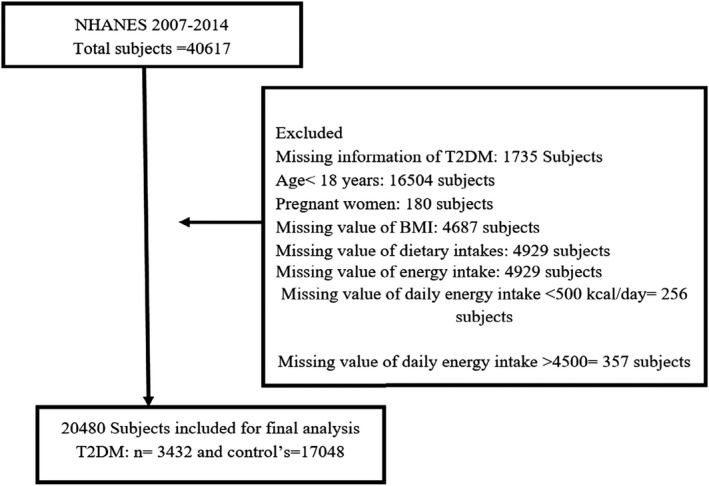
Higher dietary intake of calcium (Ca), magnesium (Mg), and vitamin D has been associated with reduced risk of type 2 diabetes (T2DM), and a higher intracellular ratio of Ca to Mg leads to insulin resistance. Previous epidemiological studies did not examine the combined effects of dietary Ca, Mg, and vitamin D as well as ratio of Ca to Mg with T2DM. Therefore, we assessed the relationship between dietary intakes of Mg, Ca, and vitamin D (using 24-hr recalls) individually and in composite and T2DM in the National Health and Nutrition Examination Survey 2007-2014, which involved 20,480 adults (9,977 men and 10,503 women) with comprehensive information on related nutrients, and anthropometric, demographic, and biomarker variables using multivariable logistic regression. The results indicated that dietary calcium at Q3 (812 mg/day) was significantly linked with T2DM in women (OR: 1.30; 95% CI: 1.02, 1.65). Dietary vitamin D at Q3 (5.25 μg/day) significantly reduced the odds of T2DM by 21% in men (OR: 0.79; 95% CI: 0.64, 0.98). This is an interesting study that has important implications for dietary recommendations. It is concluded that US adults having dietary Ca below the RDA were associated with increased risk of T2DM in all population and women, while higher ratio of Ca to Mg was associated with increased risk of T2DM in all population and increased vitamin D intake is related to decreased risk of T2DM in men. Moreover, further research is needed to make more definitive nutritional recommendations.
饮食中钙(Ca)、镁(Mg)和维生素D的摄入量较高与2型糖尿病(T2DM)风险降低有关,而细胞内钙与镁的比例较高会导致胰岛素抵抗。以往的流行病学研究未考察饮食中钙、镁、维生素D以及钙与镁的比例与T2DM的综合影响。因此,我们在2007 - 2014年美国国家健康和营养检查调查中,使用多变量逻辑回归评估了镁、钙和维生素D的饮食摄入量(采用24小时回忆法)单独及综合情况与T2DM之间的关系,该调查涉及20480名成年人(9977名男性和10503名女性),他们拥有相关营养素、人体测量学、人口统计学和生物标志物变量的全面信息。结果表明,处于第三四分位数(812毫克/天)的饮食钙与女性的T2DM显著相关(比值比:1.30;95%置信区间:1.02,1.65)。处于第三四分位数(5.25微克/天)的饮食维生素D使男性患T2DM的几率显著降低21%(比值比:0.79;95%置信区间:0.64,0.98)。这是一项有趣的研究,对饮食建议具有重要意义。研究得出结论,饮食钙低于推荐膳食摄入量(RDA)的美国成年人在所有人群和女性中患T2DM的风险增加,而钙与镁的比例较高在所有人群中与T2DM风险增加相关,维生素D摄入量增加与男性T2DM风险降低相关。此外,需要进一步研究以做出更明确的营养建议。