Tuominen Jarno, Kallio Sakari, Kaasinen Valtteri, Railo Henry
Department of Psychology and Speech-Language Pathology, Assistentinkatu 7, 20014 University of Turku, Turku, Finland.
Turku Brain and Mind Center, 20014 University of Turku, Turku, Finland.
Neurosci Conscious. 2021 Mar 10;2021(1):niab002. doi: 10.1093/nc/niab002. eCollection 2021.
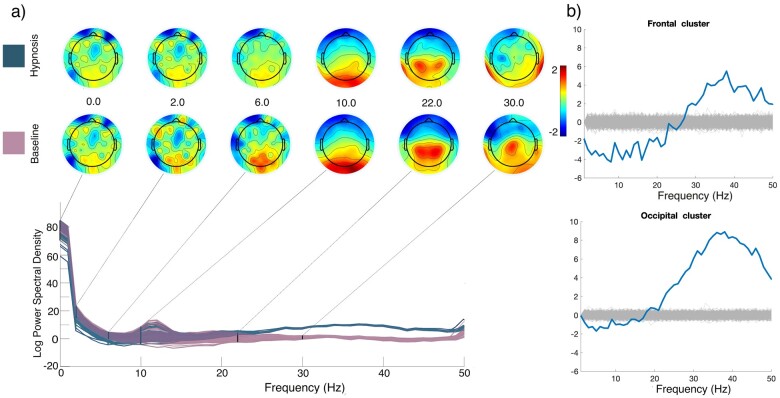
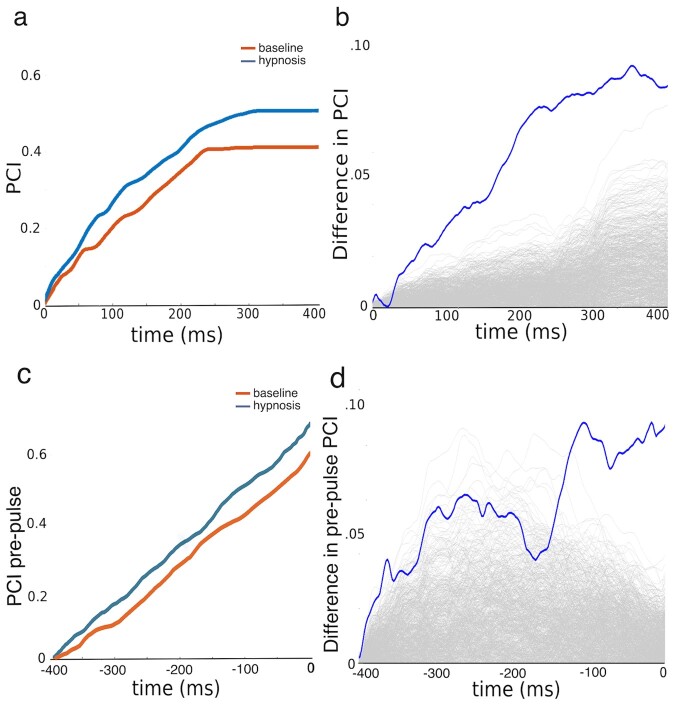
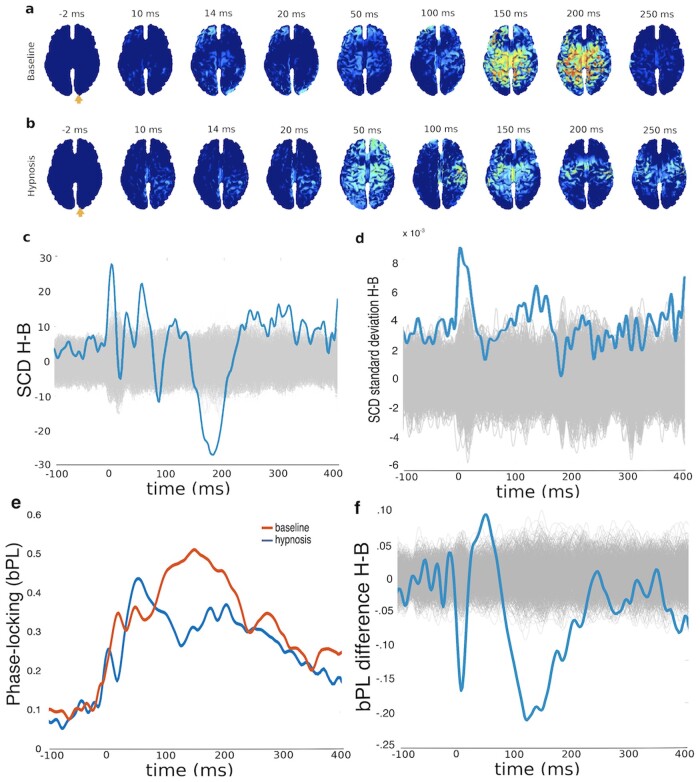
Can the brain be shifted into a different state using a simple social cue, as tests on highly hypnotizable subjects would suggest? Demonstrating an altered global brain state is difficult. Brain activation varies greatly during wakefulness and can be voluntarily influenced. We measured the complexity of electrophysiological response to transcranial magnetic stimulation in one 'hypnotic virtuoso'. Such a measure produces a response arguably outside the subject's voluntary control and has been proven adequate for discriminating conscious from unconscious brain states. We show that a single-word hypnotic induction robustly shifted global neural connectivity into a state where activity remained sustained but failed to ignite strong, coherent activity in frontoparietal cortices. Changes in perturbational complexity indicate a similar move towards a more segregated state. We interpret these findings to suggest a shift in the underlying state of the brain, likely moderating subsequent hypnotic responding.
正如对高度易受催眠的受试者的测试所表明的那样,能否通过一个简单的社会暗示就将大脑转变为一种不同的状态呢?证明大脑的整体状态发生改变是困难的。大脑激活在清醒状态下变化很大,并且会受到自主影响。我们测量了一位“催眠大师”对经颅磁刺激的电生理反应的复杂性。这样一种测量产生的反应可以说是超出了受试者的自主控制范围,并且已被证明足以区分有意识和无意识的大脑状态。我们表明,一个单词的催眠诱导有力地将整体神经连接转变为一种状态,在这种状态下活动持续存在,但未能在额顶叶皮层引发强烈、连贯的活动。微扰复杂性的变化表明向一种更加分离的状态发生了类似的转变。我们对这些发现的解释是,大脑的潜在状态发生了转变,这可能会调节随后的催眠反应。