Wang Zihao, Ji Xin, Gao Lu, Guo Xiaopeng, Lian Wei, Deng Kan, Xing Bing
Department of Neurosurgery, Peking Union Medical College Hospital, Chinese Academy of Medical Sciences and Peking Union Medical College, Beijing, China.
China Pituitary Disease Registry Center, Chinese Pituitary Adenoma Cooperative Group, Beijing, China.
Front Oncol. 2021 Mar 5;11:553594. doi: 10.3389/fonc.2021.553594. eCollection 2021.
Glioblastoma (GBM) is one of the most aggressive brain tumors with high mortality, and tumor-derived exosomes provide new insight into the mechanisms of GBM tumorigenesis, metastasis and therapeutic resistance. We aimed to establish an exosome-derived competitive endogenous RNA (ceRNA) network for constructing a prognostic model for GBM.
We obtained the expression profiles of long noncoding RNAs (lncRNAs), miRNAs, and mRNAs from the GEO and TCGA databases and identified differentially expressed RNAs in GBM to construct a ceRNA network. By performing lasso and multivariate Cox regression analyses, we identified optimal prognosis-related differentially expressed lncRNAs (DElncRNAs) and generated a risk score model termed the exosomal lncRNA (exo-lncRNA) signature. The exo-lncRNA signature was subsequently validated in the CGGA GBM cohort. Finally, a novel prognostic nomogram was constructed based on the exo-lncRNA signature and clinicopathological parameters and validated in the CGGA external cohort. Based on the ceRNA hypothesis, oncocers were identified based on highly positive correlations between lncRNAs and mRNAs mediated by the same miRNAs. Furthermore, regression analyses were performed to assess correlations between the expression abundances of lncRNAs in tumors and exosomes.
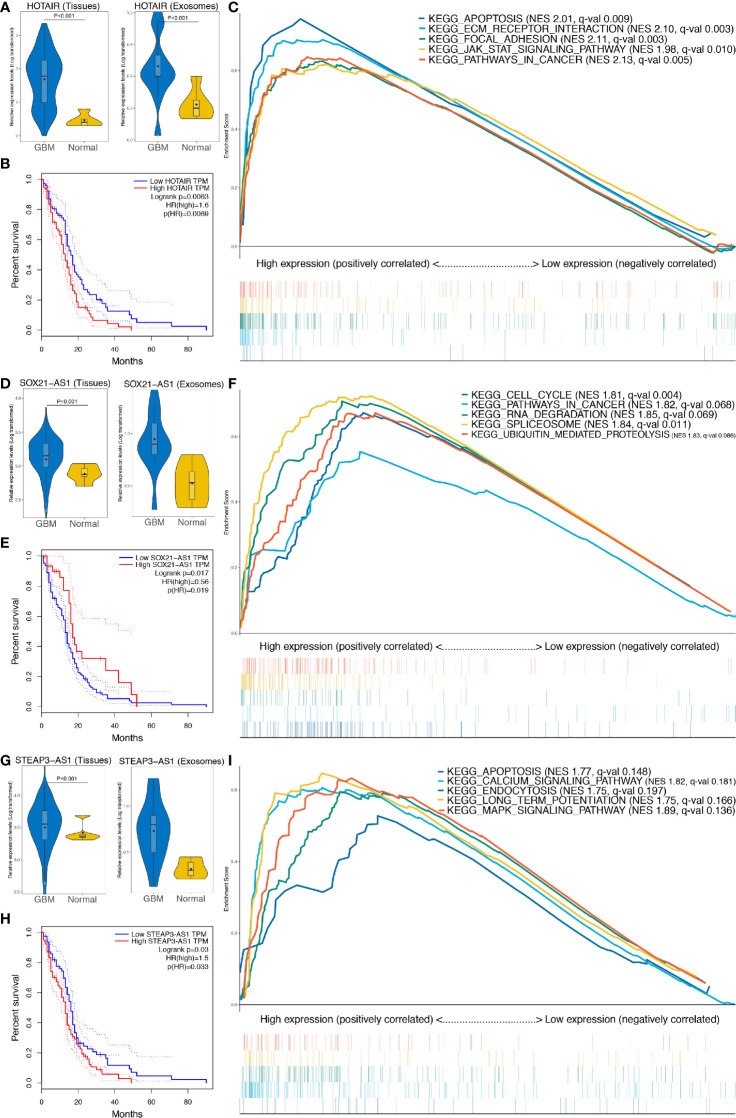
A total of 45 DElncRNAs, six DEmiRNAs, and 38 DEmRNAs were identified, and an exosome-derived ceRNA network was built. Three optimal prognostic-related DElncRNAs, HOTAIR (HR=0.341, P<0.001), SOX21-AS1 (HR=0.30, P<0.001), and STEAP3-AS1 (HR=2.47, P<0.001), were included to construct the exo-lncRNA signature, which was further proven to be an independent prognostic factor. The novel prognostic nomogram was constructed based on the exo-lncRNA signature, patient age, pharmacotherapy, radiotherapy, IDH mutation status, and MGMT promoter status, with a concordance index of 0.878. ROC and calibration plots both suggested that the nomogram had beneficial discrimination and predictive abilities. A total of 11 pairs of prognostic oncocers were identified. Regression analysis suggested excellent consistency of the expression abundance of the three exosomal lncRNAs between exosomes and tumor tissues.
Exosomal lncRNAs may serve as promising prognostic predictors and therapeutic targets. The prognostic nomogram based on the exo-lncRNA signature might provide an intuitive method for individualized survival prediction and facilitate better treatment strategies.
胶质母细胞瘤(GBM)是最具侵袭性的脑肿瘤之一,死亡率高,肿瘤来源的外泌体为GBM肿瘤发生、转移和治疗耐药机制提供了新的见解。我们旨在建立一个外泌体来源的竞争性内源RNA(ceRNA)网络,以构建GBM的预后模型。
我们从GEO和TCGA数据库中获取长链非编码RNA(lncRNA)、微小RNA(miRNA)和信使RNA(mRNA)的表达谱,并鉴定GBM中差异表达的RNA以构建ceRNA网络。通过进行套索回归和多变量Cox回归分析,我们鉴定出最佳的预后相关差异表达lncRNA(DElncRNA),并生成一个称为外泌体lncRNA(exo-lncRNA)特征的风险评分模型。随后在CGGA GBM队列中验证exo-lncRNA特征。最后,基于exo-lncRNA特征和临床病理参数构建了一个新的预后列线图,并在CGGA外部队列中进行验证。基于ceRNA假说,根据由相同miRNA介导的lncRNA和mRNA之间的高度正相关来鉴定癌共调控因子。此外,进行回归分析以评估肿瘤和外泌体中lncRNA表达丰度之间的相关性。
共鉴定出45个DElncRNA、6个DEmiRNA和38个DEmRNA,并构建了一个外泌体来源的ceRNA网络。纳入三个最佳的预后相关DElncRNA,即HOTAIR(HR = 0.341,P < 0.001)、SOX21-AS1(HR = 0.30,P < 0.001)和STEAP3-AS1(HR = 2.47,P < 0.001)来构建exo-lncRNA特征,进一步证明其为独立的预后因素。基于exo-lncRNA特征、患者年龄、药物治疗、放疗、异柠檬酸脱氢酶(IDH)突变状态和O6-甲基鸟嘌呤-DNA甲基转移酶(MGMT)启动子状态构建了新的预后列线图,一致性指数为0.878。受试者工作特征(ROC)曲线和校准图均表明列线图具有良好的区分度和预测能力。共鉴定出11对预后癌共调控因子。回归分析表明外泌体和肿瘤组织中三种外泌体lncRNA的表达丰度具有良好的一致性。
外泌体lncRNA可能是有前景的预后预测指标和治疗靶点。基于exo-lncRNA特征的预后列线图可能为个体化生存预测提供一种直观的方法,并有助于制定更好的治疗策略。