Murphy Margaret O, Huang Hong, Bauer John A, Schadler Aric, Makhoul Majd, Clasey Jody L, Chishti Aftab S, Kiessling Stefan G
Division of Pediatric Nephrology, Department of Pediatrics, University of Kentucky, Lexington, KY, United States.
Department of Pediatrics, University of Kentucky, Lexington, KY, United States.
Front Pediatr. 2021 Mar 4;9:596142. doi: 10.3389/fped.2021.596142. eCollection 2021.
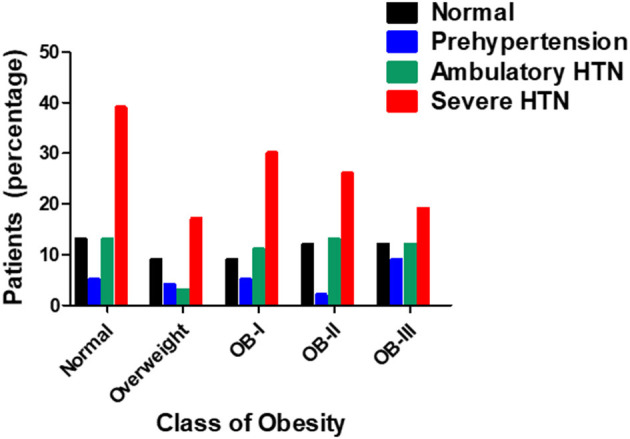
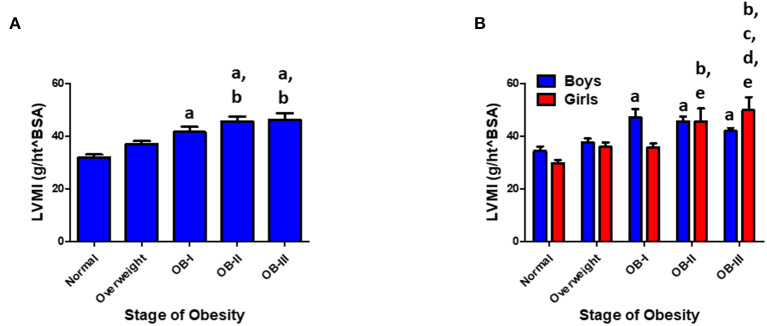
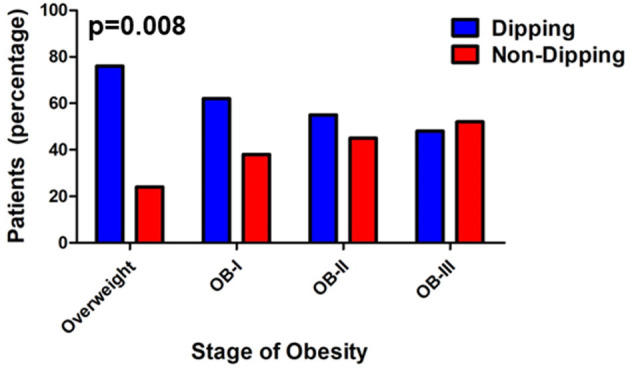
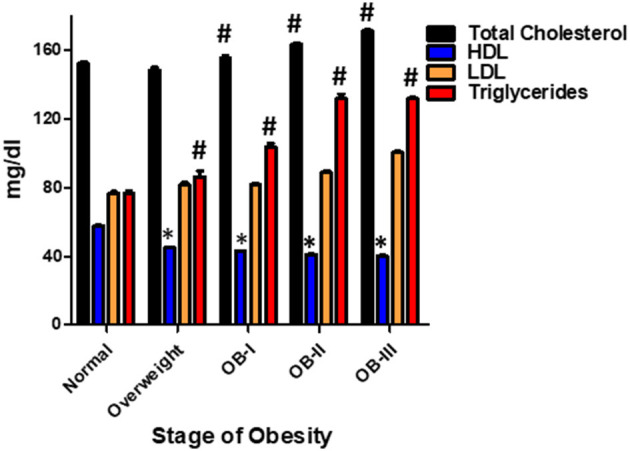
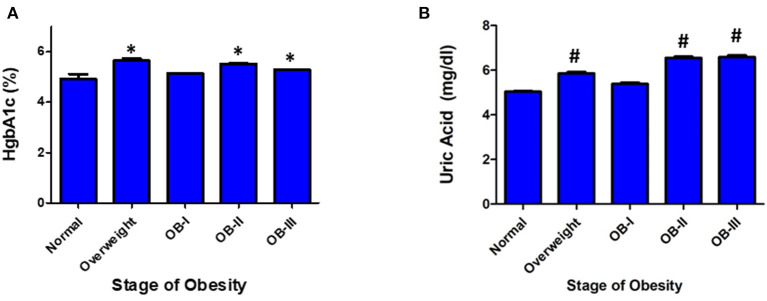
The prevalence of hypertension is increasing particularly among obese children and adolescents. Obese children and adolescents with hypertension are likely to remain hypertensive as they reach adulthood and hypertension is linked to an increased risk for cardiovascular disease. Twenty-four-hour ambulatory blood pressure monitoring (ABPM) has become one of the most important tools in diagnosing hypertension in children and adolescents and circadian patterns of blood pressure may be important disease-risk predictors. A retrospective chart review was conducted in patients aged 6-21 years who underwent 24-h ABPM at Kentucky Children's Hospital (KCH) from August 2012 through June 2017. Exclusion criteria included conditions that could affect blood pressure including chronic kidney disease and other renal abnormalities, congenital heart disease, cancer, and thyroid disease. Subjects were categorized by body mass index into normal (below 85th percentile), overweight (85th-95th percentile), stage I obesity (95th-119th percentile), stage II obesity (120th-139th) and stage III obesity (>140th). Non-dipping was defined as a nocturnal BP reduction of <10%. Two hundred and sixty-three patients (156 male patients) were included in the analysis, of whom 70 were normal weight, 33 overweight, 55 stage I obesity, 53 stage II, and 52 stage III obesity. Although there was no significant difference between normal weight and obese groups for prevalence of hypertension, there was a greater prevalence of SBP non-dipping in obese patients as BMI increased ( = 0.008). Furthermore, non-dippers had a significantly elevated LVMI as well as abnormal lab values for uric acid, blood lipid panel, creatinine, and TSH ( < 0.05). These findings demonstrate that obese children and adolescents constitute a large proportion of hypertensive children and adolescents and the severity of pediatric obesity is associated with nocturnal BP non-dipping. Additionally, obesity in children is linked to several cardiovascular risk factors including left ventricular hypertrophy, dyslipidemia, and elevated uric acid levels. Further studies utilizing ABPM measures on risk stratification in this very high-risk population are warranted.
高血压的患病率正在上升,尤其是在肥胖儿童和青少年中。患有高血压的肥胖儿童和青少年成年后很可能仍患有高血压,且高血压与心血管疾病风险增加有关。24小时动态血压监测(ABPM)已成为诊断儿童和青少年高血压最重要的工具之一,血压的昼夜模式可能是重要的疾病风险预测指标。对2012年8月至2017年6月在肯塔基儿童医院(KCH)接受24小时ABPM的6至21岁患者进行了一项回顾性病历审查。排除标准包括可能影响血压的疾病,如慢性肾病和其他肾脏异常、先天性心脏病、癌症和甲状腺疾病。根据体重指数将受试者分为正常(低于第85百分位数)、超重(第85至95百分位数)、I期肥胖(第95至119百分位数)、II期肥胖(第120至139百分位数)和III期肥胖(>第140百分位数)。非勺型血压定义为夜间血压下降<10%。263名患者(156名男性患者)纳入分析,其中70名体重正常,33名超重,55名I期肥胖,53名II期肥胖,52名III期肥胖。虽然正常体重组和肥胖组在高血压患病率上没有显著差异,但随着BMI增加,肥胖患者收缩压非勺型血压的患病率更高(P = 0.008)。此外,非勺型血压者的左室质量指数显著升高,尿酸、血脂、肌酐和促甲状腺激素的实验室值也异常(P < 0.05)。这些发现表明,肥胖儿童和青少年在高血压儿童和青少年中占很大比例,儿童肥胖的严重程度与夜间血压非勺型血压有关。此外,儿童肥胖与多种心血管危险因素有关,包括左心室肥厚、血脂异常和尿酸水平升高。有必要对这一高危人群利用ABPM措施进行风险分层的进一步研究。