Yang Yue, Xu Jin, Ge Shuyu, Lai Liqin
Department of Pathology, Tongde Hospital of Zhejiang Province, Hangzhou, China.
Department of Otolaryngology, Tongde Hospital of Zhejiang Province, Hangzhou, China.
Front Med (Lausanne). 2021 Mar 3;8:649896. doi: 10.3389/fmed.2021.649896. eCollection 2021.
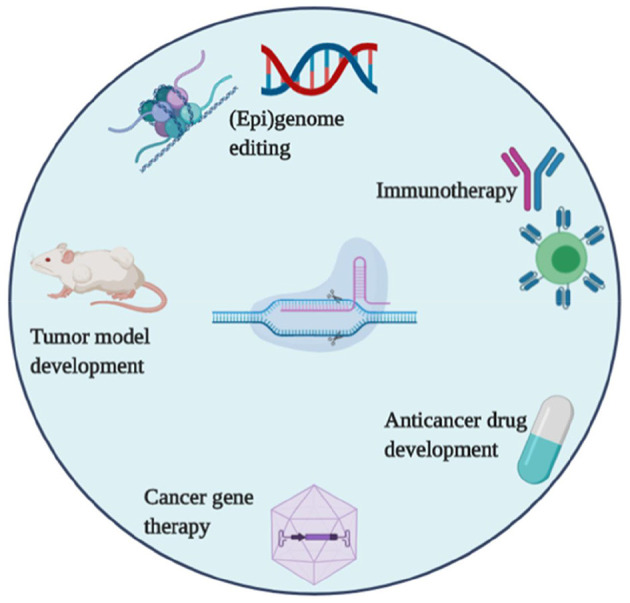
Cancer is one of the most leading causes of mortalities worldwide. It is caused by the accumulation of genetic and epigenetic alterations in 2 types of genes: tumor suppressor genes (TSGs) and proto-oncogenes. In recent years, development of the clustered regularly interspaced short palindromic repeats (CRISPR) technology has revolutionized genome engineering for different cancer research ranging for research ranging from fundamental science to translational medicine and precise cancer treatment. The CRISPR/CRISPR associated proteins (CRISPR/Cas) are prokaryote-derived genome editing systems that have enabled researchers to detect, image, manipulate and annotate specific DNA and RNA sequences in various types of living cells. The CRISPR/Cas systems have significant contributions to discovery of proto-oncogenes and TSGs, tumor cell epigenome normalization, targeted delivery, identification of drug resistance mechanisms, development of high-throughput genetic screening, tumor models establishment, and cancer immunotherapy and gene therapy in clinics. Robust technical improvements in CRISPR/Cas systems have shown a considerable degree of efficacy, specificity, and flexibility to target the specific locus in the genome for the desired applications. Recent developments in CRISPRs technology offers a significant hope of medical cure against cancer and other deadly diseases. Despite significant improvements in this field, several technical challenges need to be addressed, such as off-target activity, insufficient indel or low homology-directed repair (HDR) efficiency, delivery of the Cas system components, and immune responses. This study aims to overview the recent technological advancements, preclinical and perspectives on clinical applications of CRISPR along with their advantages and limitations. Moreover, the potential applications of CRISPR/Cas in precise cancer tumor research, genetic, and other precise cancer treatments discussed.
癌症是全球最主要的致死原因之一。它是由两类基因(肿瘤抑制基因和原癌基因)中的遗传和表观遗传改变的积累所引起的。近年来,成簇规律间隔短回文重复序列(CRISPR)技术的发展彻底改变了基因组工程,用于从基础科学到转化医学以及精准癌症治疗等不同的癌症研究。CRISPR/CRISPR相关蛋白(CRISPR/Cas)是源自原核生物的基因组编辑系统,使研究人员能够在各种类型的活细胞中检测、成像、操纵和注释特定的DNA和RNA序列。CRISPR/Cas系统对原癌基因和肿瘤抑制基因的发现、肿瘤细胞表观基因组正常化、靶向递送、耐药机制的鉴定、高通量基因筛查的发展、肿瘤模型的建立以及临床中的癌症免疫治疗和基因治疗都有重大贡献。CRISPR/Cas系统强大的技术改进已显示出在针对基因组中特定位点以实现所需应用方面具有相当程度的有效性、特异性和灵活性。CRISPR技术的最新进展为治愈癌症和其他致命疾病带来了巨大希望。尽管该领域有显著进展,但仍有一些技术挑战需要解决,如脱靶活性、插入缺失不足或同源定向修复(HDR)效率低、Cas系统组件的递送以及免疫反应。本研究旨在概述CRISPR的最新技术进展、临床前研究以及临床应用前景及其优缺点。此外,还讨论了CRISPR/Cas在精准癌症肿瘤研究、遗传学和其他精准癌症治疗中的潜在应用。