Saiboonjan Bhanubong, Roytrakul Sittiruk, Sangka Arunnee, Lulitanond Viraphong, Faksri Kiatichai, Namwat Wises
Department of Microbiology and Research and Diagnostic Center for Emerging Infectious Diseases (RCEID), Faculty of Medicine, Khon Kaen University, Khon Kaen, Thailand.
National Center for Genetic Engineering and Biotechnology (BIOTEC), National Science and Technology Development Agency (NSTDA), Rama VI Rd., Pathumthani, Thailand.
Biochem Biophys Rep. 2021 Mar 9;26:100960. doi: 10.1016/j.bbrep.2021.100960. eCollection 2021 Jul.
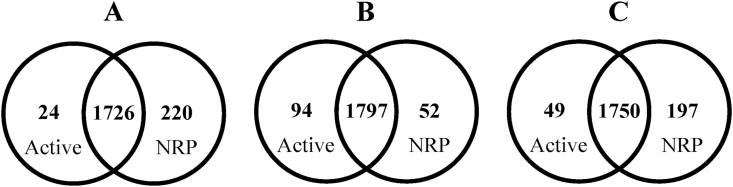
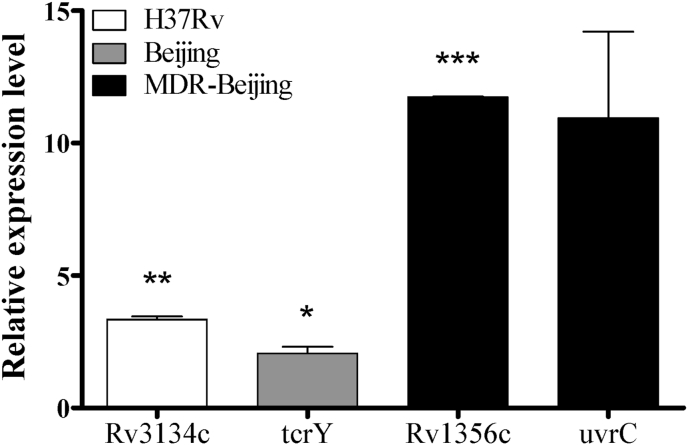
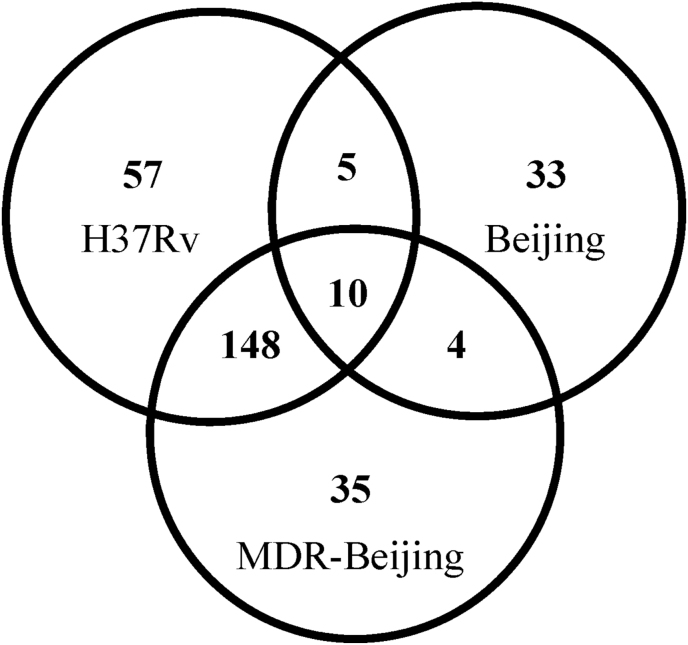
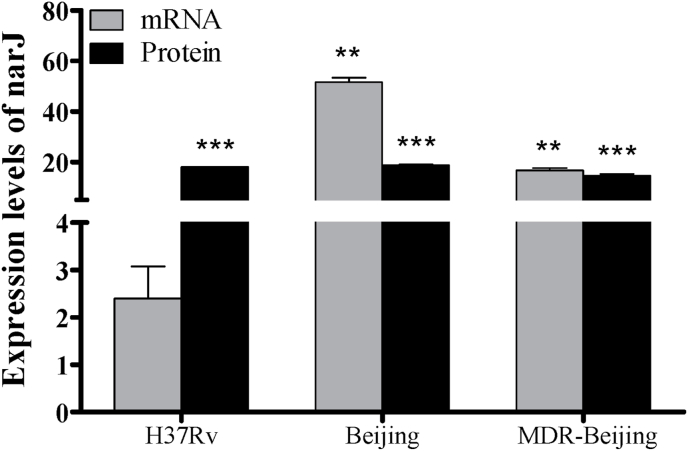
The existence of latent tuberculosis infection (LTBI) is one of the main obstacles hindering eradication of tuberculosis (TB). To better understand molecular mechanisms and explore biomarkers for the pathogen during LTBI, we cultured strains of () under stress conditions, mimicking those in the host granuloma intracellular environment, to induce entry into the non-replicating persistence stage. The stresses included hypoxia, low pH (5.0), iron deprivation (100 μM of 2, 2'-dipyridyl) and nutrient starvation (10% M7H9 medium). Three Mtb strains were studied: two clinical isolates (drug-susceptible Beijing (BJ) and multidrug-resistant Beijing (MDR-BJ) strains) and the reference laboratory strain, H37Rv. We investigated the proteomics profiles of these strains cultured in stressful conditions and then validated the findings by transcriptional analysis. NarJ (respiratory nitrate reductase delta chain) was significantly up-regulated at the protein level and the mRNA level in all three Mtb strains. The narJ gene is a member of the narGHJI operon encoding all nitrate reductase subunits, which play a role in nitrate metabolism during the adaptation of to stressful intracellular environments and the subsequent establishment of latent TB. The identification of up-regulated mRNAs and proteins of under stress conditions could assist development of biomarkers, drug targets and vaccine antigens.
潜伏性结核感染(LTBI)的存在是阻碍结核病(TB)根除的主要障碍之一。为了更好地理解分子机制并探索LTBI期间病原体的生物标志物,我们在模拟宿主肉芽肿细胞内环境的应激条件下培养了()菌株,以诱导其进入非复制性持续阶段。应激因素包括缺氧、低pH值(5.0)、铁缺乏(100μM 2,2'-联吡啶)和营养饥饿(10% M7H9培养基)。研究了三株结核分枝杆菌菌株:两株临床分离株(药敏北京(BJ)和耐多药北京(MDR-BJ)菌株)以及参考实验室菌株H37Rv。我们研究了这些菌株在应激条件下培养的蛋白质组学图谱,然后通过转录分析验证了研究结果。NarJ(呼吸硝酸盐还原酶δ链)在所有三株结核分枝杆菌菌株的蛋白质水平和mRNA水平上均显著上调。narJ基因是编码所有硝酸盐还原酶亚基的narGHJI操纵子的成员,在结核分枝杆菌适应应激性细胞内环境及随后潜伏性结核的形成过程中,这些亚基在硝酸盐代谢中发挥作用。在应激条件下鉴定结核分枝杆菌上调的mRNA和蛋白质有助于生物标志物、药物靶点和疫苗抗原的开发。