Kilpatrick Laura E, Hill Stephen J
Division of Bimolecular Sciences and Medicinal Chemistry, Biodiscovery Institute, School of Pharmacy, University of Nottingham, Nottingham, NG7 2RD, UK.
Centre of Membrane Proteins and Receptors (COMPARE), University of Birmingham and University of Nottingham, The Midlands, NG7 2UH, UK.
Curr Opin Endocr Metab Res. 2021 Feb;16:102-112. doi: 10.1016/j.coemr.2020.10.003.
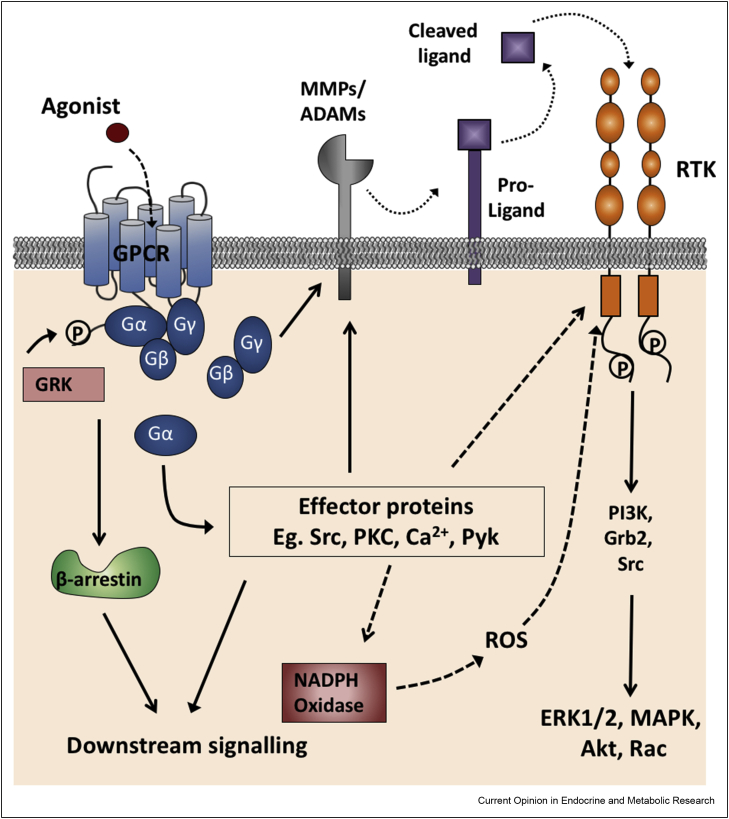
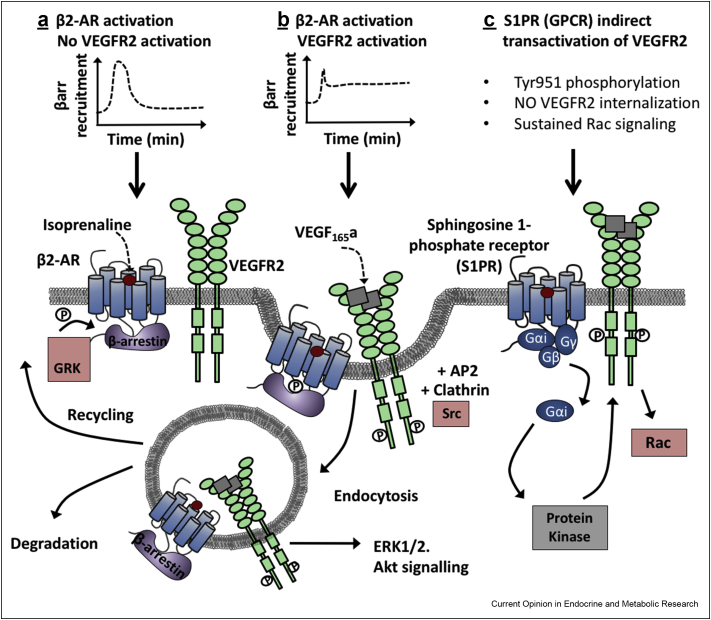
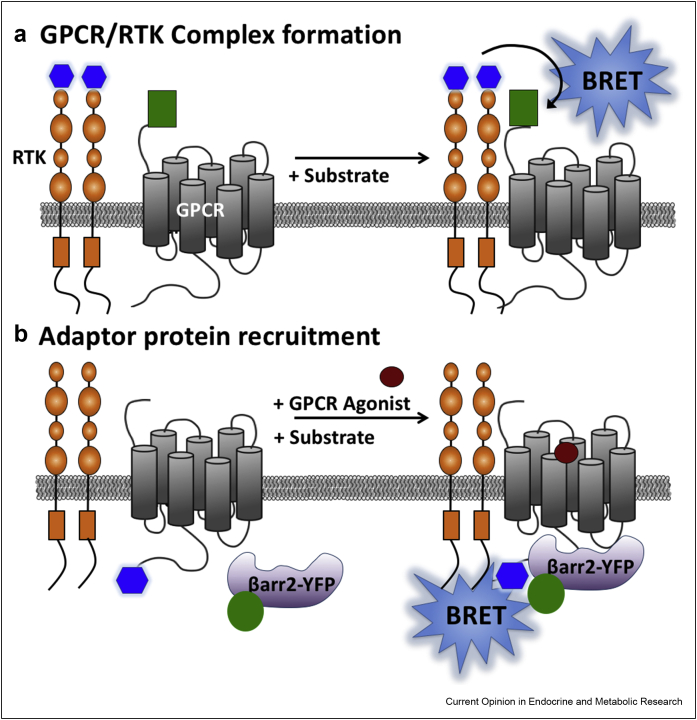
Alterations in signalling due to bidirectional transactivation of G protein-coupled receptor (GPCRs) and receptor tyrosine kinases (RTKs) are well established. Transactivation significantly diversifies signalling networks within a cell and has been implicated in promoting both advantageous and disadvantageous physiological and pathophysiological outcomes, making the GPCR/RTK interactions attractive new targets for drug discovery programmes. Transactivation has been observed for a plethora of receptor pairings in multiple cell types; however, the precise molecular mechanisms and signalling effectors involved can vary with receptor pairings and cell type. This short review will discuss the recent applications of proximity-based assays, such as resonance energy transfer and fluorescence-based imaging in investigating the dynamics of GPCR/RTK complex formation, subsequent effector protein recruitment and the cellular locations of complexes in living cells.
由于G蛋白偶联受体(GPCRs)和受体酪氨酸激酶(RTKs)的双向反式激活导致的信号改变已得到充分证实。反式激活显著地使细胞内的信号网络多样化,并与促进有利和不利的生理及病理生理结果有关,这使得GPCR/RTK相互作用成为药物发现计划中具有吸引力的新靶点。在多种细胞类型中,已观察到大量受体配对的反式激活;然而,所涉及的精确分子机制和信号效应器可能因受体配对和细胞类型而异。这篇简短的综述将讨论基于邻近性分析的最新应用,如共振能量转移和基于荧光的成像,以研究活细胞中GPCR/RTK复合物形成的动力学、随后效应蛋白的募集以及复合物的细胞定位。