Department of Internal Medicine IV, Nephrology and Hypertension, Saarland University Hospital, Kirrberger Strasse, Building 41, 66424 Homburg/Saar, Germany.
Vth Department of Medicine, University Heidelberg, Mannheim Medical Faculty, Theodor-Kutzer-Ufer 1-3, 68167 Mannheim, Germany.
Eur Heart J. 2021 May 7;42(18):1742-1756. doi: 10.1093/eurheartj/ehab107.
Inflammation plays an important role in cardiovascular disease (CVD) development. The NOD-like receptor protein-3 (NLRP3) inflammasome contributes to the development of atherosclerosis in animal models. Components of the NLRP3 inflammasome pathway such as interleukin-1β can therapeutically be targeted. Associations of genetically determined inflammasome-mediated systemic inflammation with CVD and mortality in humans are unknown.
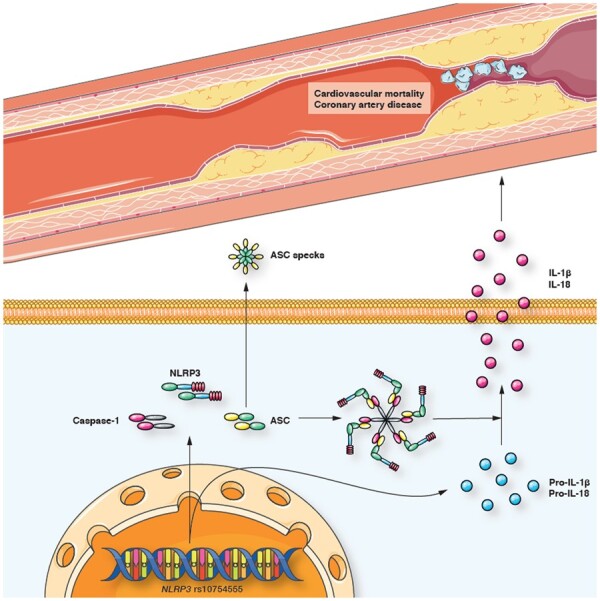
We explored the association of genetic NLRP3 variants with prevalent CVD and cardiovascular mortality in 538 167 subjects on the individual participant level in an explorative gene-centric approach without performing multiple testing. Functional relevance of single-nucleotide polymorphisms on NLRP3 inflammasome activation has been evaluated in monocyte-enriched peripheral blood mononuclear cells (PBMCs). Genetic analyses identified the highly prevalent (minor allele frequency 39.9%) intronic NLRP3 variant rs10754555 to affect NLRP3 gene expression. rs10754555 carriers showed significantly higher C-reactive protein and serum amyloid A plasma levels. Carriers of the G allele showed higher NLRP3 inflammasome activation in isolated human PBMCs. In carriers of the rs10754555 variant, the prevalence of coronary artery disease was significantly higher as compared to non-carriers with a significant interaction between rs10754555 and age. Importantly, rs10754555 carriers had significantly higher risk for cardiovascular mortality during follow-up. Inflammasome inducers (e.g. urate, triglycerides, apolipoprotein C3) modulated the association between rs10754555 and mortality.
The NLRP3 intronic variant rs10754555 is associated with increased systemic inflammation, inflammasome activation, prevalent coronary artery disease, and mortality. This study provides evidence for a substantial role of genetically driven systemic inflammation in CVD and highlights the NLRP3 inflammasome as a therapeutic target.
炎症在心血管疾病(CVD)的发展中起着重要作用。NOD 样受体蛋白 3(NLRP3)炎性小体有助于动物模型中动脉粥样硬化的发展。NLRP3 炎性小体途径的组成部分,如白细胞介素-1β,可作为治疗靶点。遗传决定的炎性小体介导的全身炎症与人类 CVD 和死亡率之间的关联尚不清楚。
我们在个体参与者水平上,采用探索性的以基因为中心的方法,在没有进行多次测试的情况下,研究了 NLRP3 基因变异与 538167 例患者中现患 CVD 和心血管死亡率之间的关系。单核苷酸多态性对 NLRP3 炎性小体激活的功能相关性已在单核细胞富集的外周血单核细胞(PBMC)中进行了评估。遗传分析确定了高度普遍存在的(次要等位基因频率为 39.9%)内含子 NLRP3 变体 rs10754555 影响 NLRP3 基因表达。rs10754555 携带者的 C 反应蛋白和血清淀粉样蛋白 A 血浆水平明显升高。携带 G 等位基因的人,其分离的人 PBMC 中的 NLRP3 炎性小体激活明显更高。与非携带者相比,rs10754555 变异携带者的冠状动脉疾病患病率明显更高,且 rs10754555 与年龄之间存在显著的交互作用。重要的是,rs10754555 携带者在随访期间心血管死亡率明显更高。炎性小体激动剂(如尿酸、甘油三酯、载脂蛋白 C3)调节了 rs10754555 与死亡率之间的关联。
NLRP3 内含子变体 rs10754555 与全身炎症增加、炎性小体激活、现患冠状动脉疾病和死亡率增加有关。本研究为遗传驱动的全身炎症在 CVD 中的重要作用提供了证据,并强调了 NLRP3 炎性小体作为治疗靶点的重要性。