Applied Physiology & Nutrition Research Group, Laboratory of Assessment and Conditioning in Rheumatology, Faculdade de Medicina FMUSP, Universidade de Sao Paulo, SP, Sao Paulo, Brazil.
Rheumatology Division, Faculdade de Medicina FMUSP, Universidade de Sao Paulo, Sao Paulo, SP, Brazil.
Pediatr Rheumatol Online J. 2021 Mar 22;19(1):39. doi: 10.1186/s12969-021-00519-z.
It is currently unknown whether patients with childhood-onset Takayasu disease (c-TA) are prone to physical inactivity and poor aerobic capacity. In this study, we assessed physical activity levels and cardiorespiratory fitness along with health-related quality of life (HRQL) and various traditional and non-traditional risk factors in patients with c-TA vs. healthy controls.
c-TA patients with non-active disease (n = 17) and age- and sex-matched healthy controls (n = 17) were enrolled in the study. We assessed physical activity levels, aerobic capacity, body composition, systemic inflammation, cardiometabolic markers, disease-related parameters, and HRQL.
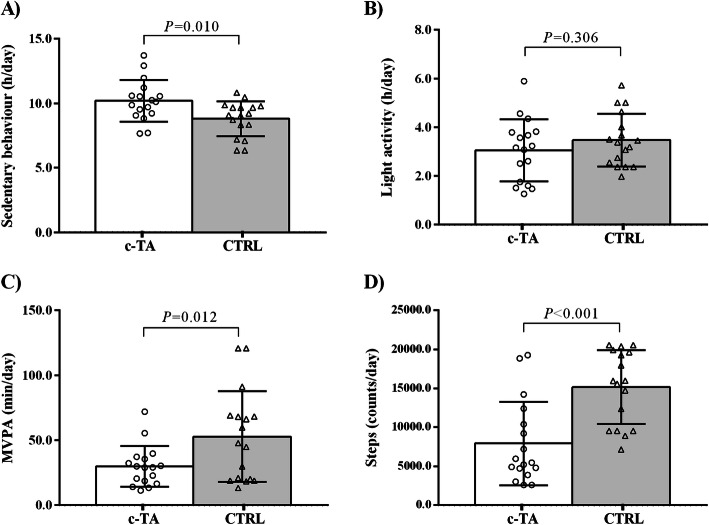
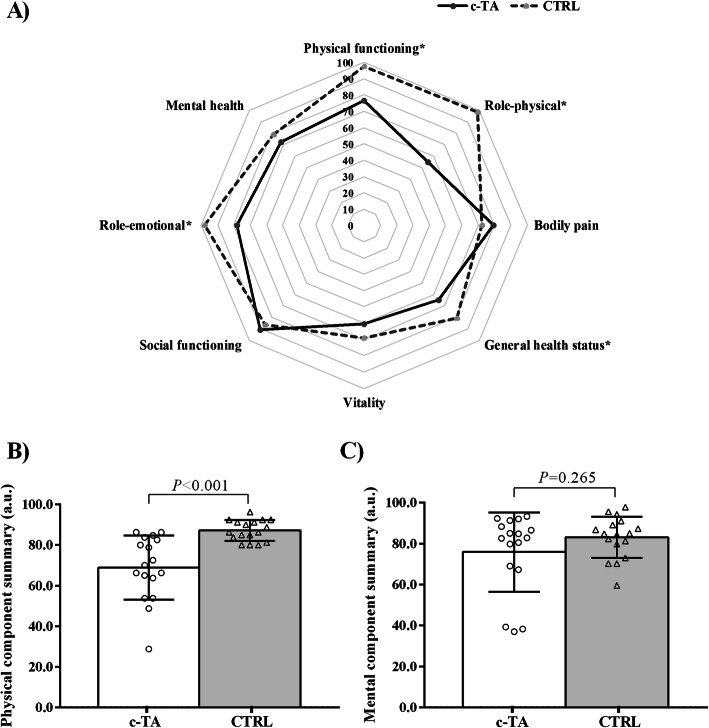
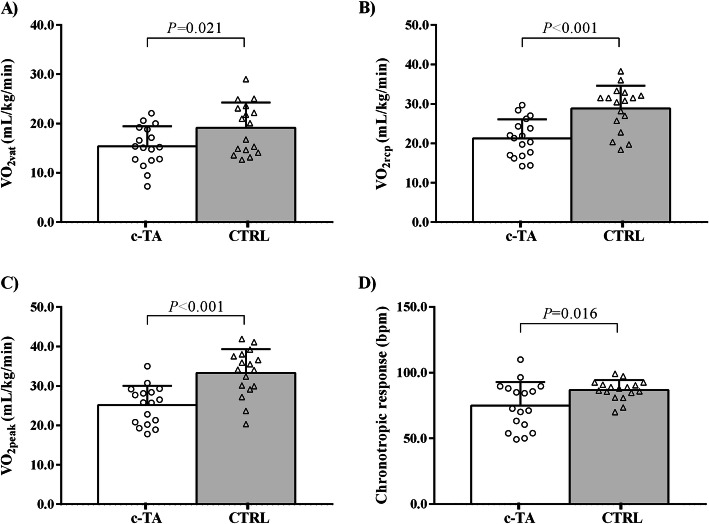
c-TA patients showed greater time spent in sedentary behavior (P = 0.010), and lower moderate-to-vigorous physical activity (P > 0.001) and lower step counts per day (P > 0.001). VO (P < 0.001) and chronotropic response (P = 0.016) were significantly lower in patients with c-TA and they had worse HRQL in physical domain (P < 0.001), lower bone mineral content and density, and higher insulin levels vs. healthy controls (all P ≤ 0.05).
c-TA patients exhibited reduced physical activity levels and aerobic capacity, worse cardiometabolic risk factors and HRQL parameter compared with healthy peers. Physical inactivity and aerobic deconditioning emerge as potentially novel risk factors for c-TA. The role of physical activity interventions in preventing poor outcomes and improving HRQL in c-TA remains to be explored.
目前尚不清楚儿童期起病的 Takayasu 病(c-TA)患者是否容易出现身体活动不足和有氧能力差的情况。在这项研究中,我们评估了 c-TA 患者与健康对照组相比的身体活动水平、心肺适能以及健康相关生活质量(HRQL)和各种传统及非传统危险因素。
纳入了 17 名无活动期疾病的 c-TA 患者(n=17)和年龄、性别匹配的健康对照组(n=17)。我们评估了身体活动水平、有氧能力、身体成分、全身炎症、心血管代谢标志物、疾病相关参数和 HRQL。
c-TA 患者的久坐时间更多(P=0.010),中高强度体力活动(P>0.001)和每天的步数更少(P>0.001)。c-TA 患者的 VO2(P<0.001)和变时反应(P=0.016)明显更低,他们在身体领域的 HRQL 更差(P<0.001),骨矿物质含量和密度更低,胰岛素水平更高,与健康对照组相比(所有 P≤0.05)。
与健康同龄人相比,c-TA 患者的身体活动水平和有氧能力降低,心血管代谢危险因素和 HRQL 指标更差。身体活动不足和有氧适应不良可能成为 c-TA 的潜在新危险因素。身体活动干预在预防 c-TA 不良结局和改善 HRQL 方面的作用仍有待探索。