Department of Medicine, National Jewish Health, Denver, Colorado, USA
TA Inflammation Med, Boehringer Ingelheim International GmbH, Biberach an der Riss, Germany.
BMJ Open. 2021 Mar 22;11(3):e042526. doi: 10.1136/bmjopen-2020-042526.
A better understanding is needed of the different phenotypes that exist for patients with chronic obstructive pulmonary disease (COPD), their relationship with the pathogenesis of COPD and how they may affect disease progression. Biomarkers, including those associated with emphysema, may assist in characterising patients and in predicting and monitoring the course of disease. The FOOTPRINTS study (study 352.2069) aims to identify biomarkers associated with emphysema, over a 3-year period.
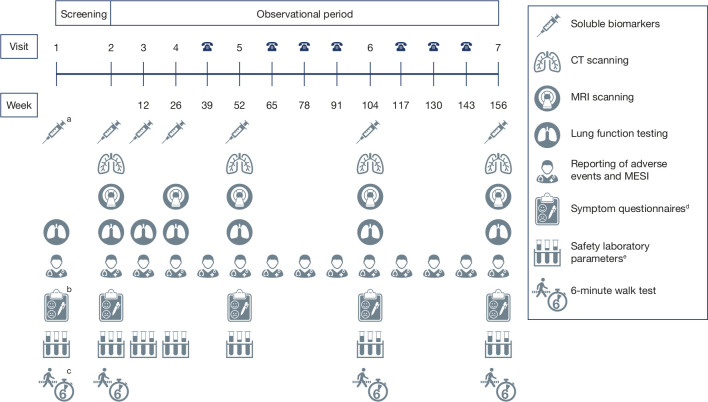
The FOOTPRINTS study is a prospective, longitudinal, multinational (12 countries), multicentre (51 sites) biomarker study, which has enrolled a total of 463 ex-smokers, including subjects without airflow limitation (as defined by the 2015 Global Initiative for Chronic Obstructive Lung Disease (GOLD) strategy report), patients with COPD across the GOLD stages 1-3 and patients with COPD and alpha1-antitrypsin deficiency. The study has an observational period lasting 156 weeks that includes seven site visits and additional phone interviews. Biomarkers in blood and sputum, imaging data (CT and magnetic resonance), clinical parameters, medical events of special interest and safety are being assessed at regular visits. Disease progression based on biomarker values and COPD phenotypes are being assessed using multivariate statistical prediction models.
The study protocol was approved by the authorities and ethics committees/institutional review boards of the respective institutions where applicable, which included study sites in Belgium, Canada, Denmark, Finland, Germany, Japan, Korea, Poland, Spain, Sweden, UK and USA; written informed consent has been obtained from all study participants. Ethics committee approval was obtained for all participating sites prior to enrolment of the study participants. The study results will be reported in peer-reviewed publications.
NCT02719184.
需要更好地了解慢性阻塞性肺疾病(COPD)患者存在的不同表型、它们与 COPD 发病机制的关系以及它们如何影响疾病进展。生物标志物,包括与肺气肿相关的生物标志物,可能有助于对患者进行特征描述,并预测和监测疾病的进程。FOOTPRINTS 研究(研究 352.2069)旨在确定与肺气肿相关的生物标志物,为期 3 年。
FOOTPRINTS 研究是一项前瞻性、纵向、多国(12 个国家)、多中心(51 个地点)的生物标志物研究,共纳入了 463 名戒烟者,包括无气流受限的受试者(如 2015 年全球慢性阻塞性肺疾病(GOLD)策略报告定义)、GOLD 1-3 期 COPD 患者以及 COPD 和α1-抗胰蛋白酶缺乏症患者。该研究的观察期持续 156 周,包括 7 次访视和额外的电话访谈。定期访视时评估血液和痰中的生物标志物、影像学数据(CT 和磁共振)、临床参数、特殊关注的医疗事件和安全性。使用多变量统计预测模型评估基于生物标志物值和 COPD 表型的疾病进展情况。
该研究方案已获得当局和各机构伦理委员会/机构审查委员会的批准(如适用,包括比利时、加拿大、丹麦、芬兰、德国、日本、韩国、波兰、西班牙、瑞典、英国和美国的研究地点),所有研究参与者均已获得书面知情同意。在研究参与者入组之前,所有参与地点均获得了伦理委员会的批准。研究结果将在同行评议的出版物中报告。
NCT02719184。