
生长激素释放激素和生长激素受体均被靶向破坏的新型双突变雌性小鼠的生理和代谢特征
Physiological and metabolic characteristics of novel double-mutant female mice with targeted disruption of both growth hormone-releasing hormone and growth hormone receptor.
作者信息
Icyuz Mert, Zhang Fang, Fitch Michael P, Joyner Matthew R, Challa Anil K, Sun Liou Y
机构信息
Department of Biology, University of Alabama at Birmingham, Birmingham, Alabama, USA.
出版信息
Aging Cell. 2021 Apr;20(4):e13339. doi: 10.1111/acel.13339. Epub 2021 Mar 23.
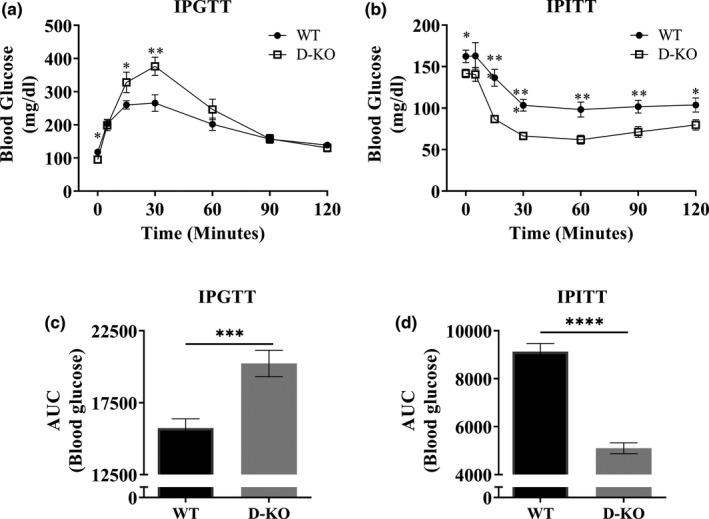
Mice with disruptions of growth hormone-releasing hormone (GHRH) or growth hormone receptor (GHR) exhibit similar phenotypes of prolonged lifespan and delayed age-related diseases. However, these two models respond differently to calorie restriction indicating that they might carry different and/or independent mechanisms for improved longevity and healthspan. In order to elucidate these mechanisms, we generated GHRH and GHR double-knockout mice (D-KO). In the present study, we focused specifically on the characteristics of female D-KO mice. The D-KO mice have reduced body weight and enhanced insulin sensitivity compared to wild-type (WT) controls. Growth retardation in D-KO mice is accompanied by decreased GH expression in pituitary, decreased circulating IGF-1, increased high-molecular-weight (HMW) adiponectin, and leptin hormones compared to WT controls. Generalized linear model-based regression analysis, which controls for body weight differences between D-KO and WT groups, shows that D-KO mice have decreased lean mass, bone mineral density, and bone mineral content, but increased adiposity. Indirect calorimetry markers including oxygen consumption, carbon dioxide production, and energy expenditure were significantly lower in D-KO mice relative to the controls. In comparison with WT mice, the D-KO mice displayed reduced respiratory exchange ratio (RER) values only during the light cycle, suggesting a circadian-related metabolic shift toward fat utilization. Interestingly, to date survival data suggest extended lifespan in D-KO female mice.
生长激素释放激素(GHRH)或生长激素受体(GHR)功能缺失的小鼠表现出相似的表型,即寿命延长和与年龄相关疾病的延迟发生。然而,这两种模型对卡路里限制的反应不同,这表明它们可能具有不同和/或独立的机制来改善寿命和健康跨度。为了阐明这些机制,我们培育了GHRH和GHR双敲除小鼠(D-KO)。在本研究中,我们特别关注雌性D-KO小鼠的特征。与野生型(WT)对照相比,D-KO小鼠体重减轻且胰岛素敏感性增强。与WT对照相比,D-KO小鼠的生长迟缓伴随着垂体中GH表达降低、循环IGF-1减少、高分子量(HMW)脂联素增加以及瘦素激素增加。基于广义线性模型的回归分析控制了D-KO组和WT组之间的体重差异,结果显示D-KO小鼠的瘦体重、骨矿物质密度和骨矿物质含量降低,但肥胖程度增加。相对于对照组,D-KO小鼠的间接测热法指标,包括耗氧量、二氧化碳产生量和能量消耗均显著降低。与WT小鼠相比,D-KO小鼠仅在光照周期期间呼吸交换率(RER)值降低,这表明与昼夜节律相关的代谢向脂肪利用转变。有趣的是,迄今为止的生存数据表明D-KO雌性小鼠的寿命延长。


 Zotero 插件