Department of Paediatrics, Murdoch Children's Research Institute, Royal Children's Hospital, University of Melbourne, Melbourne, Australia.
Child Health Department, Faculty of Medicine, Public Health, and Nursing, Universitas Gadjah Mada, Yogyakarta, Indonesia.
PLoS One. 2021 Mar 23;16(3):e0248722. doi: 10.1371/journal.pone.0248722. eCollection 2021.
Vitamin D deficiency has been associated with acute respiratory infection (ARI) in early life, but this has not been evaluated in Indonesia. We aimed to determine the incidence of ARI in Indonesian infants, and to evaluate the association with vitamin D deficiency.
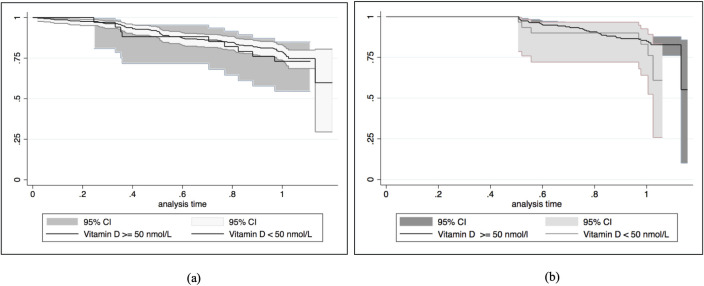
From 23 December 2015 to 31 December 2017, we conducted a community-based prospective cohort study in Yogyakarta province. We enrolled 422 pregnant women and followed their infants from birth until 12 months of age for ARI episodes. Vitamin D status was measured at birth and at age six months. We performed Cox proportional hazard regression analysis to evaluate the association between vitamin D deficiency and pneumonia incidence.
At study completion, 95% (400/422) of infants retained with a total of 412 child years of observation (CYO). The incidence of all ARI and of WHO-defined pneumonia was 3.89 (95% CI 3.70-4.08) and 0.25 (95% CI 0.21-0.30) episodes per CYO respectively. Vitamin D deficiency at birth was common (90%, 308/344) and associated with more frequent episodes of ARI non-pneumonia (adjusted odds ratio 4.48, 95% CI:1.04-19.34). Vitamin D status at birth or six months was not associated with subsequent pneumonia incidence, but greater maternal sun exposure during pregnancy was associated with a trend to less frequent ARI and pneumonia in infants.
ARI, pneumonia, and vitamin D deficiency at birth were common in Indonesian infants. Minimising vitamin D deficiency at birth such as by supplementation of mothers or safe sun exposure during pregnancy has the potential to reduce ARI incidence in infants in this setting.
维生素 D 缺乏与婴幼儿时期的急性呼吸道感染(ARI)有关,但在印度尼西亚尚未对此进行评估。我们旨在确定印度尼西亚婴儿的 ARI 发病率,并评估其与维生素 D 缺乏的关联。
2015 年 12 月 23 日至 2017 年 12 月 31 日,我们在日惹省进行了一项基于社区的前瞻性队列研究。我们招募了 422 名孕妇,并从出生开始随访其婴儿至 12 个月龄,以记录 ARI 发作情况。在出生时和 6 个月时测量维生素 D 状态。我们进行 Cox 比例风险回归分析,以评估维生素 D 缺乏与肺炎发病率之间的关系。
研究完成时,95%(400/422)的婴儿保留了 412 个儿童观察年(CYO),共有 412 个 CYO。所有 ARI 和世界卫生组织定义的肺炎的发病率分别为 3.89(95%CI 3.70-4.08)和 0.25(95%CI 0.21-0.30)/CYO。出生时维生素 D 缺乏很常见(90%,308/344),且与 ARI 非肺炎发作更为频繁相关(调整后的优势比 4.48,95%CI:1.04-19.34)。出生时或 6 个月时的维生素 D 状态与随后的肺炎发病率无关,但妊娠期间母亲更多的阳光暴露与婴儿 ARI 和肺炎发作频率降低的趋势相关。
在印度尼西亚婴儿中,ARI、肺炎和出生时维生素 D 缺乏很常见。在这种情况下,通过补充母亲或妊娠期间安全阳光暴露来最大限度地减少出生时的维生素 D 缺乏,可能会降低婴儿的 ARI 发病率。