Department of Colorectal Surgery, National Cancer Center Hospital East, 6-5-1 Kashiwanoha, Kashiwa, Chiba, 277-8577, Japan.
Department of General Surgical Science, Gunma University Graduate School of Medicine, 3-39-22 Showa-machi, Maebashi, Gunma, 371-8511, Japan.
BMC Cancer. 2021 Mar 23;21(1):302. doi: 10.1186/s12885-021-08046-6.
Transmembrane protein 180 (TMEM180) is a newly identified colorectal cancer (CRC)-specific molecule that is expressed very rarely in normal tissue and up-regulated under hypoxic conditions. We developed a monoclonal antibody (mAb) against TMEM180 and decided to examine the medical significance using the mAb.
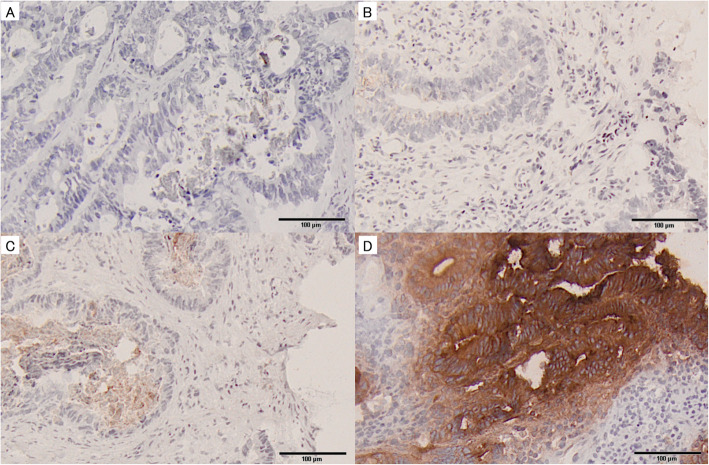
A total of 157 patients (86 men and 71 women; median age 63.0 years) with stage III CRC who underwent curative surgery were analyzed for TMEM180 expression as a retrospective cohort design. Immunohistochemistry with anti-TMEM180 mAb was conducted on frozen sections, and the data were evaluated for any correlation with clinicopathological indices or prognosis. SW480 CRC cells were examined to investigate the relationship between the expression of TMEM180 and tumourigenesis of xenografts.
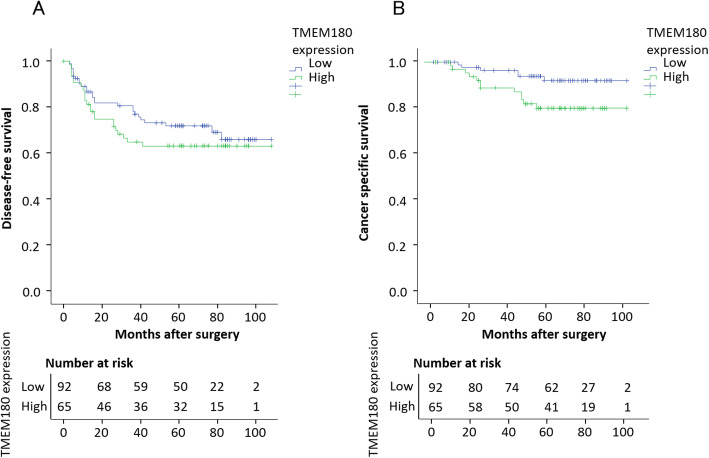
In total, 92 cases had low TMEM expression and 65 had high TMEM180 expression. For disease-free survival, hazard ratio in high-TMEM180 cases was 1.449 (95% confidential interval = 0.802-2.619) higher than in low-TMEM180 cases, but the difference was not significant (p = 0.219). For cancer specific survival, hazard ratio in high-TMEM180 cases was 3.302 (95% confidential interval = 1.088-10.020), significantly higher than in low-TMEM180 cases (p = 0.035). In an assay examining in vitro colony-forming activity in soft agar, SW480-WT cells clearly formed colonies, but neither KD1 nor KD2 cells did. The in vivo tumour-initiating activity of SW480 cell lines was positively correlated with the level of TMEM180 expression.
These results indicate that TMEM180 is a useful marker for clinical prognosis in patients with CRC. We believe that these fundamental data warrant further basic and translational studies of TMEM180, and its mAb, for development of therapeutics against CRC.
跨膜蛋白 180(TMEM180)是一种新发现的结直肠癌(CRC)特异性分子,在正常组织中很少表达,在缺氧条件下上调。我们开发了一种针对 TMEM180 的单克隆抗体(mAb),并决定使用该 mAb 来检验其医学意义。
采用回顾性队列设计,对 157 例接受根治性手术的 III 期 CRC 患者(86 例男性,71 例女性;中位年龄 63.0 岁)的 TMEM180 表达进行分析。采用抗 TMEM180 mAb 对冷冻切片进行免疫组织化学染色,并评估数据与临床病理指标或预后的相关性。SW480 CRC 细胞系用于研究 TMEM180 表达与异种移植肿瘤发生的关系。
总共有 92 例患者 TMEM 表达较低,65 例患者 TMEM180 表达较高。无病生存方面,高 TMEM180 病例的危险比为 1.449(95%置信区间 0.802-2.619),高于低 TMEM180 病例,但差异无统计学意义(p=0.219)。在癌症特异性生存方面,高 TMEM180 病例的危险比为 3.302(95%置信区间 1.088-10.020),显著高于低 TMEM180 病例(p=0.035)。在体外软琼脂集落形成活性检测中,SW480-WT 细胞明显形成集落,但 KD1 和 KD2 细胞均未形成。SW480 细胞系的体内肿瘤起始活性与 TMEM180 表达水平呈正相关。
这些结果表明,TMEM180 是 CRC 患者临床预后的一个有用标志物。我们认为,这些基础数据值得进一步进行 TMEM180 及其 mAb 的基础和转化研究,以开发针对 CRC 的治疗方法。