Division of Pulmonary and Critical Care Medicine, David Geffen School of Medicine at University of California Los Angeles, Los Angeles, CA, USA.
Pneumology Department, Hospital Universitari Vall D'Hebron, Vall D'Hebron Institut de Recerca (VHIR), Vall d'Hebron Hospital Campus, CIBER de Enfermedades Respiratorias (CIBERES), Barcelona, Spain.
BMC Pulm Med. 2021 Mar 23;21(1):99. doi: 10.1186/s12890-021-01466-x.
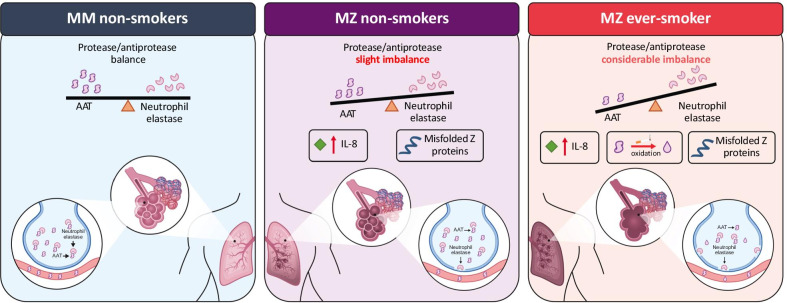
Alpha-1 antitrypsin deficiency (AATD) is a significantly under-diagnosed genetic condition caused by reduced levels and/or functionality of alpha-1 antitrypsin (AAT), predisposing individuals to lung, liver or other systemic diseases. The management of individuals with the PIMZ genotype, characterized by mild or moderate AAT deficiency, is less clear than of those with the most common severe deficiency genotype (PIZZ). Recent genetic data suggest that the PIMZ genotype may be significantly more prevalent than currently thought. The only specific treatment for lung disease associated with severe AATD is the intravenous infusion of AAT augmentation therapy, which has been shown to slow disease progression in PIZZ individuals. There is no specific evidence for the clinical benefit of AAT therapy in PIMZ individuals, and the risk of emphysema development in this group remains controversial. As such, current guidelines do not support the use of AAT augmentation in PIMZ individuals. Here, we discuss the limited data on the PIMZ genotype and offer pro and con perspectives on pursuing an AAT-specific therapeutic strategy in PIMZ individuals with lung disease. Ultimately, further research to demonstrate the safety, risk/benefit balance and efficacy of AAT therapy in PI*MZ individuals is needed.
α-1 抗胰蛋白酶缺乏症(AATD)是一种由于α-1 抗胰蛋白酶(AAT)水平和/或功能降低而导致的严重未被诊断的遗传疾病,使个体易患肺部、肝脏或其他系统性疾病。PIMZ 基因型个体的管理,其特征是轻度或中度 AAT 缺乏,不如最常见的严重缺乏基因型(PIZZ)明确。最近的遗传数据表明,PIMZ 基因型的流行程度可能比目前认为的要高得多。与严重 AATD 相关的肺部疾病的唯一特定治疗方法是 AAT 增强疗法的静脉输注,该疗法已被证明可减缓 PIZZ 个体的疾病进展。在 PIMZ 个体中,AAT 治疗的临床获益没有具体证据,并且该组发生肺气肿的风险仍存在争议。因此,目前的指南不支持在 PIMZ 个体中使用 AAT 增强。在这里,我们讨论了关于 PIMZ 基因型的有限数据,并对在患有肺部疾病的 PIMZ 个体中采用 AAT 特异性治疗策略的利弊进行了探讨。最终,需要进一步的研究来证明 AAT 治疗在 PI*MZ 个体中的安全性、风险/收益平衡和疗效。