Institute of Biochemistry and Molecular Biology, Semmelweis University, Budapest, Hungary.
Earlham Institute, Norwich, UK.
Cell Death Dis. 2021 Mar 23;12(4):309. doi: 10.1038/s41419-021-03599-7.
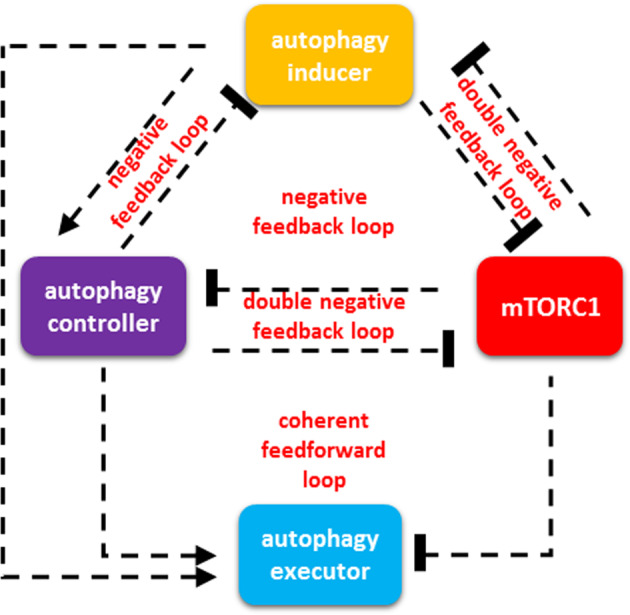
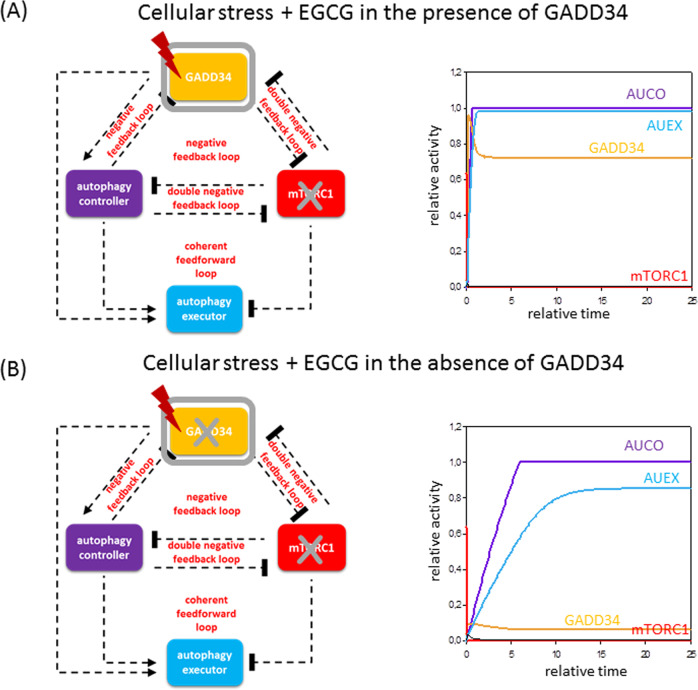
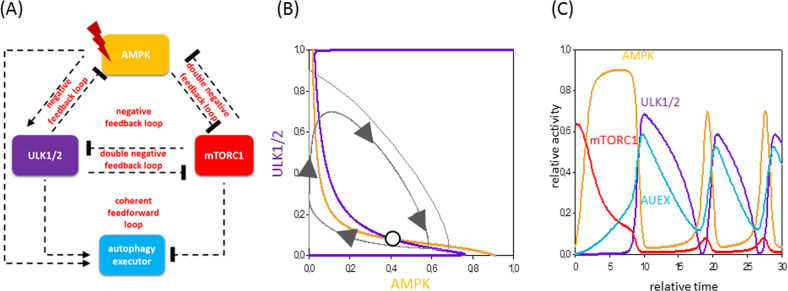
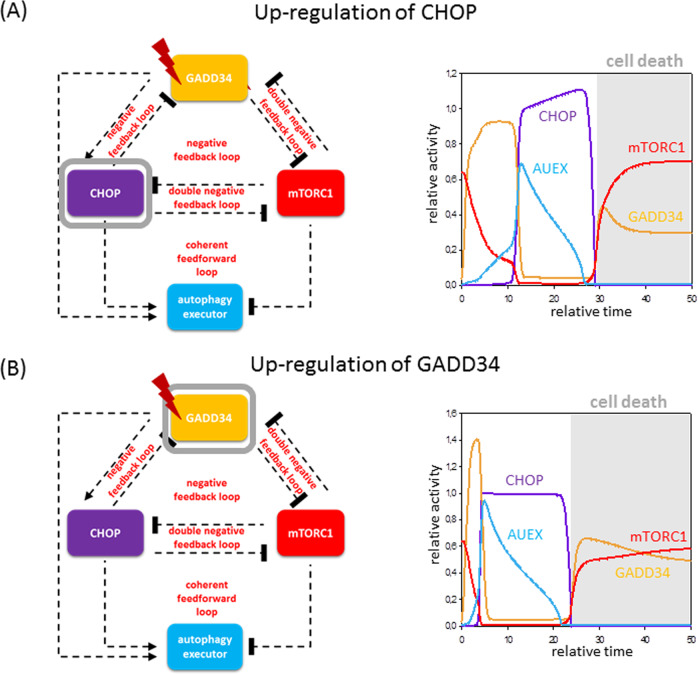
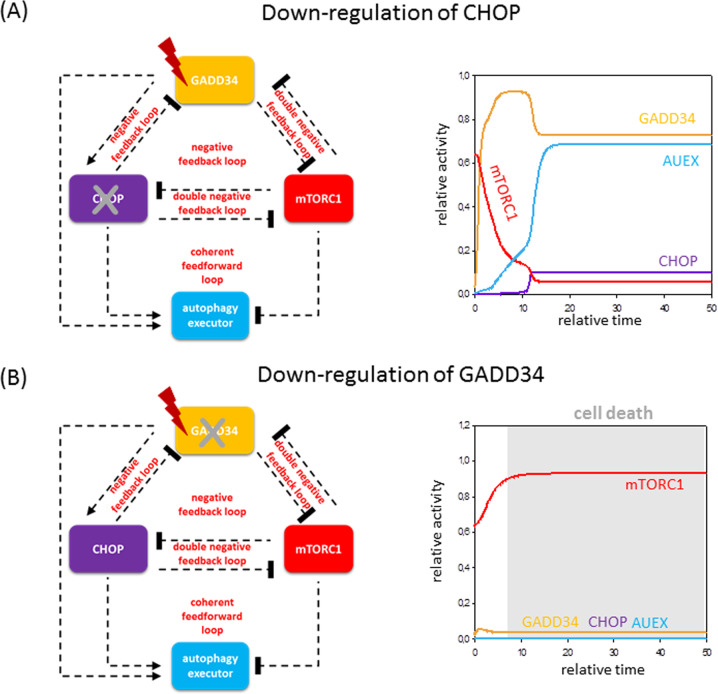
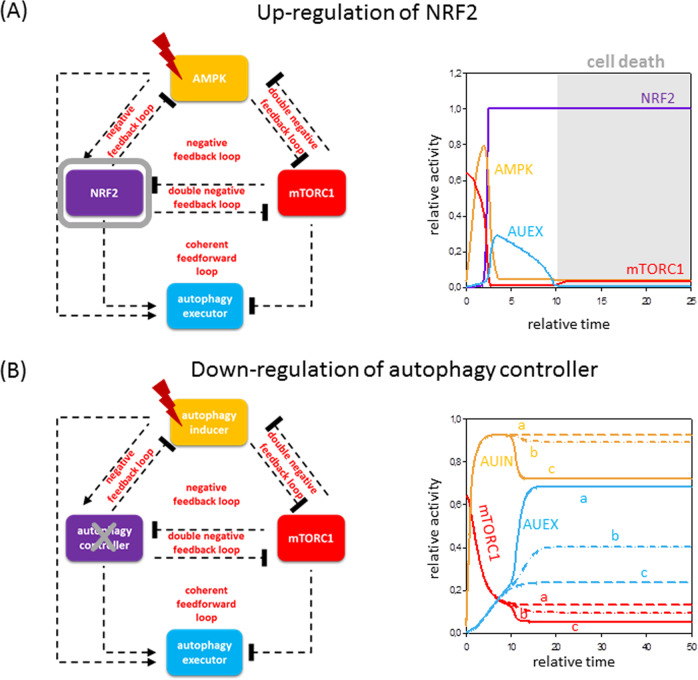
Although autophagy is a type of programmed cell death, it is also essential for cell survival upon tolerable level of various stress events. For the cell to respond adequately to an external and/or internal stimulus induced by cellular stress, autophagy must be controlled in a highly regulated manner. By using systems biology techniques, here we explore the dynamical features of autophagy induction. We propose that the switch-like characteristic of autophagy induction is achieved by a control network, containing essential feedback loops of four components, so-called autophagy inducer, autophagy controller, mTORC1 and autophagy executor, respectively. We show how an autophagy inducer is capable to turn on autophagy in a cellular stress-specific way. The autophagy controller acts as a molecular switch and not only promotes autophagy but also blocks the permanent hyperactivation of the process via downregulating the autophagy inducer. In this theoretical analysis, we explore in detail the properties of all four proposed controlling elements and their connections. Here we also prove that the kinetic features of this control network can be considered accurate in various stress processes (such as starvation, endoplasmic reticulum stress and oxidative stress), even if the exact components may be different. The robust response of the resulting control network is essential during cellular stress.
尽管自噬是一种程序性细胞死亡,但它对于细胞在可容忍的各种应激事件水平下的存活也是必不可少的。为了使细胞能够对细胞应激引起的外部和/或内部刺激做出适当的反应,自噬必须以高度调控的方式进行控制。在这里,我们使用系统生物学技术来探索自噬诱导的动态特征。我们提出,自噬诱导的开关特性是通过一个包含四个关键组件的反馈回路的控制网络来实现的,这四个组件分别是自噬诱导物、自噬控制器、mTORC1 和自噬执行者。我们展示了自噬诱导物如何能够以细胞应激特异性的方式开启自噬。自噬控制器作为一种分子开关,不仅促进自噬,还通过下调自噬诱导物来阻止过程的永久过度激活。在这个理论分析中,我们详细探讨了所有四个提议的控制元件及其连接的特性。我们还证明,即使确切的成分可能不同,这个控制网络的动力学特征在各种应激过程(如饥饿、内质网应激和氧化应激)中都可以被认为是准确的。在细胞应激期间,这种产生的控制网络的稳健响应是必不可少的。