Márton Margita, Kurucz Anita, Lizák Beáta, Margittai Éva, Bánhegyi Gábor, Kapuy Orsolya
Department of Medical Chemistry, Molecular Biology and Pathobiochemistry, Semmelweis University, 1094 Budapest, Hungary.
Institute of Clinical Experimental Research, Semmelweis University, 1085 Budapest, Hungary.
Int J Mol Sci. 2017 Jan 5;18(1):58. doi: 10.3390/ijms18010058.
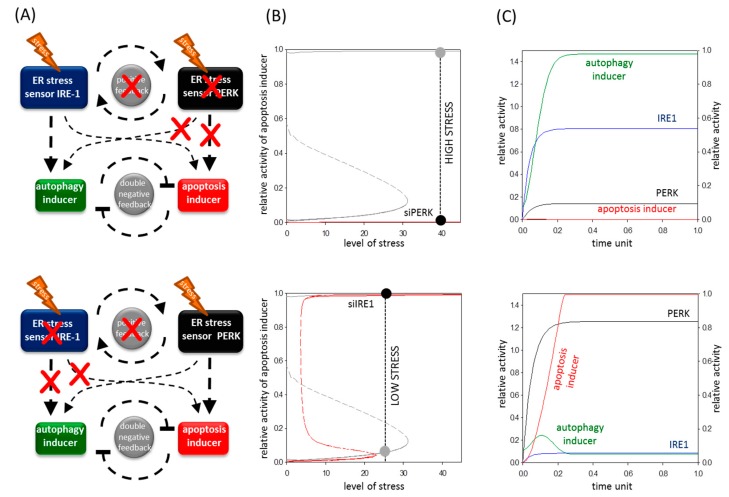
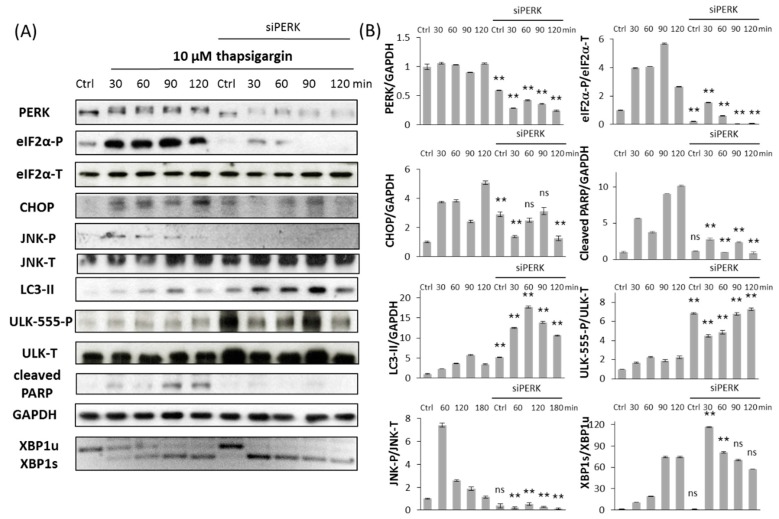
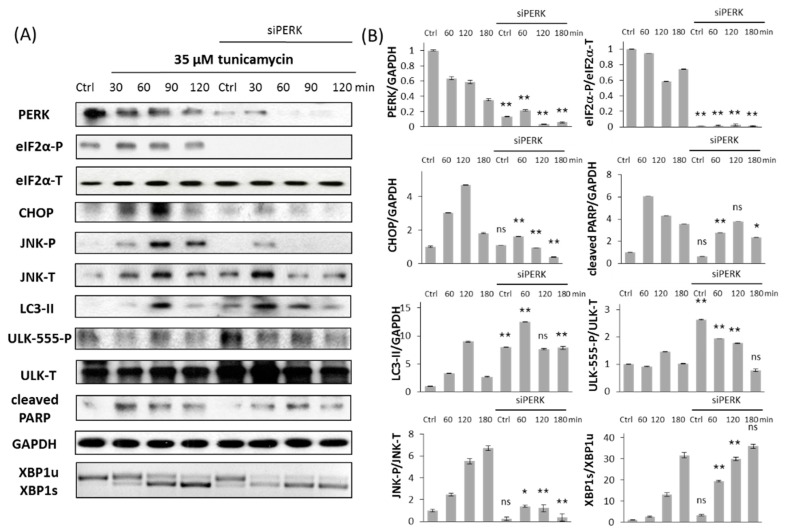
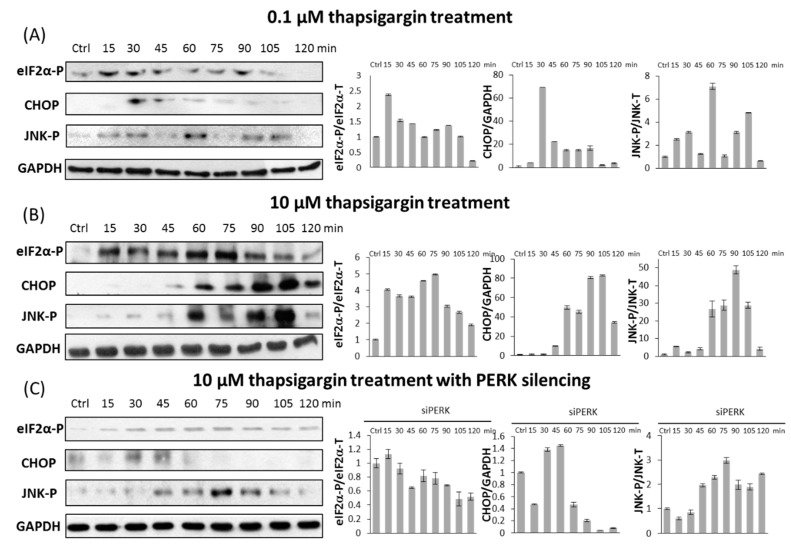
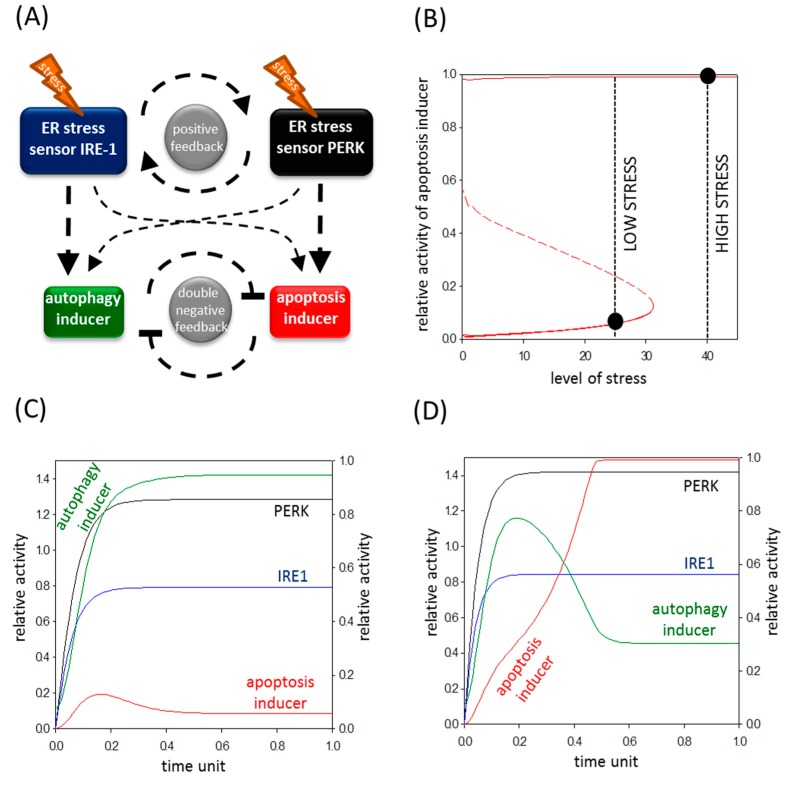
Accumulation of misfolded/unfolded proteins in the endoplasmic reticulum (ER) leads to the activation of three branches (Protein kinase (RNA)-like endoplasmic reticulum kinase [PERK], Inositol requiring protein 1 [IRE-1] and Activating trascription factor 6 [ATF6], respectively) of unfolded protein response (UPR). The primary role of UPR is to try to drive back the system to the former or a new homeostatic state by self-eating dependent autophagy, while excessive level of ER stress results in apoptotic cell death. Our study focuses on the role of PERK- and IRE-1-induced arms of UPR in life-or-death decision. Here we confirm that silencing of PERK extends autophagy-dependent survival, whereas the IRE-1-controlled apoptosis inducer is downregulated during ER stress. We also claim that the proper order of surviving and self-killing mechanisms is controlled by a positive feedback loop between PERK and IRE-1 branches. This regulatory network makes possible a smooth, continuous activation of autophagy with respect to ER stress, while the induction of apoptosis is irreversible and switch-like. Using our knowledge of molecular biological techniques and systems biological tools we give a qualitative description about the dynamical behavior of PERK- and IRE-1-controlled life-or-death decision. Our model claims that the two arms of UPR accomplish an altered upregulation of autophagy and apoptosis inducers during ER stress. Since ER stress is tightly connected to aging and age-related degenerative disorders, studying the signaling pathways of UPR and their role in maintaining ER proteostasis have medical importance.
内质网(ER)中错误折叠/未折叠蛋白质的积累会导致未折叠蛋白反应(UPR)的三个分支(分别为蛋白激酶(RNA)样内质网激酶[PERK]、肌醇需求蛋白1[IRE-1]和激活转录因子6[ATF6])被激活。UPR的主要作用是试图通过自噬依赖性自噬将系统恢复到之前或新的稳态,而内质网应激水平过高则会导致细胞凋亡死亡。我们的研究聚焦于UPR中由PERK和IRE-1诱导的分支在生死抉择中的作用。在此我们证实,PERK沉默可延长自噬依赖性存活,而在ER应激期间,IRE-1控制的凋亡诱导因子会下调。我们还声称,存活和自我杀伤机制的正确顺序由PERK和IRE-1分支之间的正反馈回路控制。这种调节网络使得自噬能够相对于内质网应激进行平稳、持续的激活,而凋亡的诱导是不可逆的且呈开关式。利用我们对分子生物学技术和系统生物学工具的了解,我们对PERK和IRE-1控制的生死抉择的动态行为进行了定性描述。我们的模型表明,UPR的两个分支在ER应激期间实现了自噬和凋亡诱导因子的上调改变。由于内质网应激与衰老和年龄相关的退行性疾病密切相关,研究UPR的信号通路及其在维持内质网蛋白稳态中的作用具有医学重要性。