Natural and Medical Sciences Research Center, University of Nizwa, Nizwa, 616, Oman.
Department of Biotechnology, Yeungnam University, Gyeongsan, Gyeongsangbuk-do, 38541, Republic of Korea.
Sci Rep. 2021 Mar 23;11(1):6676. doi: 10.1038/s41598-021-86201-6.
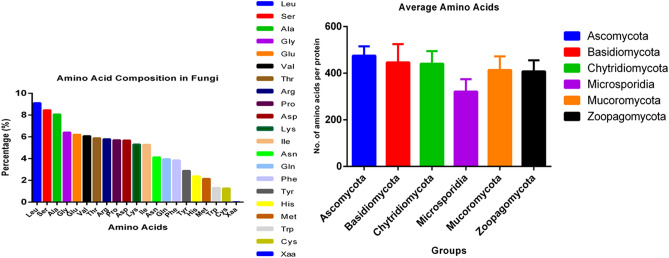
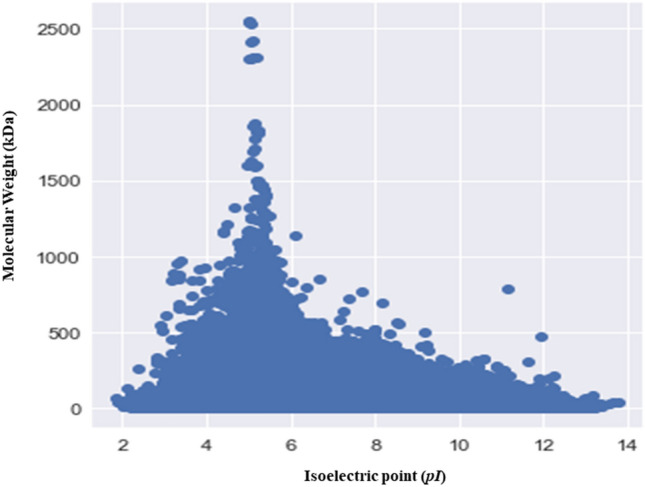
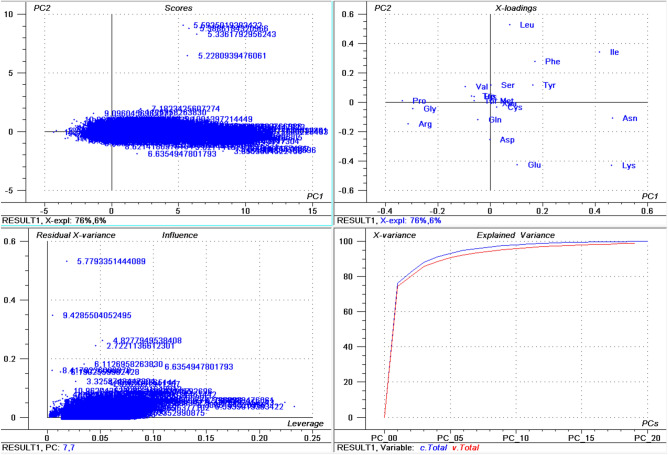
The molecular weight and isoelectric point (pI) of the proteins plays important role in the cell. Depending upon the shape, size, and charge, protein provides its functional role in different parts of the cell. Therefore, understanding to the knowledge of their molecular weight and charges is (pI) is very important. Therefore, we conducted a proteome-wide analysis of protein sequences of 689 fungal species (7.15 million protein sequences) and construct a virtual 2-D map of the fungal proteome. The analysis of the constructed map revealed the presence of a bimodal distribution of fungal proteomes. The molecular mass of individual fungal proteins ranged from 0.202 to 2546.166 kDa and the predicted isoelectric point (pI) ranged from 1.85 to 13.759 while average molecular weight of fungal proteome was 50.98 kDa. A non-ribosomal peptide synthase (RFU80400.1) found in Trichoderma arundinaceum was identified as the largest protein in the fungal kingdom. The collective fungal proteome is dominated by the presence of acidic rather than basic pI proteins and Leu is the most abundant amino acid while Cys is the least abundant amino acid. Aspergillus ustus encodes the highest percentage (76.62%) of acidic pI proteins while Nosema ceranae was found to encode the highest percentage (66.15%) of basic pI proteins. Selenocysteine and pyrrolysine amino acids were not found in any of the analysed fungal proteomes. Although the molecular weight and pI of the protein are of enormous important to understand their functional roles, the amino acid compositions of the fungal protein will enable us to understand the synonymous codon usage in the fungal kingdom. The small peptides identified during the study can provide additional biotechnological implication.
蛋白质的分子量和等电点(pI)在细胞中起着重要作用。根据形状、大小和电荷,蛋白质在细胞的不同部位发挥其功能作用。因此,了解其分子量和电荷(pI)的知识非常重要。因此,我们对 689 种真菌物种(715 万种蛋白质序列)的蛋白质序列进行了全蛋白质组分析,并构建了真菌蛋白质组的虚拟 2-D 图谱。构建图谱的分析揭示了真菌蛋白质组存在双峰分布。单个真菌蛋白质的分子量范围从 0.202 到 2546.166 kDa,预测等电点(pI)范围从 1.85 到 13.759,而真菌蛋白质组的平均分子量为 50.98 kDa。在木霉中发现的非核糖体肽合酶(RFU80400.1)被鉴定为真菌界中最大的蛋白质。集合真菌蛋白质组主要由存在酸性而不是碱性 pI 蛋白主导,亮氨酸是最丰富的氨基酸,半胱氨酸是最不丰富的氨基酸。棘孢曲霉编码的酸性 pI 蛋白比例最高(76.62%),而蜜蜂微孢子虫编码的碱性 pI 蛋白比例最高(66.15%)。在分析的真菌蛋白质组中都没有发现硒代半胱氨酸和吡咯赖氨酸氨基酸。尽管蛋白质的分子量和 pI 对于理解其功能作用非常重要,但真菌蛋白质的氨基酸组成将使我们能够了解真菌界中的同义密码子使用情况。在研究过程中发现的小肽可以提供额外的生物技术意义。