Department of Biotech and Omics, Natural and Medical Sciences Research Center, University of Nizwa, Nizwa, 616, Oman.
Department of Biotechnology, Yeungnam University, Gyeongsan, 48541, South Korea.
Sci Rep. 2021 Oct 28;11(1):21291. doi: 10.1038/s41598-021-00797-3.
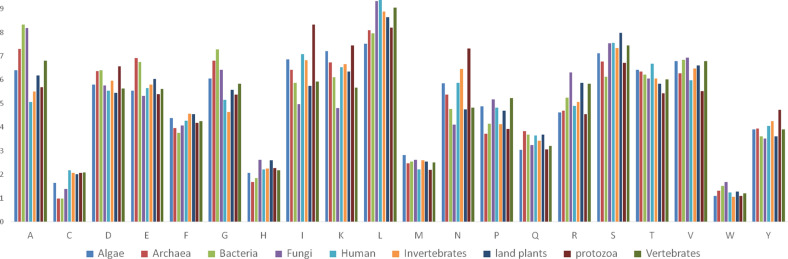
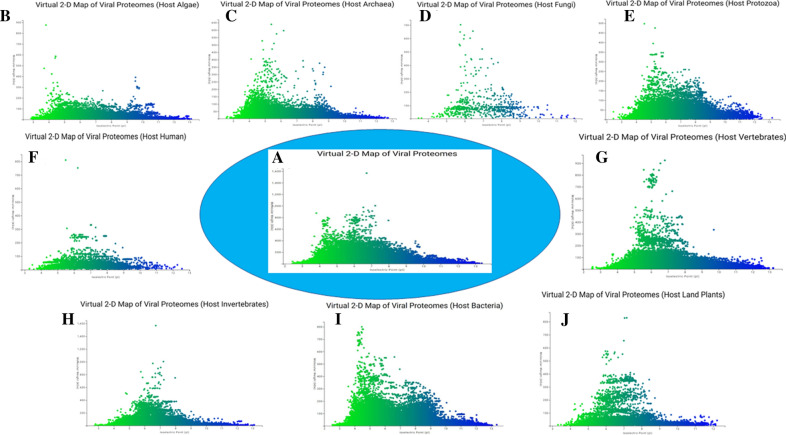
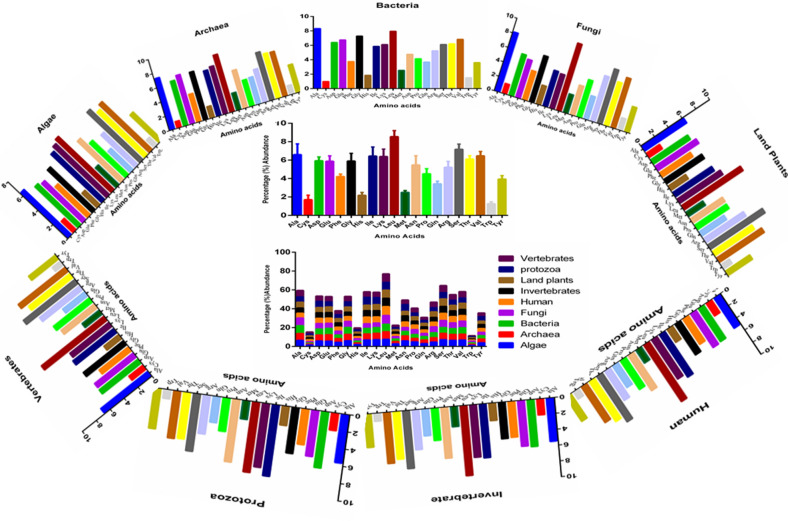
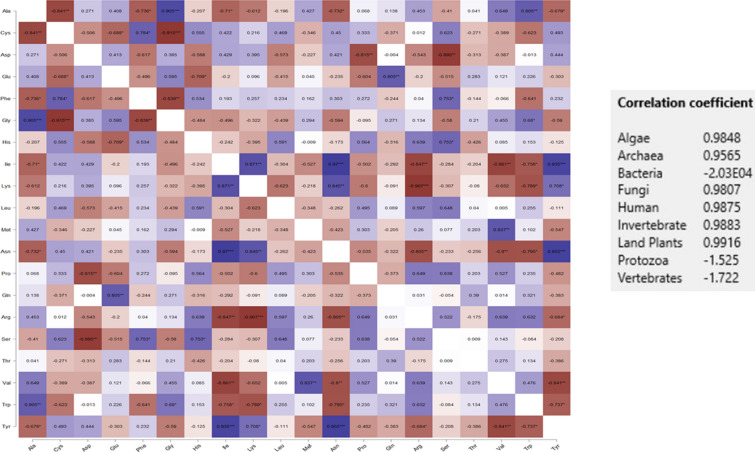
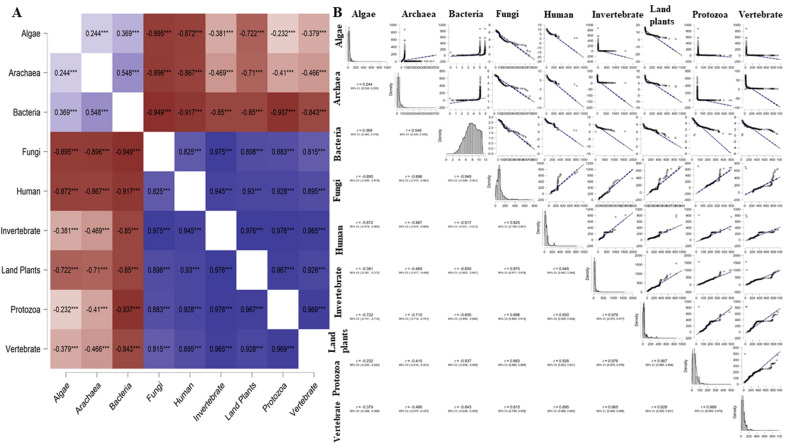
A proteome-wide study of the virus kingdom based on 1.713 million protein sequences from 19,128 virus proteomes was conducted to construct an overall proteome map of the virus kingdom. Viral proteomes encode an average of 386.214 amino acids per protein with the variation in the number of protein-coding sequences being host-specific. The proteomes of viruses of fungi hosts (882.464) encoded the greatest number of amino acids, while the viral proteome of bacterial host (210.912) encoded the smallest number of amino acids. Viral proteomes were found to have a host-specific amino acid composition. Leu (8.556%) was the most abundant and Trp (1.274%) the least abundant amino acid in the collective proteome of viruses. Viruses were found to exhibit a host-dependent molecular weight and isoelectric point of encoded proteins. The isoelectric point (pI) of viral proteins was found in the acidic range, having an average pI of 6.89. However, the pI of viral proteins of algal (pI 7.08) and vertebrate (pI 7.09) hosts was in the basic range. The virtual 2D map of the viral proteome from different hosts exhibited host-dependent modalities. The virus proteome from algal hosts and archaea exhibited a bimodal distribution of molecular weight and pI, while the virus proteome of bacterial host exhibited a trimodal distribution, and the virus proteome of fungal, human, land plants, invertebrate, protozoa, and vertebrate hosts exhibited a unimodal distribution.
基于来自 19128 种病毒蛋白质组的 1713000 个蛋白质序列,对病毒界进行了蛋白质组范围的研究,以构建病毒界的整体蛋白质组图谱。病毒蛋白质组平均每个蛋白质编码 386.214 个氨基酸,蛋白质编码序列数量的变化具有宿主特异性。真菌宿主的病毒蛋白质组(882464 个)编码的氨基酸数量最多,而细菌宿主的病毒蛋白质组(210912 个)编码的氨基酸数量最少。病毒蛋白质组被发现具有宿主特异性的氨基酸组成。亮氨酸(8.556%)是病毒集体蛋白质组中最丰富的氨基酸,色氨酸(1.274%)是最稀缺的氨基酸。病毒被发现表现出依赖于宿主的蛋白质编码分子量和等电点。病毒蛋白质的等电点(pI)被发现处于酸性范围内,平均 pI 为 6.89。然而,藻类(pI7.08)和脊椎动物(pI7.09)宿主的病毒蛋白质的 pI 处于碱性范围内。来自不同宿主的病毒蛋白质组的虚拟 2D 图谱表现出依赖于宿主的模态。藻类和古菌宿主的病毒蛋白质组表现出分子量和 pI 的双峰分布,而细菌宿主的病毒蛋白质组表现出三峰分布,真菌、人类、陆地植物、无脊椎动物、原生动物和脊椎动物宿主的病毒蛋白质组表现出单峰分布。