Xu Peng, Wang Shuo, Luo Yukun, Yin Jun, Belkacemi Yazid, Lu Shun, Feng Mei, Lang Jinyi
Department of Radiation Oncology, Sichuan Cancer Hospital and Research Institute, Chengdu, People's Republic of China.
Department of Radiation Oncology, APHP - University Hospital of Henri Mondor, Creteil, France.
Cancer Manag Res. 2021 Mar 15;13:2411-2417. doi: 10.2147/CMAR.S283494. eCollection 2021.
This study was retrospectively evaluated the outcome of postoperative intensity modulation radiotherapy (IMRT) for patients with adenoid cystic carcinoma of head and neck (ACCHN), and identified the unfavorable prognostic factors.
Fifty-five ACCHN patients treated in Sichuan Cancer Hospital between January 2007 and December 2016 were retrospectively evaluated. Median age of patient was 47 years (range, 21-73 years). Thirty-five patients were male and 20 were female. In 30 patients, tumors were located in major salivary glands (54.5%), and 25 patients in minor salivary glands (45.5%). The numbers of R0, R1, and R2 surgical resection classification patients were 22 (40.0%), 20 (36.4%), and 13 (23.6%). The median total RT dose was 62 Gy (range, 46-72 Gy), and 54.5% of patients were treated with adjuvant chemotherapy. Statistical analyses were performed using the Log rank test for univariate analysis and the Cox proportional hazard model for multivariate analysis.
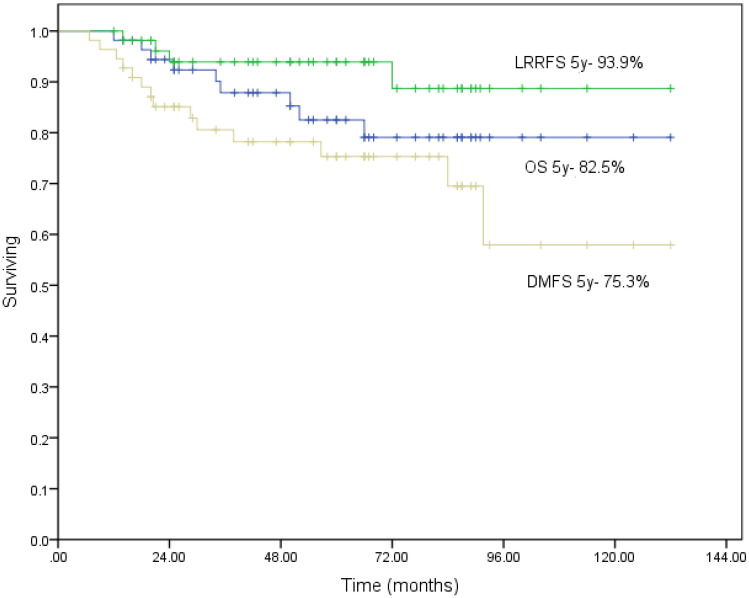
Median follow-up period was 68.5 months (12-132 months). The 5-year local-regional recurrence-free survival (LRRFS), distant metastasis-free survival (DMFS) and overall survival (OS) were 93.9%, 75.3% and 82.5%. In univariate analysis, T stages (=0.025) and AJCC stages (=0.036) were the prognostic factors for OS; Age (=0.042), T stages (=0.025), N stages (=0.021), AJCC stages (=0.021) and adjuvant chemotherapy (=0.010) were the prognostic factors for DMFS; T stage (=0.049) was the prognostic factor for LRRFS. In multivariate factors analyses, T stages (=0.026), AJCC stages (=0.028) and RT dose (=0.025) were the significant prognosticators for OS. The most common acute toxicities over three degrees were myelosuppression (5.5%), mucositis (9.1%) and dermatitis (1.8%).
Postoperative IMRT seems to achieve reasonable local-regional control and OS in patients with adenoid cystic carcinoma of head and neck, with acceptable treatment relative toxicities.
本研究回顾性评估头颈部腺样囊性癌(ACCHN)患者术后调强放疗(IMRT)的疗效,并确定不良预后因素。
回顾性评估2007年1月至2016年12月在四川省肿瘤医院接受治疗的55例ACCHN患者。患者中位年龄为47岁(范围21 - 73岁)。男性35例,女性20例。30例患者肿瘤位于大唾液腺(54.5%),25例患者肿瘤位于小唾液腺(45.5%)。R0、R1和R2手术切除分类的患者数量分别为22例(40.0%)、20例(36.4%)和13例(23.6%)。中位总放疗剂量为62 Gy(范围46 - 72 Gy),54.5%的患者接受了辅助化疗。采用Log rank检验进行单因素分析,采用Cox比例风险模型进行多因素分析。
中位随访期为68.5个月(12 - 132个月)。5年局部区域无复发生存率(LRRFS)、远处转移无复发生存率(DMFS)和总生存率(OS)分别为93.9%、75.3%和82.5%。单因素分析中,T分期(=0.025)和美国癌症联合委员会(AJCC)分期(=0.036)是OS的预后因素;年龄(=0.042)、T分期(=0.025)、N分期(=0.021)、AJCC分期(=0.021)和辅助化疗(=0.010)是DMFS的预后因素;T分期(=0.049)是LRRFS的预后因素。多因素分析中,T分期(=0.026)、AJCC分期(=0.028)和放疗剂量(=0.025)是OS的显著预后因素。超过三级的最常见急性毒性反应为骨髓抑制(5.5%)、黏膜炎(9.1%)和皮炎(1.8%)。
术后IMRT似乎能使头颈部腺样囊性癌患者获得合理的局部区域控制和总生存,且治疗相关毒性可接受。