Section of Hospital Medicine, University of Pennsylvania Perelman School of Medicine, Philadelphia.
Center for Evidence-based Practice, University of Pennsylvania Perelman School of Medicine, Philadelphia.
JAMA Netw Open. 2021 Mar 1;4(3):e210952. doi: 10.1001/jamanetworkopen.2021.0952.
Hospitalization is associated with decreased mobility and functional decline. Behaviorally designed gamification can increase mobility in community settings but has not been tested among patients at risk for functional decline during a high-risk transition period after hospitalization.
To test a behaviorally designed gamification intervention with a social support partner to increase patient mobility after hospital discharge.
DESIGN, SETTING, AND PARTICIPANTS: This study is a randomized clinical trial of a 12-week intervention without follow-up. Enrollment occurred from January 2018 to June 2019 at a referral hospital with a remote at-home monitoring intervention among patients living predominantly in 3 states (Pennsylvania, New Jersey, and Delaware). Participants included adult patients discharged from general medicine and oncology units to home. Data analysis was performed from October 2019 to March 2020.
All participants received a wearable device to track daily steps. The control group received feedback from the device but no other interventions. The intervention group entered into a 12-week game informed by behavioral economics to assign points and levels for achieving step goals and reinforced by a support partner who received updates on participant progress.
The primary outcome was change in mean daily steps from baseline through the 12-week intervention. Secondary measures were change in functional status and urgent care utilization (ie, emergency department visits and hospital readmissions) within this period.
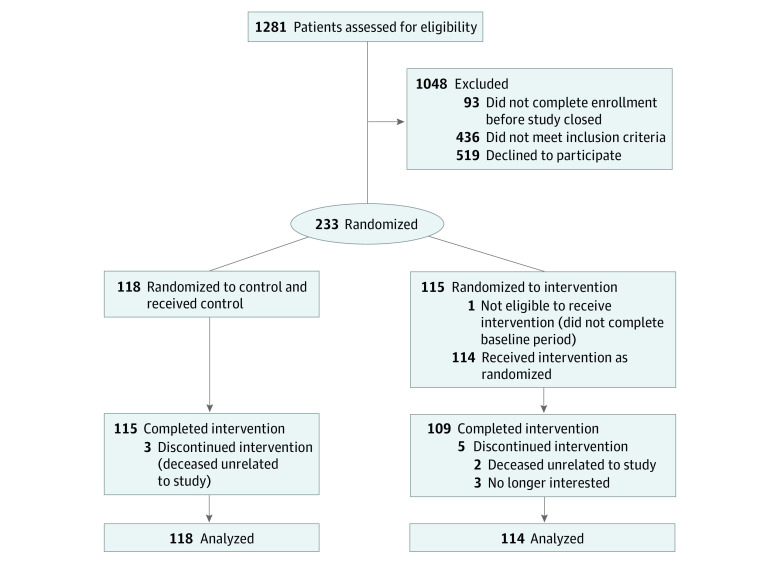
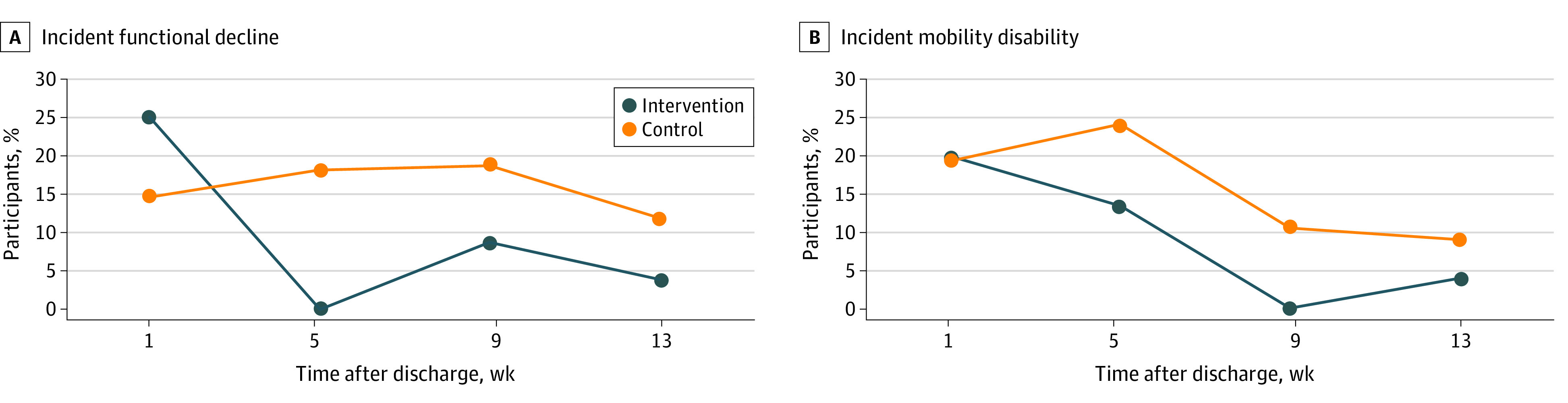
A total of 232 participants were enrolled in the study (118 randomized to control and 114 randomized to the intervention). Participants had a mean (SD) age of 40 (14) years, 141 (61%) were female, 101 (43%) were White, and 103 (44%) had an annual household income less than $50 000. Daily step counts increased from 3795 to 4652 steps (difference, 857 steps; 95% CI, 488 to 1224 steps) among intervention participants and increased from 3951 to 4499 steps (difference, 548 steps; 95% CI, 193 to 903 steps) among control participants. The change in mean daily step count from baseline was not significantly different for participants in the intervention group vs the control group (adjusted difference, 270 steps; 95% CI, -214 to 754 steps; P = .27). Among the subgroup of 76 participants with higher levels of social engagement, post hoc exploratory analyses showed a significant increase in mobility for intervention vs control (adjusted difference, 1125 steps; 95% CI, 409 to 1841 steps; P = .002). Fewer participants in this subgroup experienced functional decline (1 of 36 participants [4%] in the intervention group vs 5 of 40 participants [12%] in the control group) and hospital readmission at 30 days (3 of 36 participants [8%] in the intervention group vs 6 of 40 participants [15%] in the control group), but the differences were not statistically significant. There were no significant differences in these secondary outcomes for the overall sample.
Gamification with social incentives did not affect mobility or functional decline in all participants, but post hoc analysis suggests positive findings for both outcomes for patients with higher social engagement.
ClinicalTrials.gov Identifier: NCT03321279.
重要性:住院与活动能力下降和功能衰退有关。行为设计的游戏化可以提高社区环境中的活动能力,但尚未在住院后高风险过渡期间有功能下降风险的患者中进行测试。
目的:测试一种行为设计的游戏化干预措施,该措施与社会支持伙伴合作,以增加患者出院后的活动能力。
设计、地点和参与者:这是一项没有随访的 12 周干预的随机临床试验。参与者主要来自宾夕法尼亚州、新泽西州和特拉华州的三个州,从 2018 年 1 月至 2019 年 6 月在转诊医院的远程家庭监测干预中招募了住院后出院到家庭的成年患者。参与者包括从普通医学和肿瘤病房出院的患者。数据分析于 2019 年 10 月至 2020 年 3 月进行。
干预措施:所有参与者都使用可穿戴设备来跟踪日常步数。对照组从设备中获得反馈,但没有其他干预措施。干预组采用了一种基于行为经济学的 12 周游戏,为达到目标步数分配分数和级别,并通过支持伙伴得到加强,支持伙伴可以收到参与者进展的更新。
主要结果和措施:主要结果是从基线到 12 周干预期间平均每日步数的变化。次要措施是在此期间功能状态和紧急护理利用率(即急诊就诊和医院再入院)的变化。
结果:共有 232 名参与者入组(118 名随机分配到对照组,114 名随机分配到干预组)。参与者的平均(SD)年龄为 40(14)岁,141 名(61%)为女性,101 名(43%)为白人,103 名(44%)家庭年收入低于 50000 美元。与对照组相比,干预组的日常步数从 3795 步增加到 4652 步(差异,857 步;95%置信区间,488 至 1224 步),从 3951 步增加到 4499 步(差异,548 步;95%置信区间,193 至 903 步)。与对照组相比,干预组和对照组参与者的平均每日步数从基线的变化没有显著差异(调整后的差异,270 步;95%置信区间,-214 至 754 步;P=0.27)。在社会参与度较高的 76 名参与者的亚组中,事后探索性分析显示,干预组的活动能力显著增加(调整后的差异,1125 步;95%置信区间,409 至 1841 步;P=0.002)。在 30 天的时间里,较少的参与者出现功能下降(干预组的 36 名参与者中有 1 名[4%],对照组的 40 名参与者中有 5 名[12%])和医院再入院(干预组的 36 名参与者中有 3 名[8%],对照组的 40 名参与者中有 6 名[15%]),但差异没有统计学意义。对于整个样本,这些次要结果没有显著差异。
结论和相关性:具有社会激励的游戏化并没有影响所有参与者的活动能力或功能下降,但事后分析表明,对于社会参与度较高的患者,这两个结果都有积极的发现。
试验注册:ClinicalTrials.gov 标识符:NCT03321279。