Department of Stomatology, Shanghai Tenth People's Hospital, Tongji University School of Medicine, Shanghai 200072, P.R. China.
Mol Med Rep. 2021 May;23(5). doi: 10.3892/mmr.2021.11989. Epub 2021 Mar 24.
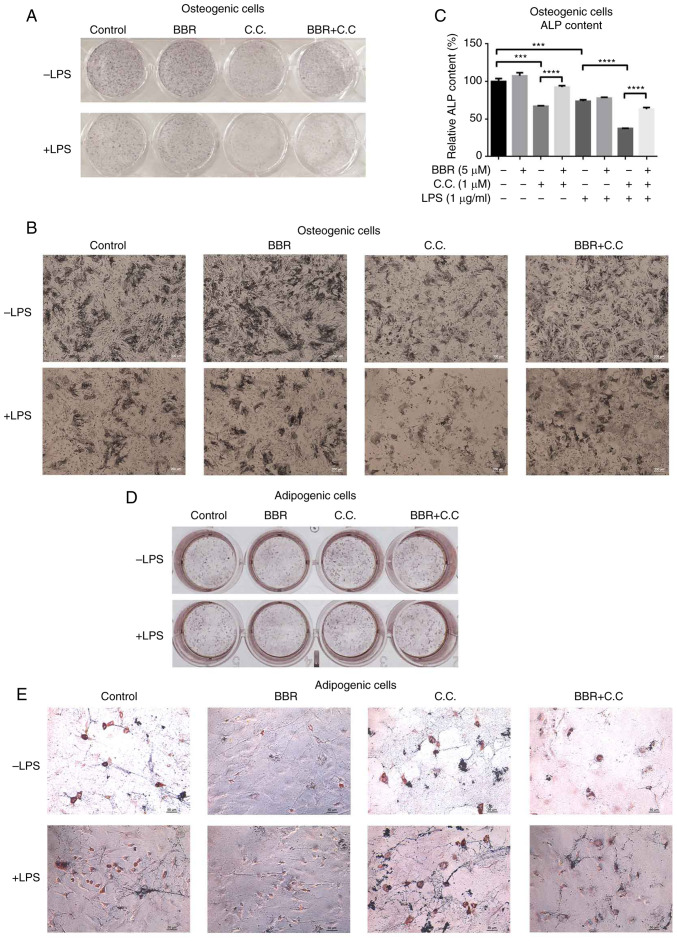
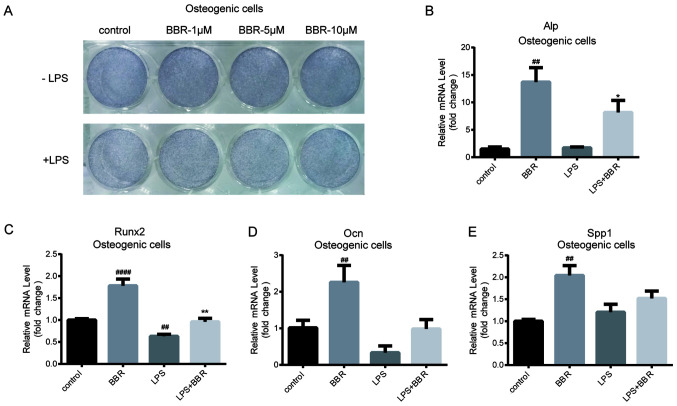
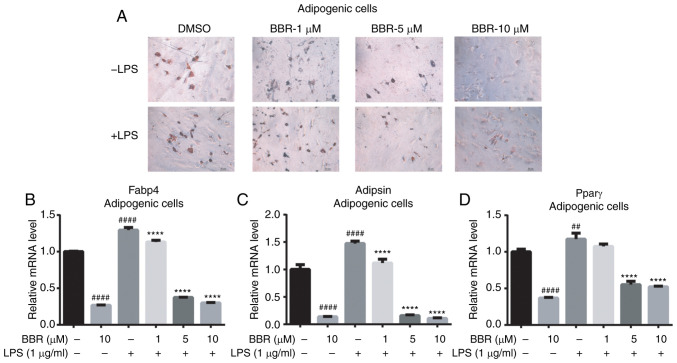
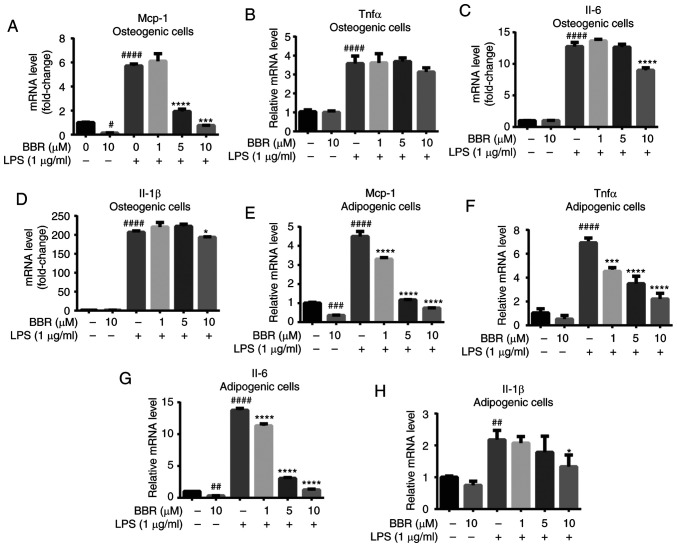
Lipopolysaccharide (LPS) from oral pathogenic bacteria is an important factor leading to alveolar bone absorption and the implant failure. The present study aimed to evaluate the modulation of berberine hydrochloride (BBR) on the LPS-mediated osteogenesis and adipogenesis imbalance in rat bone marrow-derived mesenchymal stem cells (BMSCs). Cell viability, osteoblastic and adipogenic differentiation levels were measured using the Cell Counting Kit-8 assay, alkaline phosphatase (ALP) staining and content assay, and oil red O staining, respectively. Reverse transcription-quantitative PCR and immunoblotting were used to detect the related gene and protein expression levels. In undifferentiated cells, BBR increased the mRNA expression levels of the osteoblastic genes (Alp, RUNX family transcription factor 2, osteocalcin and secreted phosphoprotein 1) but not the adipogenic genes (fatty acid binding protein 4, Adipsin and peroxisome proliferator-activated receptorγ). LPS-induced osteoblastic gene downregulation, adipogenic gene enhancement and NF-κB activation were reversed by BBR treatment. In osteoblastic differentiated cells, decreased ALP production by LPS treatment was recovered with BBR co-incubation. In adipogenic differentiated cells, LPS-mediated lipid accumulation was decreased by BBR administration. The mRNA expression levels of the pro-inflammatory factors (MCP-1, TNF-α, IL-6 and IL-1β) were increased by LPS under both adipogenic and osteoblastic conditions, which were effectively ameliorated by BBR. The actions of BBR were attenuated by compound C, suggesting that the role of BBR may be partly due to AMP-activated protein kinase activation. The results demonstrated notable pro-osteogenic and anti-adipogenic actions of BBR in a LPS-stimulated inflammatory environment. This indicated a potential role of BBR for bacterial infected-related peri-implantitis medication.
口腔致病菌的脂多糖(LPS)是导致牙槽骨吸收和种植体失败的重要因素。本研究旨在评估盐酸小檗碱(BBR)对 LPS 介导的大鼠骨髓间充质干细胞(BMSCs)成骨和成脂失衡的调节作用。通过细胞计数试剂盒-8 测定法、碱性磷酸酶(ALP)染色和含量测定以及油红 O 染色分别测量细胞活力、成骨和成脂分化水平。使用逆转录定量 PCR 和免疫印迹检测相关基因和蛋白表达水平。在未分化细胞中,BBR 增加了成骨基因(Alp、RUNX 家族转录因子 2、骨钙素和分泌型磷蛋白 1)的 mRNA 表达水平,但不增加成脂基因(脂肪酸结合蛋白 4、Adipsin 和过氧化物酶体增殖物激活受体γ)的 mRNA 表达水平。BBR 处理逆转了 LPS 诱导的成骨基因下调、成脂基因增强和 NF-κB 激活。在成骨分化细胞中,BBR 共孵育恢复了 LPS 处理导致的 ALP 产生减少。在成脂分化细胞中,BBR 给药减少了 LPS 介导的脂质积累。在成脂和成骨条件下,LPS 增加了促炎因子(MCP-1、TNF-α、IL-6 和 IL-1β)的 mRNA 表达水平,BBR 有效改善了这种情况。BBR 的作用被化合物 C 减弱,表明 BBR 的作用部分可能是由于 AMP 激活蛋白激酶的激活。结果表明,BBR 在 LPS 刺激的炎症环境中具有显著的促骨形成和抗脂形成作用。这表明 BBR 可能在细菌感染相关的种植体周围炎药物治疗中具有潜在作用。