Medizinische Klinik und Poliklinik I, University Hospital Munich Campus Grosshadern, Marchioninistraße, München, Deutschland, Germany.
German Sites Development Principles and Practice of Clinical Research Harvard T.H., Chan School of Public Health Dresden International University, Dresden, Germany.
Clin Cardiol. 2021 May;44(5):708-714. doi: 10.1002/clc.23599. Epub 2021 Mar 24.
Transcatheter mitral valve repair (TMVR) has shown to improve symptoms and functional capacity in patients with severe mitral valve regurgitation (MR). Novel device developments provide the technology to treat patients with complex anatomies and large coaptation gaps. Nevertheless, the question of superiority of one device remains unanswered. We aimed to compare the MitraClip XTR and MitraClip NTR system in a real world setting.
TMVR with the MitraClip XTR system is equally effective, but associated with a higher risk of leaflet injury.
We retrospectively analyzed peri-procedural and mid-term clinical and echocardiographic outcomes of 113 patients treated for severe MR between March 2018 and August 2019 at the University Hospital of Munich.
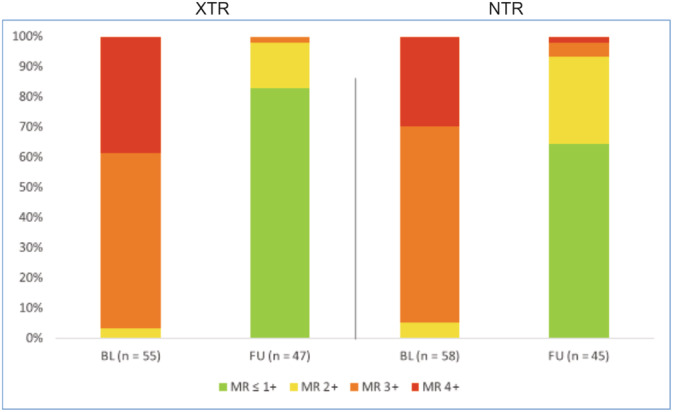
Postprocedural MR reduction to ≤2+ was comparable in both groups (XTR: 96.1% vs. NTR: 97.6%, p = .38). There was a significant difference in a composite safety endpoint of periprocedural Major adverse cardiac and cerebrovascular events (MACCE) including leaflet injury between groups (XTR 14.6% vs. NTR 1.7%, 95% CI [2.7, 24.6], p = .012). After a median follow-up of 8.5 (4.4, 14.0) months, durable reduction of MR was confirmed (XTR: in 91.9% vs. NTR: 96.8%, p = .31) and clinical and symptomatic improvement was comparable in both groups accordingly.
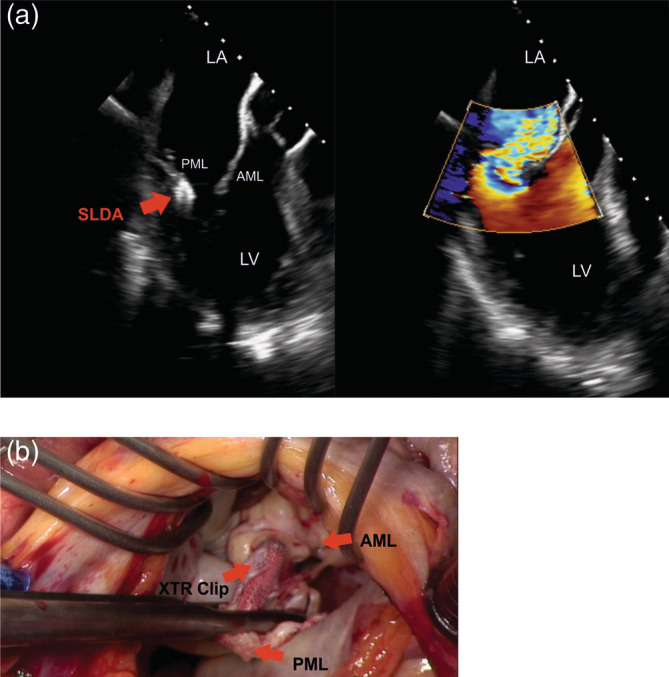
While efficacy was comparable in both treatment groups, patients treated with the MitraClip XTR systems showed more events of acute leaflet tear and single leaflet device attachment (SLDA). A detailed echocardiographic assessment should be done to identify risk candidates for acute leaflet injury.
经导管二尖瓣修复术(TMVR)已被证明可改善重度二尖瓣反流(MR)患者的症状和功能能力。新型设备的发展提供了治疗复杂解剖结构和较大对合间隙患者的技术。然而,一种设备的优越性问题仍然没有答案。我们旨在真实环境中比较 MitraClip XTR 和 MitraClip NTR 系统。
TMVR 使用 MitraClip XTR 系统同样有效,但与更高的瓣叶损伤风险相关。
我们回顾性分析了 2018 年 3 月至 2019 年 8 月慕尼黑大学医院 113 例重度 MR 患者的围手术期和中期临床及超声心动图结果。
两组术后 MR 减少至≤2+的程度相似(XTR:96.1% vs. NTR:97.6%,p=0.38)。两组之间在围手术期主要不良心脏和脑血管事件(MACCE)的复合安全终点,包括瓣叶损伤,存在显著差异(XTR 14.6% vs. NTR 1.7%,95%CI[2.7, 24.6],p=0.012)。中位随访 8.5(4.4,14.0)个月后,确认了 MR 的持续降低(XTR:91.9% vs. NTR:96.8%,p=0.31),两组的临床和症状改善相当。
虽然两组治疗效果相当,但使用 MitraClip XTR 系统的患者发生急性瓣叶撕裂和单瓣叶装置附着(SLDA)的事件更多。应进行详细的超声心动图评估,以识别急性瓣叶损伤的高危患者。