Department of Neonatology, Karolinska University Hospital, Stockholm, Sweden.
Department of Clinical Science, Intervention and Technology (CLINTEC), Division of Paediatrics, Karolinska Institutet, Stockholm, Sweden.
Eur J Clin Microbiol Infect Dis. 2021 Sep;40(9):1803-1813. doi: 10.1007/s10096-021-04211-8. Epub 2021 Mar 24.
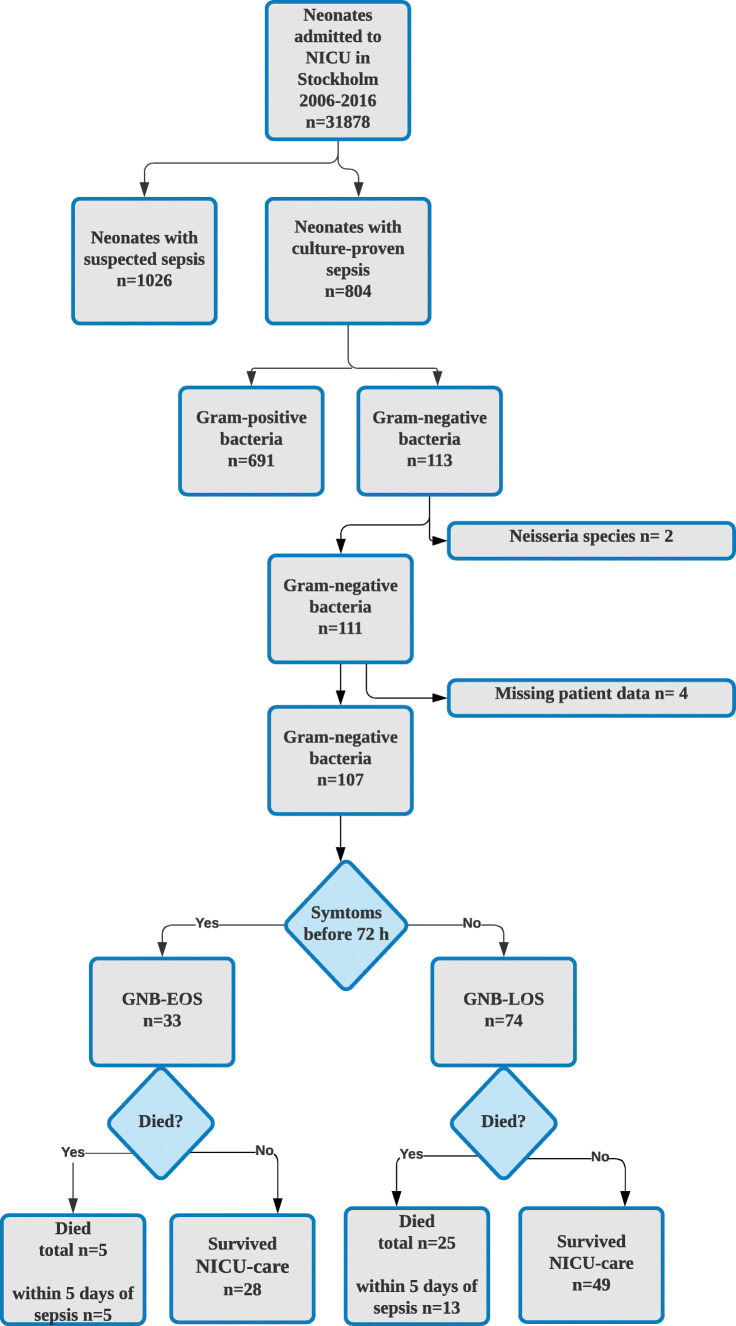
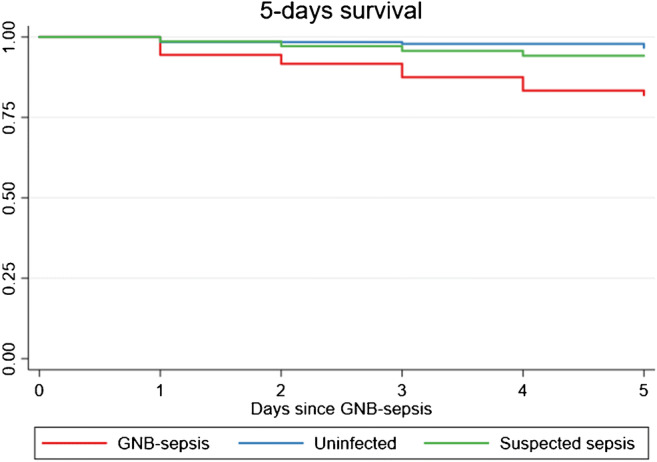
This study is to determine the incidence and outcome of neonatal gram-negative bacilli (GNB) sepsis in Stockholm, Sweden, and describe bacterial characteristics. This is a retrospective cohort study. All infants with GNB-sepsis between 2006 and 2016 were included and matched with two control groups, with suspected sepsis and uninfected neonates, respectively. Outcome was death before discharge, risk of death within 5 days after sepsis onset, and morbidity. The resistance pattern from all GNB was collected, and all available isolates were subjected to genome typing. All neonates with GNB-sepsis (n = 107) were included, and the cumulative GNB-sepsis incidence was 0.35/1000 live born. The in-hospital mortality was 30/107 (28%). GNB late-onset sepsis (LOS) was associated with an increase in mortality before discharge compared to uninfected controls (OR = 3.9; CI 1.6-9.4) but not versus suspected sepsis. The suspected LOS cases did not statistically differ significantly from uninfected controls. The case fatality rate (CFR) at 5 days was 5/33 (15%) in GNB early-onset sepsis (EOS) and 25/74 (34%) in GNB-LOS. The adjusted hazard for 5 days CFR was higher in GNB-LOS versus uninfected controls (HR = 3.7; CI 1.2-11.2), but no significant difference was seen in GNB-LOS versus suspected sepsis or in suspected sepsis versus controls. ESBL production was seen in 7/107 (6.5%) of the GNB isolates. GNB-LOS was associated with a higher 5 days CFR and in-hospital mortality compared to uninfected controls but not versus suspect sepsis. The incidence of both GNB-EOS and GNB-LOS was lower than previously reported from comparable high-income settings. The occurrence of antibiotic resistance was low.
本研究旨在确定瑞典斯德哥尔摩新生儿革兰氏阴性菌(GNB)败血症的发病率和结局,并描述细菌特征。这是一项回顾性队列研究。纳入了 2006 年至 2016 年间所有患有 GNB 败血症的婴儿,并与疑似败血症和未感染的新生儿的两组对照组相匹配。结局为出院前死亡、败血症发病后 5 天内死亡风险和发病率。收集了所有 GNB 的耐药模式,对所有可用的分离株进行了基因组分型。所有患有 GNB 败血症的新生儿(n=107)均纳入研究,GNB 败血症的累计发病率为 0.35/1000 活产儿。院内死亡率为 30/107(28%)。与未感染对照组相比,GNB 晚发型败血症(LOS)患儿的出院前死亡率增加(OR=3.9;95%CI 1.6-9.4),但与疑似败血症患儿相比则无差异。疑似 LOS 患儿与未感染对照组相比,差异无统计学意义。GNB 早发型败血症(EOS)患儿的 5 天病死率为 5/33(15%),GNB-LOS 患儿为 25/74(34%)。与未感染对照组相比,GNB-LOS 患儿 5 天病死率的调整 HR 更高(HR=3.7;95%CI 1.2-11.2),但 GNB-LOS 患儿与疑似败血症患儿或疑似败血症患儿与对照组之间无显著差异。107 株 GNB 分离株中有 7 株(6.5%)产超广谱β-内酰胺酶(ESBL)。与未感染对照组相比,GNB-LOS 患儿的 5 天病死率和院内死亡率更高,但与疑似败血症患儿相比则无差异。GNB-EOS 和 GNB-LOS 的发生率均低于之前在类似高收入环境中报道的水平。抗生素耐药的发生率较低。