Department of General Practice, People's Hospital of Rizhao, Affiliated Clinical Hospital of Jining Medical University, Jining Medical University, Rizhao, Shandong, China.
Department of Critical Care Medicine, Renmin Hospital of Wuhan University, Wuhan, China.
Disaster Med Public Health Prep. 2022 Oct;16(5):1916-1921. doi: 10.1017/dmp.2021.82. Epub 2021 Mar 25.
The aim of this study is to evaluate the clinical characteristics and outcomes in 2019 coronavirus disease (COVID-19) patients and to help clinicians perform correct treatment and evaluate prognosis and guide the treatment.
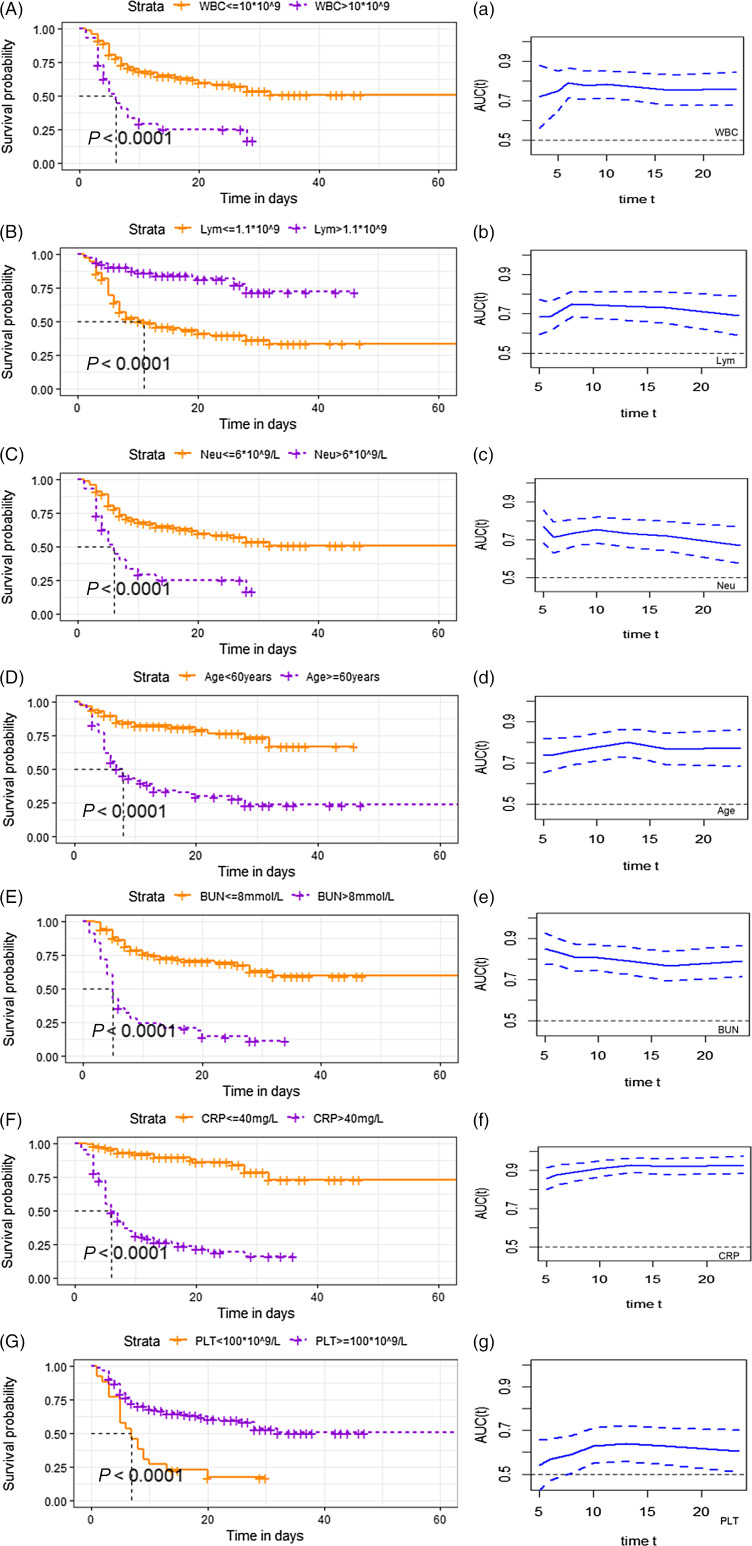
Patients totaling 239 were diagnosed with COVID-19 and were included in this study. Patients were divided into the group and the group according to their outcome (improvement or death). Clinical characteristics and laboratory parameters were collected from medical records. Continuous variables were tested by an independent sample T test, and categorical variables were analyzed by the chi-square test or Fisher's exact test. The Cox proportional hazard regression model was used for survival analysis in patients. The time-dependent area under curves (AUC) based on white blood cell count, lymphocyte count, neutrophil count by age, blood urea nitrogen, and C-reactive protein were plotted.
Efficacy evaluation indicated that 99 (41.4%) patients had deteriorated, and 140 (58.6%) patients had improved. Oxygen saturation, hemoglobin levels, infection-related indicators, lymphocyte and platelet counts, C-reactive protein, serum albumin, liver and kidney function, and lactate dehydrogenase in improvement group were statistically significant between the and groups. A survival analysis revealed that comorbidities, lymphocyte counts, platelet count, serum albumin, C-reactive protein level, and renal dysfunction may be risk factors in patients with COVID-19.
Patients with comorbidities, lower lymphocyte counts in hemogram, platelet count and serum albumin, high C-reactive protein level, and renal dysfunction may have higher risk for death. More attention should be given to risk management in the progression of COVID-19.
本研究旨在评估 2019 年冠状病毒病(COVID-19)患者的临床特征和结局,帮助临床医生进行正确的治疗,评估预后并指导治疗。
本研究共纳入 239 例 COVID-19 患者。根据患者的转归(好转或死亡),将患者分为 组和 组。从病历中收集临床特征和实验室参数。采用独立样本 t 检验比较连续变量,采用卡方检验或 Fisher 确切概率法比较分类变量。采用 Cox 比例风险回归模型对 患者进行生存分析。根据白细胞计数、淋巴细胞计数、中性粒细胞计数、血尿素氮、C 反应蛋白随年龄的时间依赖性曲线下面积(AUC)进行绘制。
疗效评估显示,99 例(41.4%)患者病情恶化,140 例(58.6%)患者好转。在好转组和恶化组中,血氧饱和度、血红蛋白水平、感染相关指标、淋巴细胞和血小板计数、C 反应蛋白、血清白蛋白、肝肾功能和乳酸脱氢酶存在统计学差异。生存分析显示,合并症、淋巴细胞计数、血小板计数、血清白蛋白、C 反应蛋白水平和肾功能不全可能是 COVID-19 患者的危险因素。
合并症、血常规中淋巴细胞计数较低、血小板计数和血清白蛋白较低、C 反应蛋白水平较高和肾功能不全的 COVID-19 患者死亡风险可能较高。在 COVID-19 的进展过程中,应更加关注风险管理。