Matsubara Taichi, Seto Takashi, Takamori Shinkichi, Fujishita Takatoshi, Toyozawa Ryo, Ito Kensaku, Yamaguchi Masafumi, Okamoto Tatsuro
Department of Thoracic Oncology, National Hospital Organization Kyushu Cancer Center, Fukuoka, Japan.
Onco Targets Ther. 2021 Mar 17;14:1961-1968. doi: 10.2147/OTT.S301500. eCollection 2021.
Anti-programmed death 1 (PD-1) antibodies have emerged as frontline treatments for patients with advanced non-small cell lung cancer (NSCLC) on the basis of global Phase III trials. However, current data regarding responses to anti-PD-1 therapy in older patients with NSCLC or those with poor performance status (PS) are limited. Therefore, we examined the therapeutic effect of anti PD-1 antibody in these patients.
We retrospectively examined consecutive patients treated with anti-PD-1 monotherapy (pembrolizumab or nivolumab) from January 2016 to September 2018.
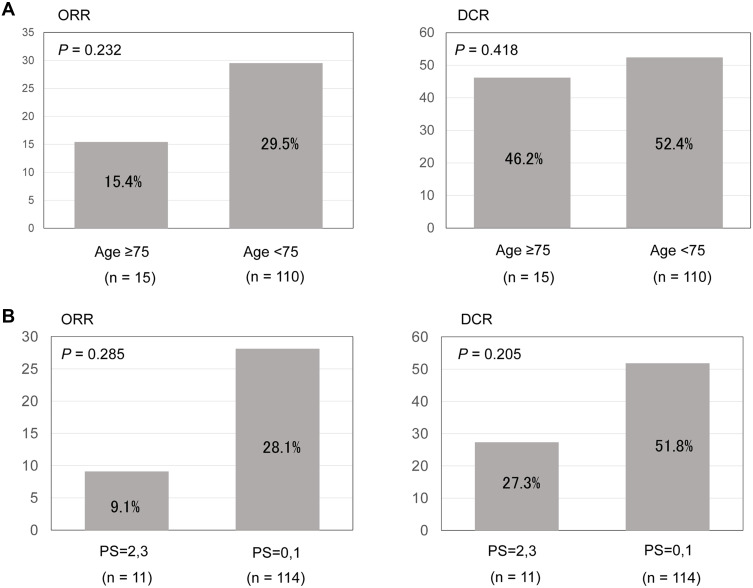
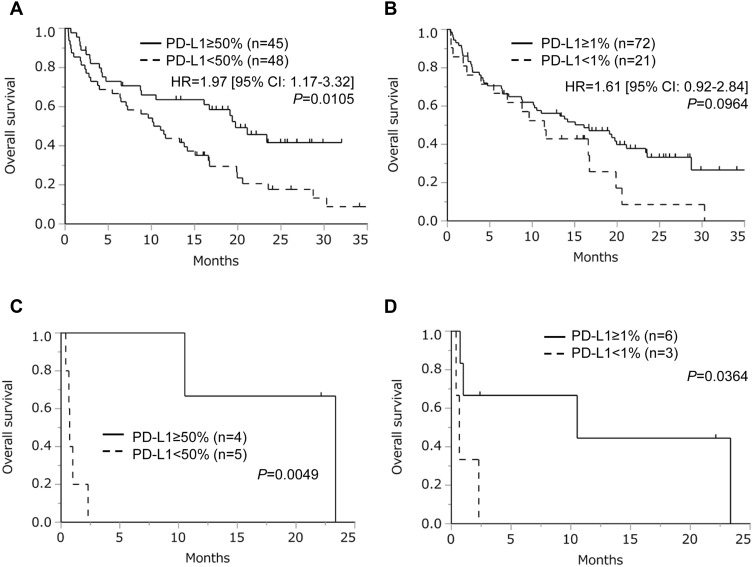
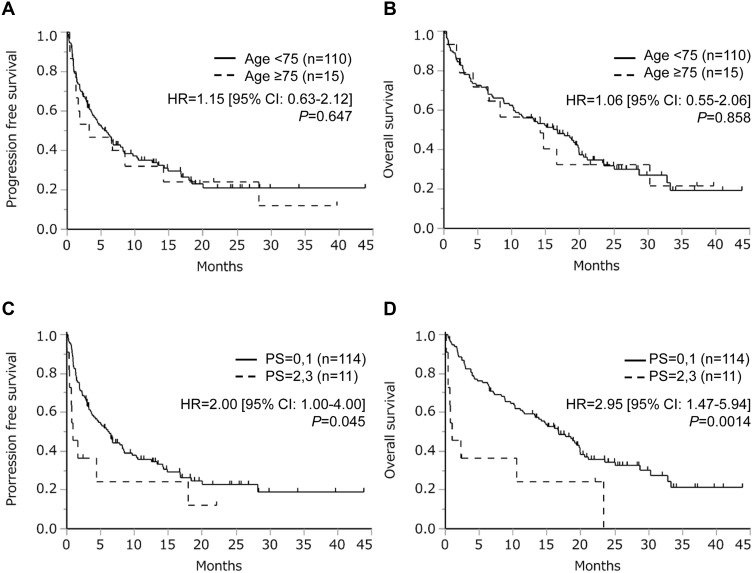
We enrolled 125 patients (median age, 60 years), 80.8% of whom were men. Patients aged ≥75 years were considered older patients (n = 15), and those with PS 2-3 were regarded as having poor PS (n = 11). The objective response and disease control rates were 15.4% and 46.2%, respectively, in older patients and 9.1% and 27.3%, respectively, in those with poor PS. Progression-free survival (PFS) and overall survival (OS) did not significantly differ between older and younger patients. However, poor PS was significantly associated with poor survival. High programmed death ligand 1 (PD-L1) expression in tumor specimens (≥50%) was associated with favorable survival in the entire cohort as well as patients with poor PS. Safety analyses demonstrated no significant difference in the occurrence of any adverse event, including grade ≥3 adverse events, between patients with poor PS or older age and the remaining patients.
Anti-PD-1 therapy had similar efficacy in older and younger patients with NSCLC, whereas survival was significantly worse in patients with poor PS. However, immune checkpoint inhibitors may be considered for patients with poor PS harboring positive PD-L1 expression.
基于全球III期试验,抗程序性死亡1(PD-1)抗体已成为晚期非小细胞肺癌(NSCLC)患者的一线治疗方法。然而,目前关于老年NSCLC患者或体能状态(PS)较差患者对抗PD-1治疗反应的数据有限。因此,我们研究了抗PD-1抗体在这些患者中的治疗效果。
我们回顾性研究了2016年1月至2018年9月期间接受抗PD-1单药治疗(帕博利珠单抗或纳武利尤单抗)的连续患者。
我们纳入了125例患者(中位年龄60岁),其中80.8%为男性。年龄≥75岁的患者被视为老年患者(n = 15),PS为2-3的患者被视为PS较差(n = 11)。老年患者的客观缓解率和疾病控制率分别为15.4%和46.2%,PS较差患者分别为9.1%和27.3%。老年和年轻患者的无进展生存期(PFS)和总生存期(OS)无显著差异。然而,PS较差与生存不良显著相关。肿瘤标本中高程序性死亡配体1(PD-L1)表达(≥50%)与整个队列以及PS较差患者的良好生存相关。安全性分析表明,PS较差或年龄较大的患者与其余患者在任何不良事件(包括≥3级不良事件)的发生上无显著差异。
抗PD-1治疗在老年和年轻NSCLC患者中具有相似的疗效,而PS较差的患者生存明显较差。然而,对于PS较差且PD-L1表达阳性的患者,可考虑使用免疫检查点抑制剂。