Wei Zhengbo, Yao Mengwei, Ning Sisi, Wu Yuan, Zhou Xunzhao, Zhong Changtao, Yan Kui, Xie Ying
Department of Head and Neck Tumor Surgery, Cancer Hospital of Guangxi Medical University, Nanning, People's Republic of China.
Graduate School of Guangxi Medical University, Nanning, People's Republic of China.
Pharmgenomics Pers Med. 2021 Mar 17;14:359-367. doi: 10.2147/PGPM.S296215. eCollection 2021.
We examined whether the single-nucleotide polymorphism (SNP) rs13181 in the gene encoding excision repair cross complementation group 2 (ERCC2) is associated with the risk and prognosis of nasopharyngeal carcinoma (NPC).
SNPs at rs13181 were genotyped in 439 NPC patients (NPC group) and 431 age- and gender-matched cancer-free controls (control group) from a region of China where NPC is endemic, and frequencies of GG, GT and TT genotypes were compared between the two groups in the case-control study. In a subset of 365 NPC cases, SNPs were examined for potential correlation with tumor-free survival time (TFS) and overall survival (OS).
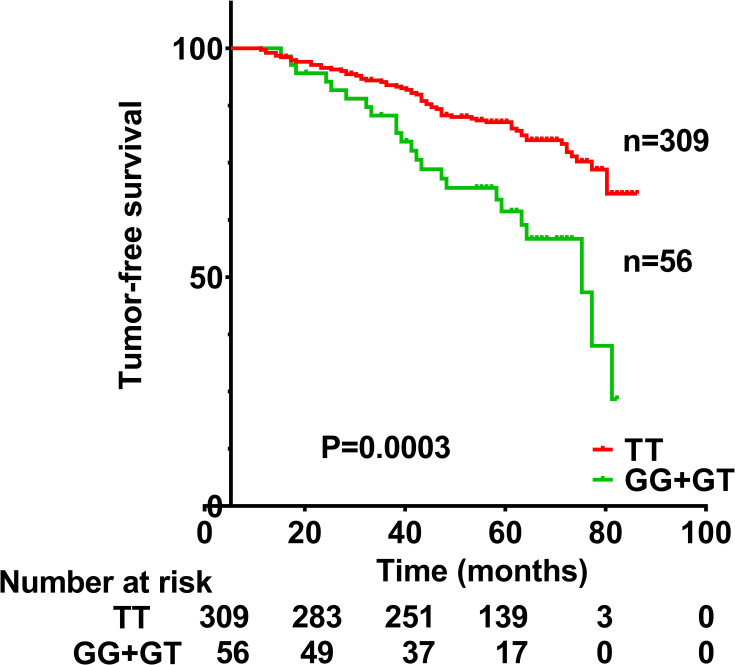
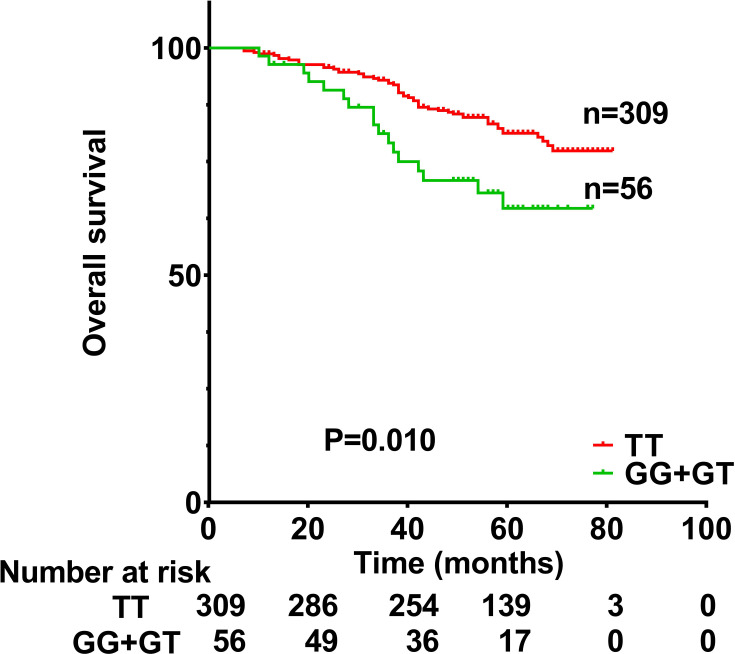
Relative to NPC risk with a TT genotype, NPC risk was similar with GT + GG genotypes (OR 1.052, 95% CI 0.656-1.688), after adjusting for gender, age, smoking history, and immunoglobin A against Epstein-Barr virus capsid antigen (EBV-VCA-IgA) status. Univariate analysis showed that the GG or GT genotype was associated with significantly worse TFS (p<0.001) and OS (p=0.010) than the TT genotype. Prognosis was significantly worse for men than for women (TFS, p=0.045; OS, p=0.031), for T3-T4 classification than for T1-T2 (TFS, p=0.009; OS, p=0.007), for N3 than for N0+N1+N2 (TFS, p<0.001; OS, p<0.001). Based on multivariate analysis, independent risk factors for poor TFS were GG or GT genotype (HR 2.629, 95% CI 1.625-4.254, p<0.001), T3-T4 classification (HR 2.146, 95% CI 1.244-3.701, p=0.006) and N3 (HR 2.527, 95% CI 1.574-4.059, p<0.001). GG or GT genotype (HR 2.217, 95% CI 1.283-3.832, p=0.004), gender (HR 1.989, 95% CI 1.046-3.785, p=0.036), T3-T4 (HR 2.431, 95% CI 1.306-4.526, p=0.005) and N3 (HR 2.693, 95% CI 1.637-4.432, p<0.001) were independent risk factors for poor OS.
The rs13181 SNP in ERCC2 does not appear to be associated with NPC risk, but it may serve as an independent prognostic factor for NPC recurrence and death.
我们研究了编码切除修复交叉互补组2(ERCC2)基因中的单核苷酸多态性(SNP)rs13181是否与鼻咽癌(NPC)的风险及预后相关。
在中国鼻咽癌高发地区,对439例NPC患者(NPC组)和431例年龄及性别匹配的无癌对照者(对照组)进行rs13181位点的SNP基因分型,在病例对照研究中比较两组GG、GT和TT基因型的频率。在365例NPC患者亚组中,检测SNP与无瘤生存时间(TFS)和总生存(OS)的潜在相关性。
校正性别、年龄、吸烟史和抗EB病毒衣壳抗原免疫球蛋白A(EBV-VCA-IgA)状态后,与TT基因型相比,GT+GG基因型的NPC风险相似(OR 1.052,95%CI 0.656-1.688)。单因素分析显示,与TT基因型相比,GG或GT基因型的TFS(p<0.001)和OS(p=0.010)显著更差。男性的预后显著差于女性(TFS,p=0.045;OS,p=0.031),T3-T4分期的预后比T1-T2差(TFS,p=0.009;OS,p=0.007),N3的预后比N0+N1+N2差(TFS,p<0.001;OS,p<0.001)。基于多因素分析,TFS差的独立危险因素为GG或GT基因型(HR 2.629,95%CI 1.625-4.254,p<0.001)、T3-T4分期(HR 2.146,95%CI 1.244-3.701,p=0.006)和N3(HR 2.527,95%CI 1.574-4.059,p<0.001)。GG或GT基因型(HR 2.217,95%CI 1.283-3.832,p=0.004)、性别(HR 1.989,95%CI 1.046-3.785,p=0.036)、T3-T4(HR 2.431,95%CI 1.306-4.526,p=0.005)和N3(HR 2.693,95%CI 1.637-4.432,p<0.001)是OS差的独立危险因素。
ERCC2基因中的rs13181 SNP似乎与NPC风险无关,但它可能是NPC复发和死亡的独立预后因素。