Puri Jahanvi, Sharma Sunita, Samuel Asir John, Chahal Aksh
Maharishi Markandeshwar Institute of Physiotherapy and Rehabilitation, Maharishi Markandeshwar (Deemed to be University), Mullana, Haryana, India.
J Lifestyle Med. 2021 Jan 31;11(1):38-42. doi: 10.15280/jlm.2021.11.1.38.
Rectus abdominis is the main core muscle. Weakness or any alteration in it may increase the pressure over the lower back, in obese women diastasis of rectus abdominis muscle found to be very common condition. Therefore, there may be a correlation between diastasis of rectus abdominis muscle and low back pain in obese women that needs to be explored, as there is no literature available.
In this study, 72 female subjects with Body Mass Index <30 kg/m were recruited by snowball sampling method. Demographic (name, age) and anthropometric characteristics (height, weight and body mass index) were recorded. The separation in the rectus abdominis muscle was assessed with vernier calliper.
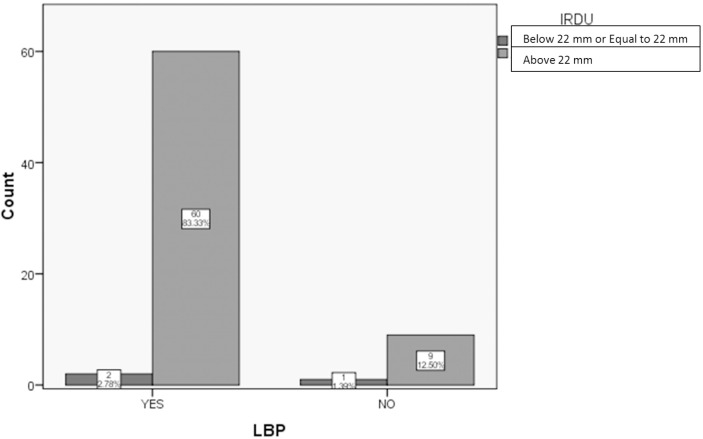
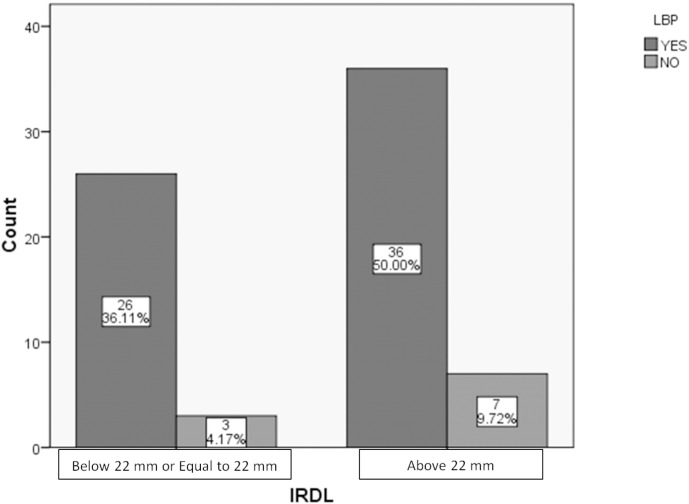
Total subjects were included in the study; all the subjects were Female without any recent abdominal surgical history. The subjects included in the study with age of 30 years to 55 years old with body mass index of the included females must be (30-30.9) kg/m i.e. women must come under obese category. Diastasis of rectus abdominis muscle was another variable used that must be present in each women. Low back pain was also used as the variable that may be present or may not be present in the women with diastasis of rectus abdominis muscle. The collected data were analysed by the appropriate statistical analysis tools. The p-value was found more than 0.05 (the alpha level set was less than 0.05) which is non-significant.
The study concluded a non-significant correlation between the diastasis of rectus abdominis muscle and low back pain in obese women. The present study concludes that it is not necessary that all obese women with low back pain always propose to have diastasis of rectus abdominis muscle.
腹直肌是主要的核心肌肉。其无力或任何改变可能会增加下背部的压力,在肥胖女性中,腹直肌分离是一种非常常见的情况。因此,由于尚无相关文献,腹直肌分离与肥胖女性下背痛之间可能存在的相关性有待探索。
在本研究中,通过滚雪球抽样法招募了72名体重指数<30 kg/m²的女性受试者。记录人口统计学特征(姓名、年龄)和人体测量学特征(身高、体重和体重指数)。用游标卡尺评估腹直肌的分离情况。
所有受试者均纳入研究;所有受试者均为女性,近期无腹部手术史。纳入研究的受试者年龄在30岁至55岁之间,纳入女性的体重指数必须为(30 - 30.9)kg/m²,即女性必须属于肥胖类别。腹直肌分离是另一个使用的变量,每个女性都必须存在该变量。下背痛也用作变量,在腹直肌分离的女性中可能存在也可能不存在。收集的数据通过适当的统计分析工具进行分析。发现p值大于0.05(设定的α水平小于0.05),这无统计学意义。
该研究得出结论,肥胖女性腹直肌分离与下背痛之间无显著相关性。本研究得出结论,并非所有患有下背痛的肥胖女性都一定存在腹直肌分离。