Zhang Feng, Gao Shuang, Zhao Yiqiao, Wu Bin, Chen Xiaonan
Department of Urology, Shengjing Hospital of China Medical University, Shenyang, China.
Department of Pathology, The People's Hospital of Liaoning Province, Shenyang, China.
Front Oncol. 2021 Mar 8;11:649356. doi: 10.3389/fonc.2021.649356. eCollection 2021.
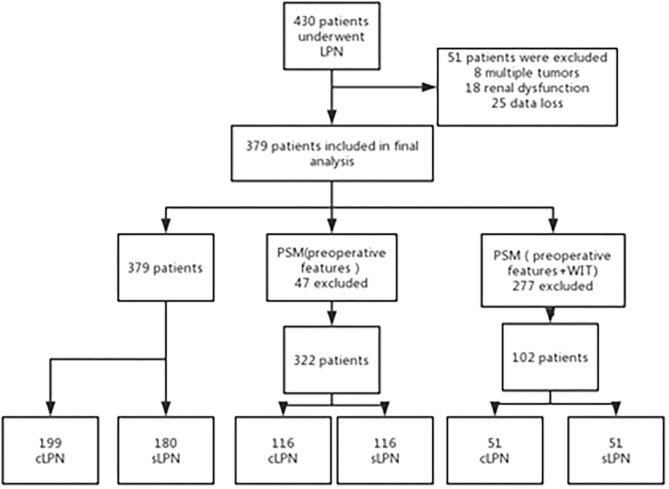
To compare the functional outcome, safety and efficacy of sutureless and conventional laparoscopic partial nephrectomy. After the inclusion and exclusion criteria were applied, our study reviewed 379 patients with T1 stage renal tumors. We applied propensity score matching (PSM) to limit potential baseline confusion. Perioperative and functional outcomes between sutureless laparoscopic partial nephrectomy (sLPN) and conventional laparoscopic partial nephrectomy (cLPN) groups were compared and analyzed before and after PSM. Of our 379 patients with T1 stage renal tumors, 199 and 180 were identified in the cLPN and sLPN groups, respectively. After applying PSM with preoperative features, 116 patients in the cLNP group were paired to 116 patients in the sLNP group. We found that all differences in preoperative baseline characteristics disappeared. All the preoperative characteristics (age, gender, tumor diameter, RENAL nephrometry score, side, preoperative eGFR, hypertension, diabetes mellitus, ASA score) were not statistically different between the two groups. The operative time (OT) ( < 0.001) and warm ischemia time (WIT) ( < 0.001) of the sLPN group were of shorter duration than that of the cLPN group. The eGFR baseline was almost equal, but there was a statistically smaller decrease in eGFR in the sLPN than in the cLPN group 1 week after surgery (14.3 vs. 7.4, < 0.001) and after 6 months (11.9 vs. 5.0, < 0.001). After both preoperative features and WIT were included in PSM, fifty-one pairs of patients were identified between the groups, the WIT difference between them disappeared, while the decrease in eGFR between the groups remained as it was previously at 1 week (15.4 vs. 8.6, < 0.001) and at 6 months (13.0 vs. 6.2, < 0.001). Sutureless laparoscopic partial nephrectomy is as safe and effective as conventional laparoscopic partial nephrectomy, and compared to cLPN, sLPN can effectively reduce the WIT, retain more renal parenchyma and protect renal function.
比较无缝合与传统腹腔镜部分肾切除术的功能结局、安全性及有效性。在应用纳入和排除标准后,我们的研究回顾了379例T1期肾肿瘤患者。我们应用倾向评分匹配(PSM)以限制潜在的基线混杂因素。对PSM前后无缝合腹腔镜部分肾切除术(sLPN)组与传统腹腔镜部分肾切除术(cLPN)组的围手术期和功能结局进行比较和分析。在我们的379例T1期肾肿瘤患者中,cLPN组和sLPN组分别有199例和180例。应用具有术前特征的PSM后,cLNP组的116例患者与sLNP组的116例患者配对。我们发现术前基线特征的所有差异均消失。两组之间所有术前特征(年龄、性别、肿瘤直径、RENAL肾计量评分、侧别、术前估算肾小球滤过率、高血压、糖尿病、美国麻醉医师协会评分)均无统计学差异。sLPN组的手术时间(OT)(<0.001)和热缺血时间(WIT)(<0.001)均短于cLPN组。eGFR基线几乎相等,但术后1周(14.3对7.4,<0.001)和6个月后(11.9对5.0,<0.001)sLPN组eGFR的下降在统计学上小于cLPN组。在PSM中纳入术前特征和WIT后,两组之间确定了51对患者,它们之间的WIT差异消失,而两组之间eGFR的下降仍与之前相同,术后1周(15.4对8.6,<0.001)和6个月时(13.0对6.2,<0.001)。无缝合腹腔镜部分肾切除术与传统腹腔镜部分肾切除术一样安全有效,并且与cLPN相比,sLPN可以有效缩短WIT,保留更多肾实质并保护肾功能。